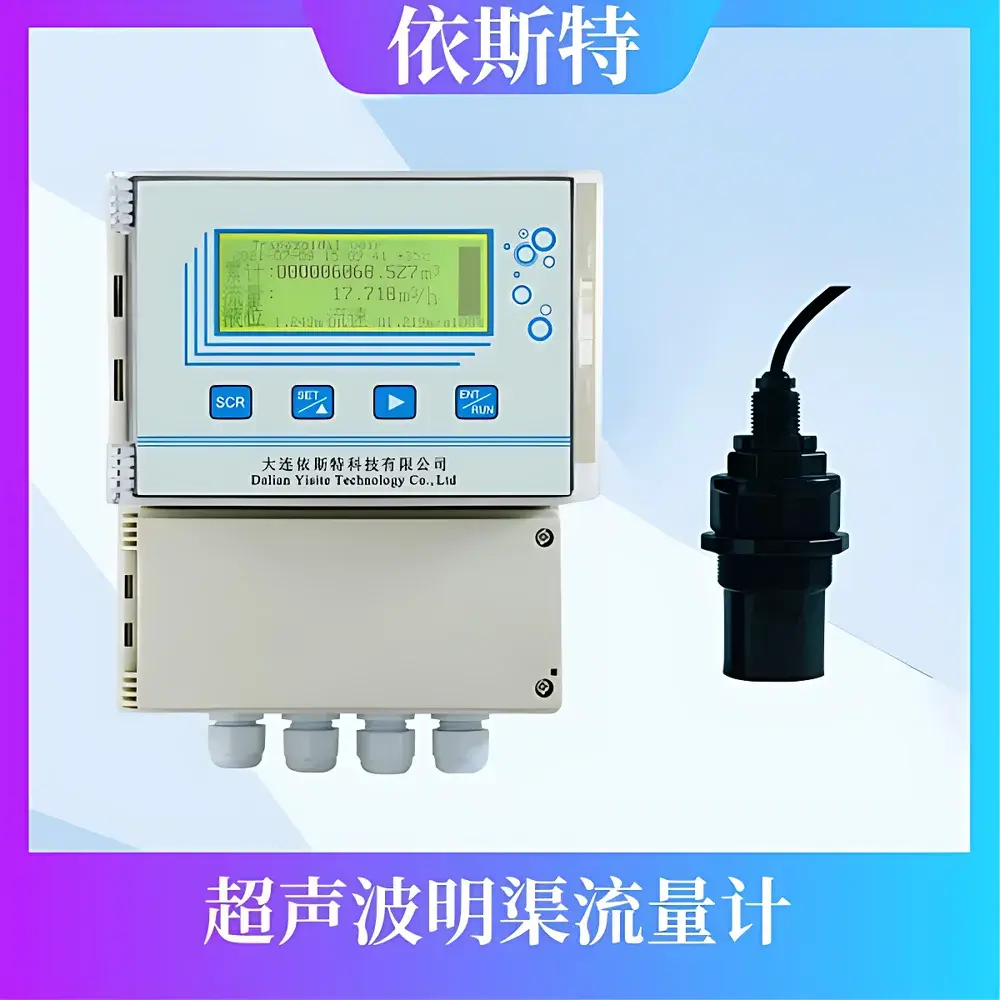
YST940M-3CY10 Ultrasonic Open-Channel Flow Meter
| Brand | YST (Dalian Yist) |
|---|---|
| Origin | Liaoning, China |
| Model | YST940M-3CY10 |
| Measurement Range | Water Level 0.1–5 m, Flow Rate 0.01–10,000 m³/h |
| Measurement Principle | Non-contact ultrasonic (time-of-flight + Doppler dual-mode adaptive) |
| Flume Compatibility | Rectangular weirs, triangular (V-notch) weirs, trapezoidal weirs, Parshall flumes |
| Power Supply | 220 V AC / 12 V DC (solar option available) |
| Communication | RS485, Ethernet, optional 4G/NB-IoT |
| Operating Temperature | −40 to +80 °C with real-time temperature compensation |
| Enclosure Rating | IP65 (main unit), IP68 (transducer) |
| Data Storage | ≥100,000 records in embedded Flash |
Overview
The YST940M-3CY10 Ultrasonic Open-Channel Flow Meter is an industrial-grade, non-contact flow monitoring solution engineered for continuous, reliable measurement of free-surface flow in open channels and flumes. Designed in accordance with internationally recognized hydraulic principles—specifically the ISO 1438 and ASTM D5388 standards for open-channel flow measurement—the device operates on dual-mode ultrasonic sensing: time-of-flight (TOF) for precise water level determination and Doppler-shift analysis for velocity profiling in turbulent or suspended-solid-laden flows. This hybrid methodology enables adaptive mode selection based on real-time hydraulic conditions, ensuring stable output across variable flow regimes—from low-velocity irrigation ditches to high-capacity stormwater conduits. Unlike intrusive insertion or electromagnetic sensors, the YST940M-3CY10 eliminates mechanical wear, fouling risk, and channel modification requirements, making it especially suitable for long-term deployment in unattended outdoor environments where maintenance access is constrained.
Key Features
- Non-contact ultrasonic sensing: Transducer mounted above the channel surface; no immersion, no moving parts, no calibration drift due to sediment accumulation or biofouling.
- Dual-mode adaptive algorithm: Automatically selects between TOF-based level measurement and Doppler-based velocity estimation depending on signal quality, flow turbulence, and suspended solids concentration.
- Multi-flume hydraulic compatibility: Pre-programmed coefficients and configuration templates for standard structures including rectangular weirs, V-notch (triangular) weirs, Cipolletti (trapezoidal) weirs, and Parshall flumes per ISO 4359 and USGS Water-Supply Paper 2175.
- Robust environmental resilience: IP65-rated enclosure for main electronics; IP68-rated transducer housing with wide-temperature-range piezoceramics (-40 °C to +80 °C); integrated thermal compensation for acoustic velocity correction.
- Flexible power architecture: Supports mains-powered (220 V AC) or low-voltage DC (12 V) operation; optional solar-charged battery kit enables off-grid deployment for remote monitoring nodes.
- Configurable communication stack: Standard RS485 Modbus RTU and Ethernet TCP/IP interfaces; field-upgradable firmware supports optional LTE Cat-M1 or NB-IoT modules for cellular telemetry without gateway dependency.
Sample Compatibility & Compliance
The YST940M-3CY10 is validated for use with clear, turbid, and aerated water—including wastewater effluent, agricultural runoff, and stormwater containing suspended solids up to 50,000 mg/L. Its Doppler mode remains functional under moderate surface foam conditions, leveraging proprietary waveform filtering to suppress false echoes from bubbles and organic scum. The instrument conforms to IEC 61326-1 (EMC for industrial environments), IEC 61000-4 series immunity testing, and meets CE marking requirements for electromagnetic compatibility and low-voltage directive compliance. While not certified to UL 61010-1 or ATEX, its design aligns with general-purpose Class I, Division 2 hazardous location practices when installed per local electrical codes. Data integrity protocols support audit-ready logging compatible with GLP/GMP-aligned workflows, including timestamped event flags for sensor diagnostics, power interruption, and configuration changes.
Software & Data Management
The device integrates a real-time embedded operating system supporting local data buffering, alarm-triggered storage, and scheduled transmission cycles. Internal Flash memory retains ≥100,000 timestamped records (level, flow, temperature, signal strength, diagnostic status), with guaranteed data integrity for ≥10 years post-power-loss. Configuration and firmware updates are performed via web-based GUI (HTTPS-enabled) or CLI over Ethernet/RS485. Cloud integration follows MQTT v3.1.1 or HTTP(S) RESTful API standards, enabling seamless ingestion into SCADA platforms (e.g., Ignition, Siemens Desigo, or custom Node-RED deployments). All remote parameter adjustments and alarm thresholds are logged with user ID, timestamp, and change delta—supporting traceability required under FDA 21 CFR Part 11 Annex 11 and ISO/IEC 17025 documentation frameworks.
Applications
- Municipal wastewater management: Real-time inflow/outflow monitoring at lift stations, combined sewer overflows (CSOs), and treatment plant influent channels.
- Agricultural water accounting: District-level irrigation scheduling using Parshall flumes in concrete-lined canals; verified against volumetric metering for water rights reporting.
- Environmental compliance monitoring: Continuous discharge verification for NPDES-permitted facilities, including seasonal flow tracking during wet/dry periods.
- Flood forecasting networks: Integration into regional hydrological models via LoRaWAN or NB-IoT backhaul, delivering sub-minute latency for early-warning systems.
- Industrial process water recycling: Closed-loop flow verification in cooling tower make-up lines and greywater reuse circuits where chemical corrosion precludes contact sensors.
FAQ
What flume types does the YST940M-3CY10 support out of the box?
The meter includes factory-loaded hydraulic coefficients for rectangular, triangular (V-notch), trapezoidal (Cipolletti), and Parshall flumes per ISO 4359 and ASTM D5388. Custom flume geometry tables can be imported via CSV.
Can the device operate reliably in freezing conditions?
Yes—the transducer housing and electronics are rated for continuous operation down to −40 °C. Ice formation on the channel surface is mitigated by active acoustic de-icing logic that adjusts pulse repetition frequency to prevent signal attenuation.
Is the stored data exportable in standardized formats?
All internal logs are accessible via Modbus register mapping or HTTP GET requests, returning JSON or CSV payloads with ISO 8601 timestamps and SI units. No proprietary binary formats are used.
Does the system support alarm notification via SMS or email?
When deployed with the optional 4G/NB-IoT module, configurable threshold alarms trigger HTTP POST payloads to third-party notification services (e.g., Twilio, SMTP gateways) or cloud middleware—no vendor lock-in.
How often does the device require recalibration?
Zero scheduled recalibration is required. The TOF-based level measurement is inherently stable; Doppler velocity scaling is verified during initial commissioning using known hydraulic geometry and verified with periodic field checks per ISO 748.