
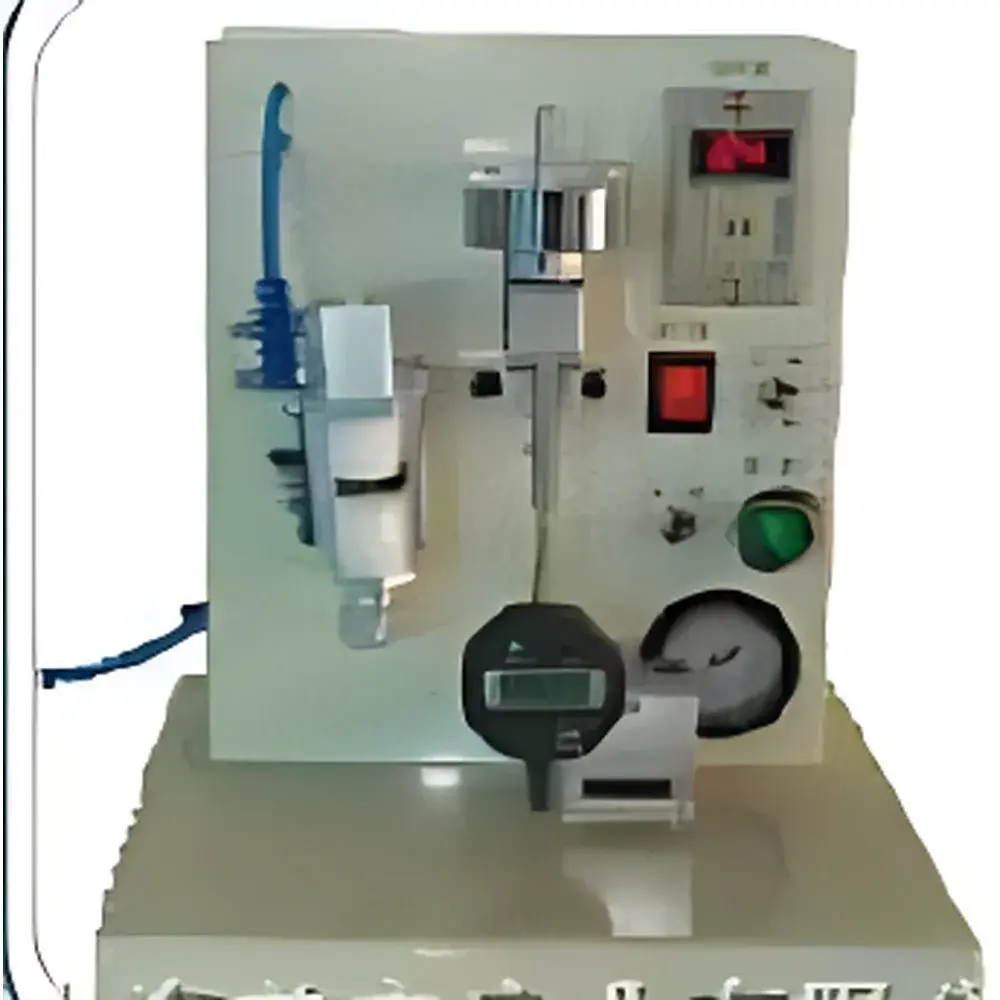
YT318 Nose Bridge Deformation Tester
| Origin | Taiwan |
|---|---|
| Manufacturer Type | Authorized Distributor |
| Regional Classification | Asia-Pacific Sourced |
| Model | YT318 |
| Pricing | Available Upon Request |
Overview
The YT318 Nose Bridge Deformation Tester is an engineered mechanical testing system designed specifically for evaluating the structural integrity and elastic recovery behavior of spectacle frame nose bridges under controlled, standardized loading conditions. It operates on the principle of quasi-static three-point bending deformation, applying a precisely defined vertical force to the bridge region while measuring displacement and residual deformation. This methodology directly supports compliance verification with international optical frame standards—including EN 1836:2015+A1:2022 (Personal eye protection — Sunglasses and related eyewear), ISO/FDIS 12870:2023 (Ophthalmic optics — Spectacle frames — Requirements and test methods), and GB/T 14214–2003 (China National Standard for Spectacle Frames). The instrument delivers repeatable, traceable mechanical assessments critical for quality assurance in frame manufacturing, regulatory submission, and supplier qualification processes.
Key Features
- Standard-compliant test fixture geometry aligned with EN 1836 Annex D and ISO 12870 Clause 6.4.2 for nose bridge deformation measurement
- Adjustable support span and loading pin diameter to accommodate varying frame geometries (e.g., metal, acetate, TR90, and hybrid constructions)
- Mechanically calibrated load application system with documented force resolution suitable for sub-Newton range quantification
- Digital displacement transducer integrated into the loading assembly for real-time deformation tracking during both loading and unloading phases
- Fixed-load protocol mode enabling execution of the prescribed 10 N ± 0.1 N force application for 10 seconds, as mandated by ISO 12870 Section 6.4.2.2
- Stainless steel construction and precision-machined contact surfaces to ensure long-term dimensional stability and minimize wear-induced measurement drift
Sample Compatibility & Compliance
The YT318 accommodates full-size spectacle frames across standard adult and adolescent dimensions, including rimless, semi-rimless, and full-rim configurations. Frame materials tested include stainless steel, titanium alloys, nickel silver, cellulose acetate, propionate, and high-performance thermoplastics such as TR90 and Grilamid. All test procedures conform to the dimensional tolerances, environmental conditioning requirements (23 °C ± 2 °C, 50 % RH ± 5 % RH per ISO 12870 Clause 5), and reporting criteria outlined in EN 1836, ISO 12870, and GB/T 14214–2003. Test reports generated using this system meet documentation expectations for ISO/IEC 17025-accredited laboratories conducting type testing or incoming inspection.
Software & Data Management
The YT318 operates as a standalone mechanical tester without embedded microprocessor control or proprietary software. Force application and displacement measurement are executed via calibrated mechanical components and analog/digital transducers compatible with third-party data acquisition systems (e.g., National Instruments DAQ, Keysight U2300A series). Users may integrate the device into GLP- or GMP-aligned workflows by connecting its analog output signals to validated laboratory information management systems (LIMS) or electronic lab notebooks (ELN). Raw displacement vs. time datasets support post-test analysis for permanent set calculation (% residual deformation), elastic modulus estimation (where material cross-section is known), and comparative benchmarking against internal specifications or regulatory thresholds. Audit trails, user access controls, and electronic signature capabilities are implemented at the host system level—not within the YT318 unit itself.
Applications
- Verification of nose bridge resistance to permanent deformation during routine wear simulation
- Comparative evaluation of new frame materials or alloy heat treatments for improved shape retention
- Root cause analysis of field-reported frame slippage or fit instability linked to bridge creep behavior
- Pre-certification testing prior to submission to notified bodies for CE marking or CNAS accreditation
- Supplier quality audits requiring objective, standardized mechanical pass/fail criteria per ISO 12870 Clause 6.4
- Internal R&D validation of ergonomic design iterations targeting reduced nasal pressure distribution
FAQ
Does the YT318 comply with FDA requirements for ophthalmic device testing?
The YT318 itself is not an FDA-regulated device; however, its test methodology aligns with consensus standards referenced in FDA guidance documents for non-prescription sunglasses (e.g., Guidance for Industry: Nonprescription Sunglasses and Fashion Eyewear, 2021). Data generated may support 510(k) submissions where mechanical performance of the frame is relevant.
Is calibration certification included with the instrument?
Calibration certificates for the displacement transducer and load application mechanism are available upon request and must be renewed annually per ISO/IEC 17025 recommendations. Traceability is maintained to NIST-traceable reference standards.
Can the YT318 be used for testing children’s eyewear frames?
Yes—provided the frame’s bridge geometry falls within the physical envelope of the test fixture and conforms to the dimensional definitions in ISO 12870 Annex A for pediatric sizing. Adjustments to support spacing may be required for miniaturized designs.
What maintenance is required to ensure long-term measurement consistency?
Monthly visual inspection of loading pins and support anvils for surface wear or deformation; annual recalibration of transducers; periodic verification of applied force using certified deadweight standards.



