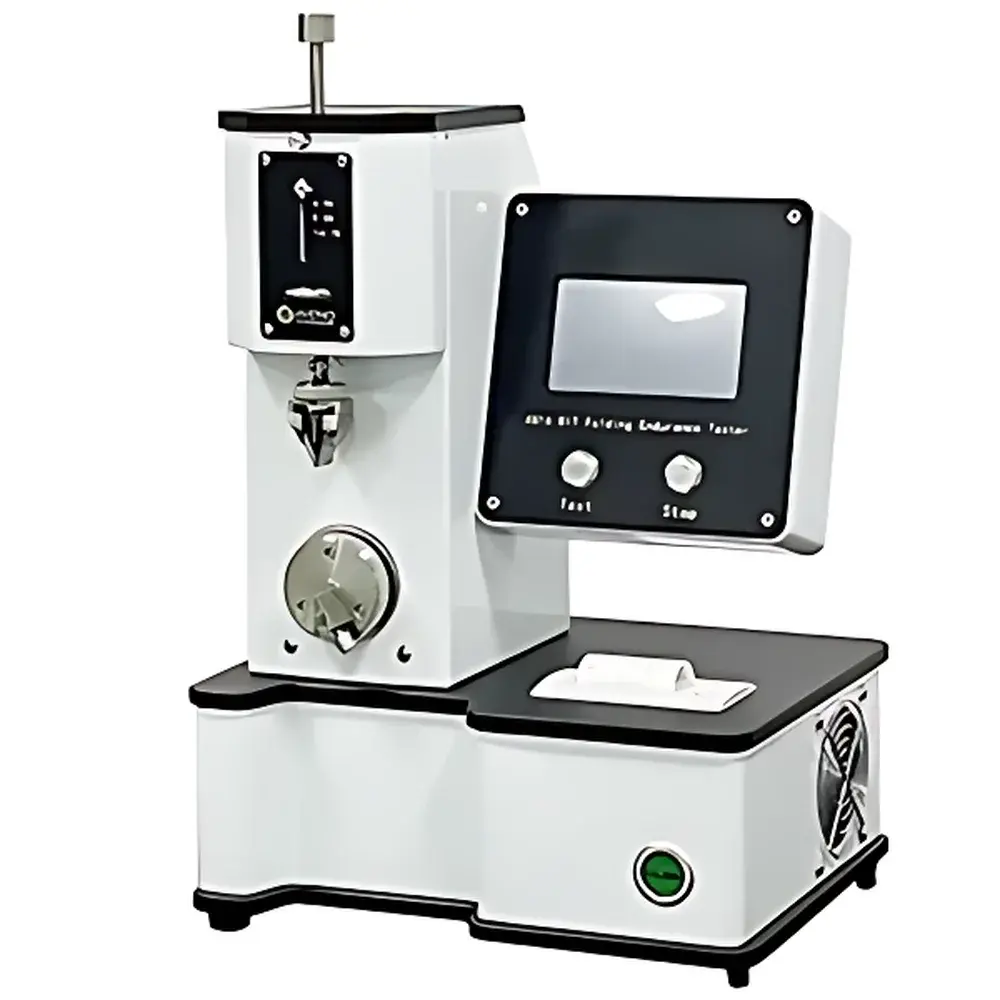
Yuelian PW-6603 MIT Fold Endurance Tester
| Brand | Yuelian / PW |
|---|---|
| Origin | Guangdong, China |
| Model | PW-6603 MIT |
| Fold Rate Range | 20–200 double folds/min |
| Fold Angle | 135° ± 2° |
| Tension Options | 4.9 N, 9.81 N, 14.7 N |
| Folding Radius | R0.38 mm ± 0.02 mm |
| Clamp Width | 15 ± 0.1 mm |
| Sample Width | 15 mm |
| Sample Length | >140 mm |
| Count Range | 1–99999 cycles |
| Display | 5-inch color touchscreen |
| Output | Thermal printer |
| Power Supply | 220 VAC, 50 Hz |
| Dimensions (Single-Station) | 330 × 290 × 510 mm |
| Weight (Single-Station) | 25 kg |
| Dimensions (5-Station) | 806 × 460 × 490 mm |
| Weight (5-Station) | 100 kg |
| Compliant Standards | ISO 5626, GB/T 2679.5, ASTM D2176, TAPPI T 511, BS ISO 5626, QB/T 1049 |
Overview
The Yuelian PW-6603 MIT Fold Endurance Tester is a precision-engineered instrument designed to quantify the fatigue resistance of flexible sheet materials under repeated bending stress. It operates on the fundamental principle of controlled double-fold cycling—where a standardized specimen is subjected to oscillatory folding at a defined angle and tension until mechanical failure occurs at the fold line. This method directly implements the MIT (Massachusetts Institute of Technology) fold endurance test protocol, widely adopted for its reproducibility in evaluating the structural integrity of thin, pliable substrates. The device conforms rigorously to ISO 5626 (“Paper — Determination of fold endurance”), ASTM D2176 (“Standard Test Method for Folding Endurance of Paper by the MIT Tester”), TAPPI T 511, and GB/T 2679.5, making it suitable for laboratories operating under GLP, ISO/IEC 17025, or regulated manufacturing environments requiring documented traceability.
Key Features
- Adjustable fold rate from 20 to 200 double folds per minute, with factory-calibrated default at 175 ± 10 double folds/min for compliance with ISO 5626 and ASTM D2176.
- Precision-machined folding heads with nominal radius R0.38 mm ± 0.02 mm and clamp width 15 ± 0.1 mm, ensuring consistent bend geometry across test cycles.
- Modular tension system using calibrated weights (4.9 N, 9.81 N, and 14.7 N options) to compress a linear spring mechanism—delivering stable, non-drifting load application during extended testing.
- Five interchangeable folding jaws with gap settings of 0.25 mm, 0.50 mm, 0.75 mm, and 1.00 mm—enabling material-specific adaptation for paper, metallized film, coated foils, and textile laminates.
- 5-inch high-resolution color touchscreen interface with intuitive icon-driven navigation, real-time cycle counting, automatic stop-on-failure detection, and user-configurable pass/fail thresholds.
- Integrated thermal printer for immediate hard-copy output of test ID, sample ID, tension value, fold rate, final cycle count, and timestamp—supporting audit-ready documentation.
Sample Compatibility & Compliance
The PW-6603 accommodates flat, flexible specimens up to 1 mm in thickness—including uncoated and coated papers, corrugated board liners, aluminum and copper foils, PET and BOPP films, nonwovens, and fine-gauge wire insulation sheaths. Specimen dimensions are standardized at 15 mm width and ≥140 mm length to ensure uniform clamping and folding kinematics. All mechanical tolerances—including fold angle (135° ± 2°), jaw radius, and gap alignment—are verified against metrological references traceable to national standards. The instrument meets essential requirements for regulatory submission workflows: raw data logs retain full audit trails (user ID, timestamp, parameter settings), and printed reports include unique test identifiers compliant with FDA 21 CFR Part 11 principles where electronic records are archived.
Software & Data Management
While the PW-6603 operates as a standalone benchtop unit with embedded firmware, its thermal printer output and touchscreen UI support seamless integration into laboratory information management systems (LIMS). Each test record contains machine-readable metadata: model number, firmware version, calibration due date, operator ID, and environmental notes (optional manual entry). For multi-station configurations (5-tester array), synchronized start/stop logic enables parallel batch testing with consolidated reporting. Optional RS-232 or USB-to-serial interfaces (available upon request) permit automated data export to CSV or Excel-compatible formats—facilitating statistical process control (SPC) analysis per ISO 9001 clause 8.5.1 and IATF 16949 section 9.1.3.
Applications
- Quality assurance in pulp & paper mills verifying fold endurance of packaging grades (e.g., kraft linerboard, folding boxboard) prior to converting.
- R&D labs assessing coating adhesion durability on metallized films used in pharmaceutical blister packaging.
- Textile suppliers validating flex life of technical fabrics for medical gowns or protective apparel under cyclic creasing.
- Electronics manufacturers screening polyimide flex-circuit substrates for hinge-zone reliability in foldable displays.
- Regulatory testing labs performing accredited determinations per ISO 5626 for CE-marked paper-based medical device packaging.
FAQ
What standards does the PW-6603 fully support?
ISO 5626, ASTM D2176, TAPPI T 511, GB/T 2679.5, BS ISO 5626, and QB/T 1049—all verified via built-in mechanical tolerances and documented calibration procedures.
Can the instrument test samples thicker than 1 mm?
No. The design envelope and jaw clearance are optimized for materials ≤1 mm thick; exceeding this may compromise fold repeatability and risk mechanical interference.
Is the folding angle adjustable beyond 135°?
No. The 135° ± 2° angle is fixed per ISO 5626 and ASTM D2176 requirements; deviation would invalidate conformance claims.
How is traceability maintained for calibration and maintenance?
Each unit ships with a factory calibration certificate referencing NIST-traceable force and angular metrology; recommended recalibration interval is 12 months or after 10,000 cycles, whichever occurs first.
Does the 5-station configuration allow independent parameter control per station?
Yes—each of the five test stations operates autonomously with individual tension, fold rate, and sample loading; synchronization is optional and software-coordinated.