
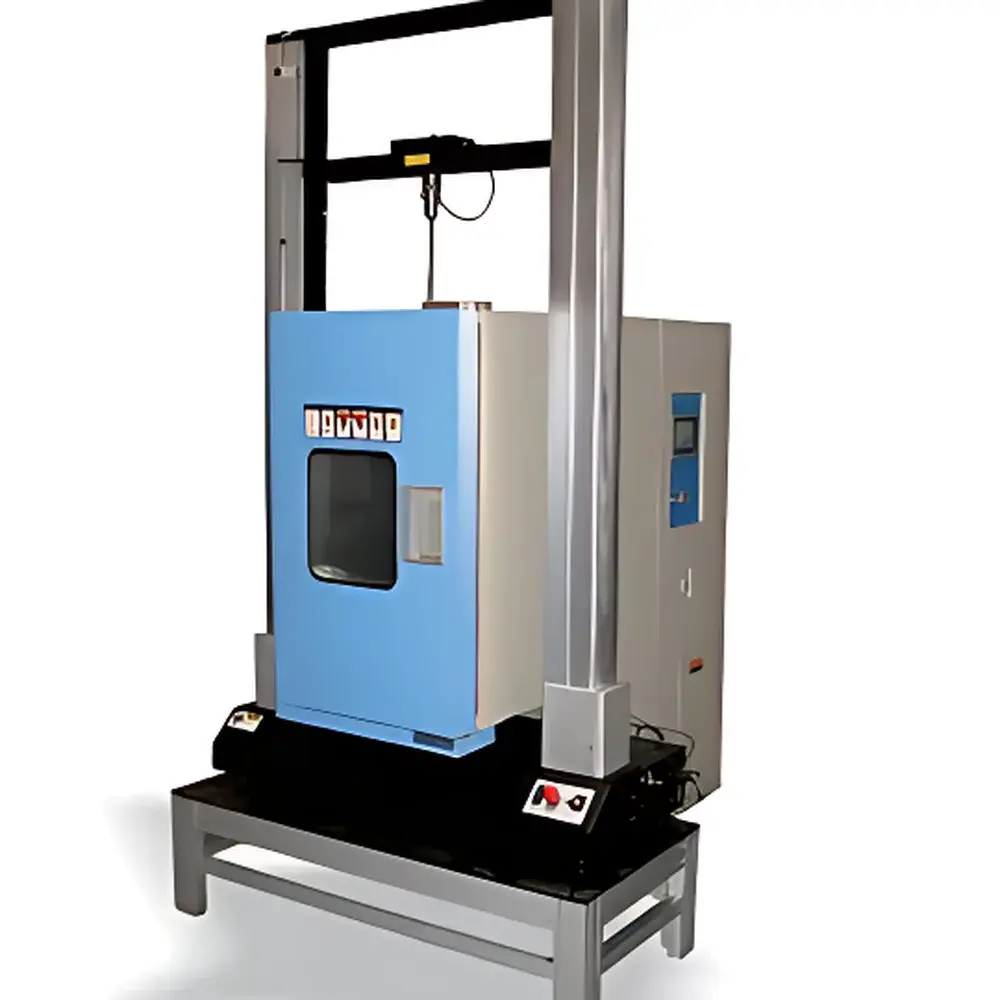
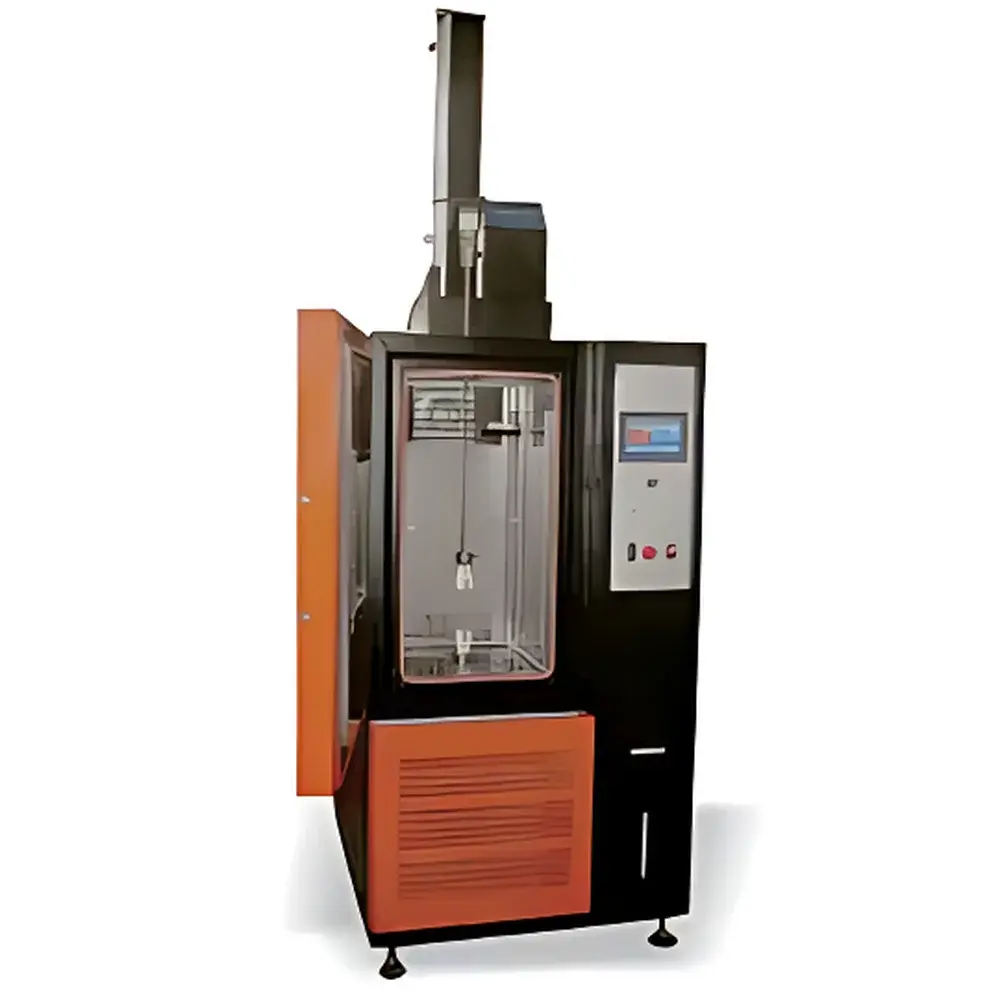
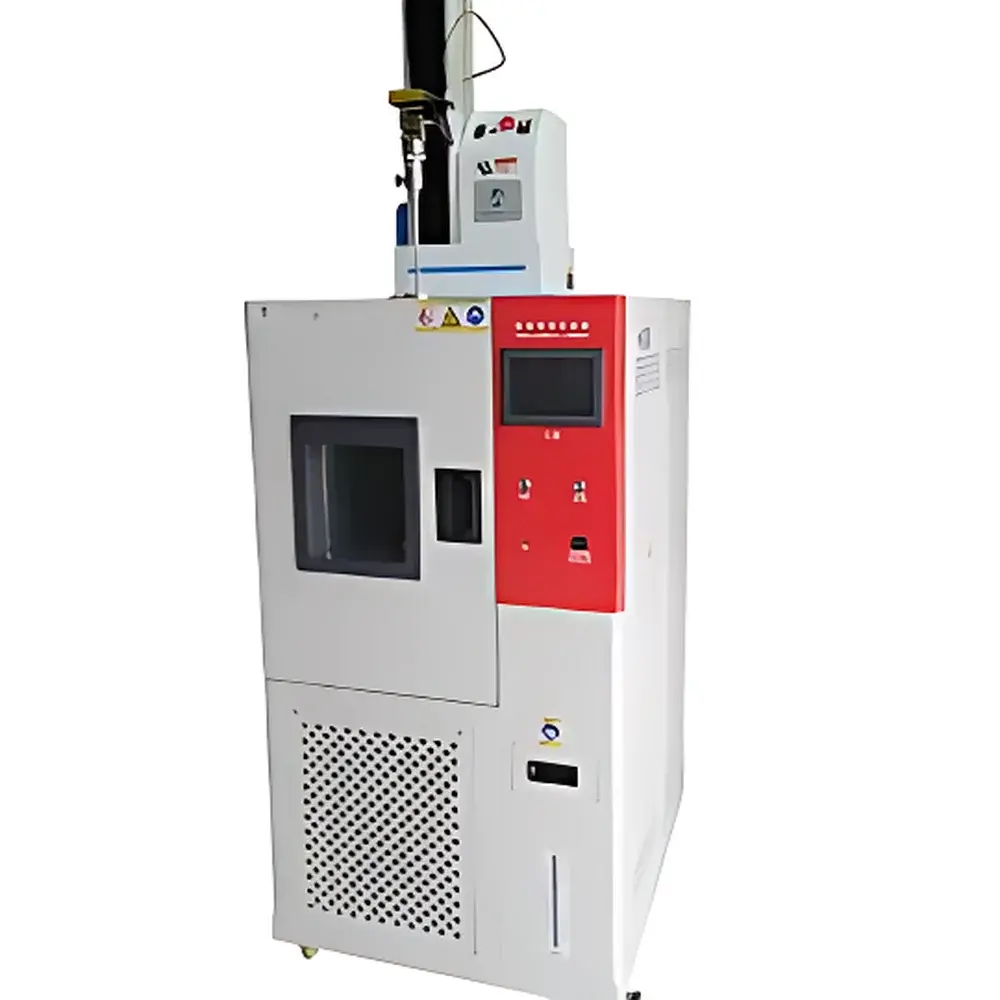
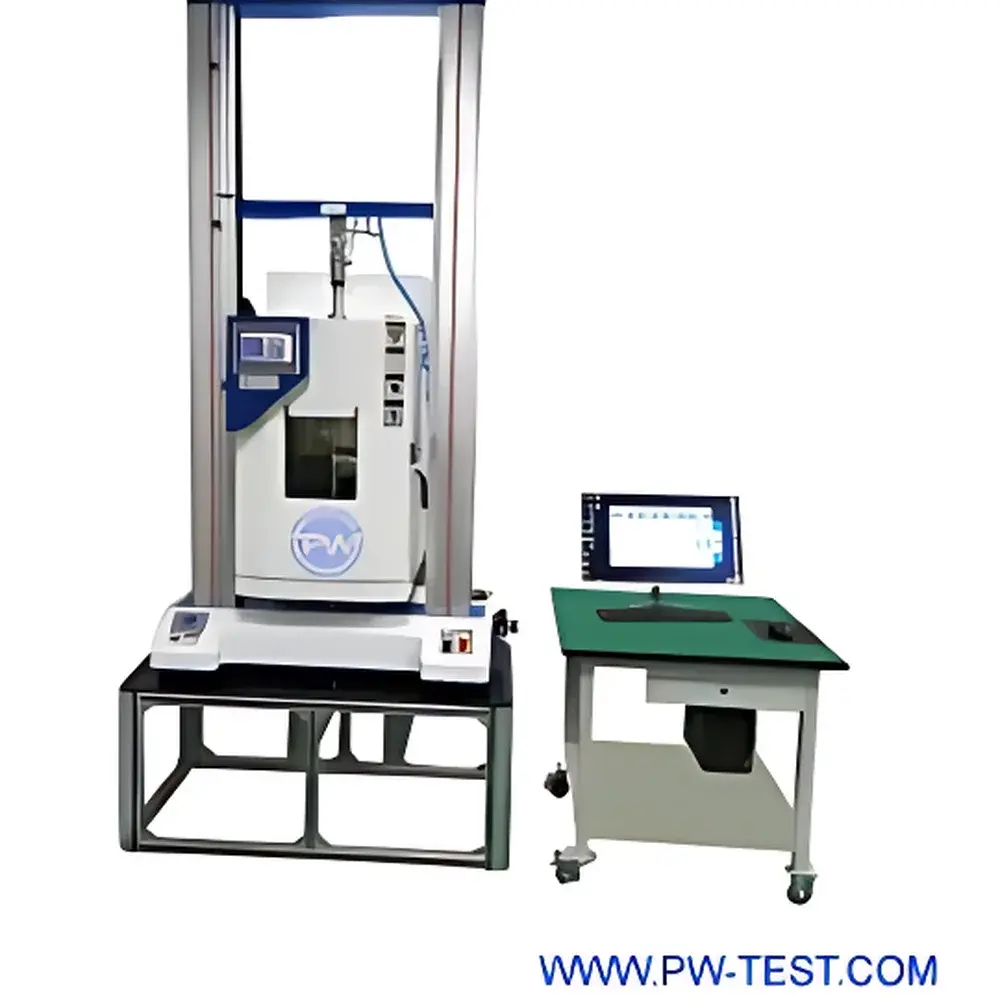
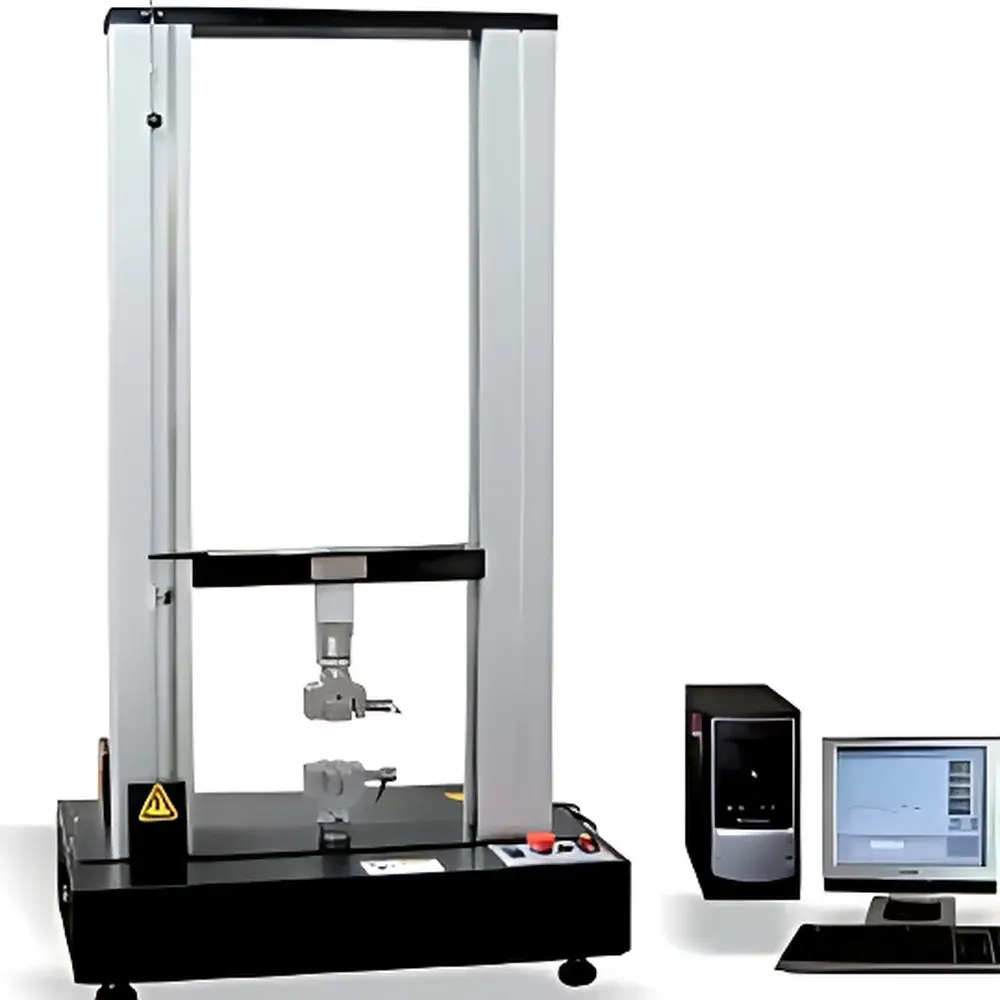
Yuelian PW-UCS128-40 High-Low Temperature Universal Testing Machine
| Brand | Yuelian |
|---|---|
| Origin | Guangdong, China |
| Model | PW-UCS128-40 |
| Instrument Type | Electromechanical Universal Testing Machine |
| Load Capacity Options | 10N, 20N, 50N, 100N, 200N, 500N, 1kN, 2kN (one selected) |
| Force Resolution | 1/500,000 |
| Force Accuracy | ±0.3% of full scale |
| Crosshead Travel | 650 mm |
| Test Width | Ø140 mm |
| Speed Range | 0.001–500 mm/min (programmable) |
| Position Resolution | 1/500,000 |
| Control Interface | PC-based software via USB |
| Drive System | Servo motor with precision ball screw and timing belt transmission |
| Power Consumption | 400 W |
| Input Voltage | 220 V, 50/60 Hz |
| Standard Fixtures | 180° peel fixture, ring tack fixture |
| Environmental Chamber Volume | 128 L |
| Internal Chamber Dimensions | 400 × 400 × 800 mm (W×H×D) |
| Temperature Range | −40 °C to +150 °C |
| Temperature Uniformity | ≤2 °C |
| Temperature Stability | ±0.5 °C |
| Temperature Deviation | ≤±2 °C |
| Humidity Control (if equipped) | ≤±3% RH at <75% RH |
| Stabilization Time (empty chamber) | ~30 min from ambient to setpoint |
| Overshoot (heating/cooling) | ≤±3 °C |
| Noise Level | ≤68 dB(A), per JB/T 9512–1999 |
| Construction | SUS#304 stainless steel interior |
Overview
The Yuelian PW-UCS128-40 High-Low Temperature Universal Testing Machine is an integrated electromechanical materials testing system engineered for precise mechanical property evaluation under controlled thermal conditions. It combines a high-resolution universal testing frame with a certified environmental chamber—enabling standardized tensile, compressive, peel, tear, shear, and loop tack measurements across a wide temperature spectrum (−40 °C to +150 °C). The system operates on the principle of controlled displacement-driven loading, where a servo motor actuates a crosshead via a preloaded ball screw and timing belt assembly, ensuring minimal backlash and repeatable force application. Force transduction is performed using a calibrated load cell with 1/500,000 internal resolution and traceable accuracy of ±0.3% FS. This architecture conforms to fundamental requirements of ISO 7500-1 (static calibration of force-proving instruments) and ASTM E4 (load verification of testing machines), supporting method development aligned with ISO 527, ASTM D638, ASTM D882, ISO 11339 (peel), and ISO 2934 (tack).
Key Features
- Modular dual-system design: Independent yet synchronized operation of the testing frame and environmental chamber, minimizing thermal interference during dynamic testing.
- Precision electromechanical actuation: Servo-driven crosshead with closed-loop position and speed control; programmable rate range from 0.001 to 500 mm/min, suitable for quasi-static to medium-speed deformation protocols.
- High-fidelity data acquisition: Force resolution down to 1/500,000 of full scale, coupled with sub-micron travel resolution—critical for low-force polymer film or biomedical adhesive characterization.
- Thermally stable chamber: 128 L internal volume with SUS#304 stainless steel construction; validated temperature uniformity ≤2 °C and stability ±0.5 °C over full operating range.
- Comprehensive safety logic: Dual-channel overload protection, emergency stop circuit, automatic test termination upon specimen failure, and programmable upper/lower travel limits with auto-return functionality.
- Standardized fixture suite: Includes ISO-compliant 180° peel clamp and loop tack fixture—designed for reproducible alignment and minimal edge effects in thin-film and pressure-sensitive adhesive testing.
Sample Compatibility & Compliance
The PW-UCS128-40 accommodates specimens up to Ø140 mm in width and 650 mm in travel length, supporting flat, tubular, and flexible sheet geometries typical of polymers, elastomers, composites, packaging films, medical tapes, and electronic encapsulants. Its environmental chamber meets structural and performance criteria outlined in IEC 60068-3-5 (environmental testing—guidance for temperature chambers) and supports test methods requiring thermal preconditioning per ISO 291 (standard atmospheres) and ASTM D618 (conditioning of plastics). All mechanical components comply with CE machinery directive 2006/42/EC, and electrical safety follows IEC 61000-6-2/6-4. For regulated environments, optional audit-trail-enabled software modules support 21 CFR Part 11 compliance—including electronic signatures, change history, and user-level access control—facilitating GLP/GMP-aligned validation.
Software & Data Management
The system is operated via dedicated Windows-based control software communicating over USB 2.0. The interface provides real-time force–displacement–time plotting, multi-curve overlay, and automated calculation of modulus, yield point, elongation at break, peel strength (N/mm), and tack energy (mJ). Raw data export is supported in CSV and XML formats for post-processing in MATLAB, Python, or statistical packages such as JMP. Software architecture includes built-in calibration wizards compliant with ISO 7500-1 procedures, with digital certificate storage for traceable load cell and extensometer verification. Optional modules enable automated test sequencing, batch reporting per ISO 17025 templates, and integration with LIMS via RESTful API endpoints.
Applications
- Tensile behavior of thermoplastic films and heat-shrinkable tubing across service temperature ranges.
- Peel adhesion strength of medical pressure-sensitive adhesives at skin-simulating temperatures (e.g., 32 °C).
- Low-temperature embrittlement assessment of automotive sealants and under-hood elastomers (−40 °C).
- High-temperature creep resistance of engineering thermoplastics used in electronics housings (+125 °C).
- Loop tack evolution of hot-melt adhesives during thermal ramp cycles.
- Compression-set and recovery kinetics of silicone gaskets under thermal cycling profiles.
FAQ
What standards does this system support for tensile testing?
It supports ASTM D638, ISO 527, ASTM D882, and GB/T 1040—provided fixtures and specimen geometry comply with respective gauge length and width requirements.
Can the chamber be upgraded for humidity control?
Yes—optional humidity control module extends capability to 10–95% RH with ±3% RH accuracy below 75% RH, meeting ISO 291 conditioning specifications.
Is the load cell calibrated and traceable?
Each unit ships with a factory calibration certificate traceable to NIM (China) or optional UKAS/NIST-traceable certification upon request.
What is the maximum specimen thickness accommodated in the chamber?
With standard fixtures, specimens up to 25 mm thick may be tested; custom jigs can extend compatibility to 50 mm depending on thermal mass and airflow constraints.
Does the system include validation documentation for GxP use?
IQ/OQ documentation packages are available; PQ protocols must be developed per site-specific SOPs and material classes, but the hardware and software architecture meet baseline 21 CFR Part 11 readiness requirements.



