
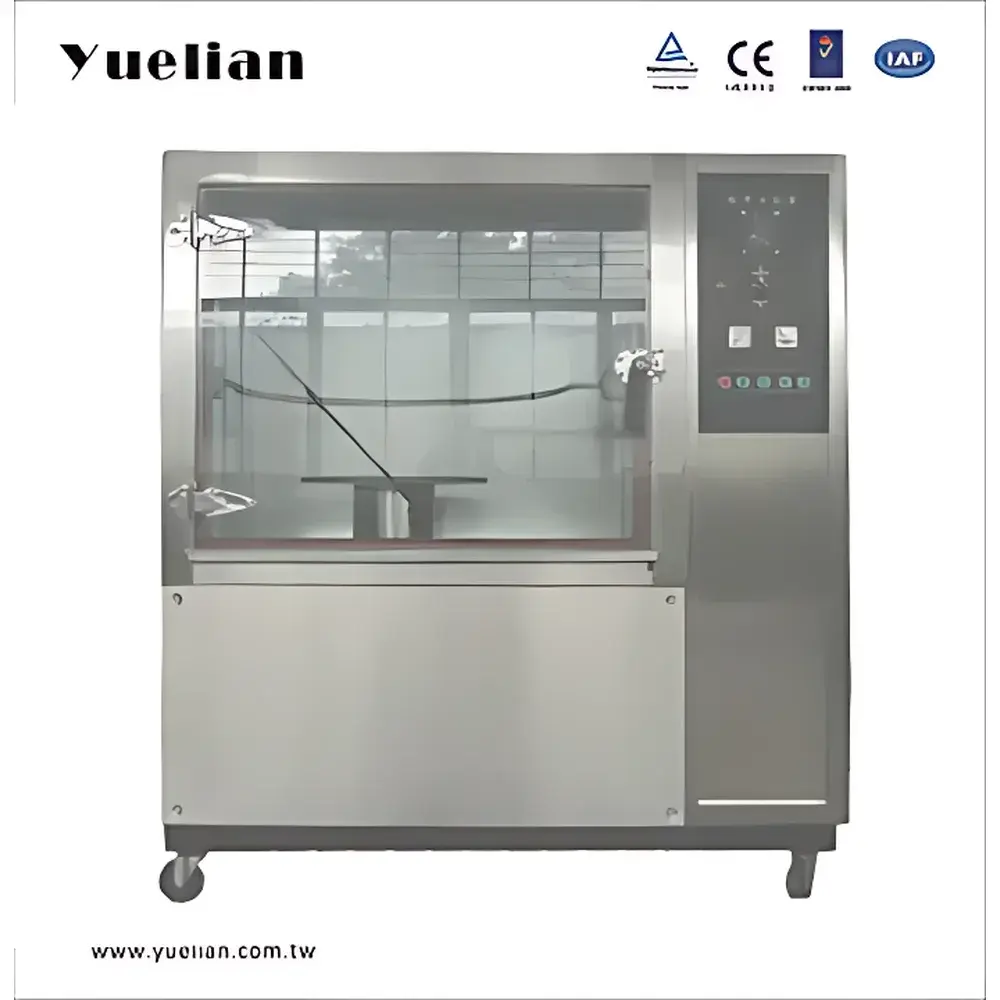
Yuelian RX1 Series IPX3/IPX4 Rain Test Chamber for Motorcycle Digital Instrument Clusters
| Brand | Yuelian |
|---|---|
| Origin | Guangdong, China |
| Manufacturer Type | Authorized Distributor |
| Country of Origin | China |
| Model | RX1 Series |
| Price | USD 1,450 (FOB Guangdong) |
| Internal Chamber Dimensions | 100 × 100 × 100 cm |
| Ambient Operating Temperature Range | RT (15–35°C) |
| Spray Arm Radius | 0.35 m |
| Adjustable Spray Arm Length | 900–2700 mm |
| Stainless Steel Spray Pipe Diameter | 600 mm |
| Pipe Wall Thickness | 20 mm |
| Nozzle Orifice Diameter | 0.4 mm |
| Nozzle Spacing | Uniform per IEC 60529 |
| Water Pressure | 60–100 kPa |
| Turntable Speed | 1–10 rpm (adjustable) |
| Turntable Diameter | 300 mm |
| Programmable Cycle Control | On/Off Timing Sequence |
| Power Supply | 220 V / 50 Hz |
| Rated Power | 1.5 kW |
| Construction | AISI 304 Stainless Steel Interior + Powder-Coated A3 Steel Exterior |
Overview
The Yuelian RX1 Series Rain Test Chamber is a purpose-engineered environmental test system designed to evaluate the ingress protection (IP) performance of motorcycle digital instrument clusters and other automotive electronic assemblies under controlled simulated rainfall conditions. It complies with the water exposure requirements of IEC 60529 (IPX3 and IPX4), ISO 20653:2021 (Road vehicles — Degrees of protection (IP code) — Protection of electrical equipment against foreign objects, water and access), and SAE J2380 (Rain Resistance Testing for Automotive Electrical Systems). The chamber utilizes a rotating turntable and calibrated radial spray arms to replicate dynamic wetting scenarios—such as frontal rain impact during vehicle motion or vertical/horizontal water deflection at varying angles—ensuring realistic stress application on sealed housings, display interfaces, and connector gaskets. Its modular architecture supports repeatable, operator-independent test execution in QC laboratories, R&D validation centers, and Tier-1 supplier testing facilities.
Key Features
- Corrosion-resistant internal chamber constructed from AISI 304 stainless steel; external enclosure fabricated from A3 carbon steel with epoxy powder coating for long-term durability in high-humidity environments
- Full stainless steel or copper-wetted components—including spray manifolds, nozzles, piping, and drainage channels—to prevent mineral scaling and ensure consistent water flow characteristics over extended service life
- Precision-machined 0.4 mm orifice nozzles arranged at standardized spacing per IEC 60529 Annex B, delivering uniform droplet distribution across the test specimen’s projected area
- Motor-driven turntable (Ø300 mm) with 1–10 rpm continuous speed adjustment, enabling angular exposure variation to simulate real-world vehicle orientation shifts during precipitation events
- Programmable rain cycle controller with independent ON/OFF timing parameters, supporting multi-stage tests such as intermittent spray, dwell periods, and sequential angle sweeps
- Integrated elapsed-time counter with non-volatile memory retention, providing auditable test duration records traceable to GLP-compliant documentation protocols
Sample Compatibility & Compliance
The RX1 chamber accommodates instrument clusters up to 100 cm in maximum dimension, including fully assembled OEM units with integrated backlighting, touch-sensitive overlays, and CAN bus connectors. Specimens are mounted on the center-turntable using standard M6 threaded inserts or custom fixture plates (optional). The system meets functional verification requirements for IPX3 (oscillating tube test) and IPX4 (splashing water from any direction), with full alignment to test method definitions in ISO 20653 Clause 6.2 and IEC 60529 Section 14.2. Optional calibration certificates (traceable to NIST-equivalent national metrology institutes) and validation reports (IQ/OQ documentation templates) are available upon request to support ISO/IEC 17025-accredited lab operations.
Software & Data Management
While the RX1 operates via an intuitive front-panel HMI with tactile membrane buttons and LED status indicators, optional RS-485 or Ethernet connectivity enables integration into centralized test management platforms. Logged data—including elapsed time, spray duration, turntable RPM, and manual start/stop timestamps—can be exported as CSV files for inclusion in LIMS or quality audit trails. The control firmware supports user-defined profile storage (up to 16 programmable cycles), password-protected parameter editing, and automatic error logging for pressure deviation or motor stall detection—features aligned with FDA 21 CFR Part 11 principles for electronic record integrity in regulated automotive electronics validation.
Applications
- Verification of sealing integrity for TFT-LCD and OLED-based motorcycle dashboards subjected to monsoon-grade rainfall exposure
- Reliability screening of MEMS-based sensors (e.g., tilt, vibration, ambient light) embedded within instrument housings
- Design validation of conformal-coated PCBAs against electrolytic corrosion initiation under cyclic wet-dry conditions
- Supplier qualification testing per OEM-specific standards (e.g., Honda ES-3012, Yamaha ESS-001, BMW GS-95024)
- Pre-certification trials prior to third-party IP rating certification at accredited bodies (e.g., TÜV Rheinland, UL, SGS)
FAQ
Does the RX1 chamber support IPX5 or IPX6 testing?
No—the RX1 is engineered specifically for IPX3/IPX4 compliance. Higher-pressure jet tests (IPX5/IPX6) require separate nozzle configurations, booster pumps, and structural reinforcement not included in this model.
Can the turntable accommodate irregularly shaped instrument clusters?
Yes—custom mounting fixtures (e.g., adjustable U-brackets, vacuum chucks) can be supplied to secure asymmetric or cantilevered assemblies without obstructing spray coverage.
Is distilled water required for operation?
Deionized or softened water is recommended to minimize nozzle clogging; tap water with ≤100 ppm total dissolved solids (TDS) may be used if filtered through a 5 µm inline cartridge.
What maintenance intervals are specified for long-term reliability?
Nozzle inspection and ultrasonic cleaning every 200 operational hours; pump seal replacement every 12 months; annual calibration verification of pressure transducer and tachometer sensor.



