
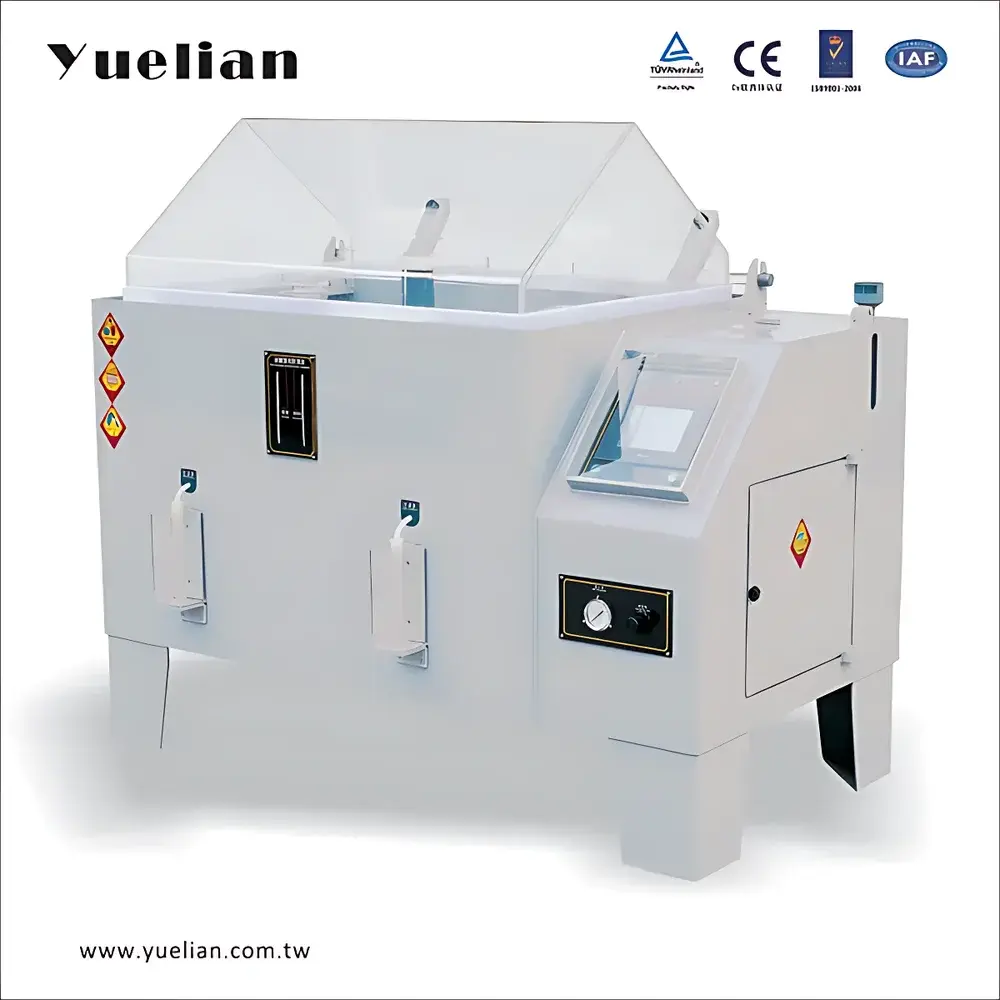
Yuelian SAS Series Programmable Cyclic Salt Spray Corrosion Test Chamber
| Brand | Yuelian |
|---|---|
| Origin | Guangdong, China |
| Manufacturer Type | Authorized Distributor |
| Country of Origin | China |
| Model | SAS-108 / SAS-270 / SAS-480 / SAS-800 |
| Internal Chamber Dimensions (W×D×H, cm) | 60×40×45 |
| Test Chamber Material | Imported HC-PVC板材 (8 mm) & PP |
| Saturation Tank Material | SUS#304 stainless steel (3 mm) |
| Chamber Temperature Range | 35±1°C (Neutral Salt Spray), 50±1°C (Corrosion Resistance Test) |
| Saturation Air Temperature | 47±1°C (NSS), 63±1°C (ASS/CASS) |
| Salt Solution Temperature | 35±1°C |
| pH Range | 6.5–7.2 (NSS), 3.0–3.2 (ASS/CASS) |
| Spray Rate | 1.0–2.0 mL/80 cm²/h |
| Spray Mode | Continuous, nozzle life ≥4000 h |
| Timer Range | 0–999.9 h with power-failure memory and audible alarm |
| Power Supply | AC 220 V, 50/60 Hz |
Overview
The Yuelian SAS Series Programmable Cyclic Salt Spray Corrosion Test Chamber is an engineered environmental test system designed to evaluate the corrosion resistance of coated, plated, and chemically treated metallic and non-metallic surfaces under controlled, repeatable conditions. Based on ASTM B117 (Neutral Salt Spray), ISO 9227 (NSS, ASS, CASS), and JIS Z2371 standards, the chamber delivers precise control over salt fog generation, temperature, humidity, and cyclic exposure sequences—including salt spray, drying, and high-humidity conditioning phases. Unlike conventional static salt spray chambers, the SAS series implements programmable multi-step corrosion cycles that replicate real-world service environments where products experience alternating wet/dry conditions during storage, transportation, and field operation. This approach yields corrosion morphologies—such as white rust, red rust, blistering, and filamentary corrosion—that correlate strongly with outdoor atmospheric degradation, making it a critical tool for automotive OEMs, Tier-1 suppliers, and electroplating quality assurance laboratories seeking predictive reliability data.
Key Features
- High-precision touch-screen controller dedicated to temperature, humidity, and cycle timing—enabling fully programmable test profiles with up to 99 segments per program.
- Dual-stage air pressure regulation ensures stable, pulsation-free compressed air supply to the spray nozzles, maintaining consistent fog density and droplet distribution.
- Tapered conical spray tower with adjustable dispersion angle optimizes salt fog uniformity and sedimentation rate across the test chamber floor (per ISO 9227 Annex A).
- Integrated saturation air tank constructed from 3 mm SUS#304 stainless steel, equipped with visual water-level indicator and automatic refill interface.
- Corrosion-resistant heating elements made of titanium alloy, delivering rapid thermal response and long-term stability in aggressive chloride environments.
- Full safety architecture: dry-run protection, overflow cutoff, overtemperature lockout, and audible/visual alarm activation with automatic shutdown upon fault detection.
- Pre-saturated compressed air treatment system minimizes nozzle clogging and ensures reproducible aerosol particle size distribution (typical median diameter ~1–3 µm).
Sample Compatibility & Compliance
The SAS chamber accommodates specimens up to 160 cm wide (SAS-800 model), supporting standard test panels (e.g., ASTM G85 Annexes), fasteners, automotive trim components, printed circuit board assemblies, and electroplated hardware. All internal wetted surfaces are fabricated from HC-PVC or polypropylene—materials certified per UL 94 HB and resistant to 5% NaCl solution at elevated temperatures. The system complies with regulatory requirements for GLP-compliant testing: full audit trail logging (optional), user-access level management, and electronic signature support (when integrated with compliant LIMS). It meets essential design criteria outlined in IEC 60068-2-11 (salt mist), ISO 16750-4 (road vehicles), and VW 80101 (cyclic corrosion testing for automotive components).
Software & Data Management
The embedded controller records real-time chamber parameters—including chamber temperature, saturation tank temperature, elapsed cycle time, and operational status—with timestamped storage (≥30 days onboard). Optional RS-485/Modbus RTU or Ethernet TCP/IP connectivity enables integration into centralized test management platforms. Data export supports CSV format for post-test statistical analysis (e.g., corrosion rating per ISO 10289, ASTM D610, or ISO 4628-3). Firmware updates maintain alignment with evolving international test method revisions, and configuration backups can be saved to USB media for traceability and lab accreditation audits (ISO/IEC 17025).
Applications
- Validation of zinc, nickel, chromium, and tin plating adhesion and porosity on steel substrates.
- Comparative evaluation of organic coatings (epoxy, polyester, acrylic) and conversion coatings (chromate, trivalent Cr, phosphate) under accelerated aging protocols.
- Qualification of anti-corrosion pretreatments used in automotive body-in-white (BIW) manufacturing.
- QC release testing for aerospace fasteners per AMS 2700 and MIL-STD-810 Method 509.
- Failure mode analysis of galvanic couples and bimetallic assemblies exposed to coastal or de-icing salt environments.
FAQ
What standards does the SAS series support?
It fully supports ASTM B117, ISO 9227 (NSS, ASS, CASS), JIS Z2371, GB/T 2423.17, and VW 80101 cyclic corrosion test protocols.
Can the chamber perform fully automated multi-phase cycles?
Yes—users define custom sequences combining salt spray, hot air drying (up to 70°C), and RH-controlled humid soak phases with independent setpoints and dwell times.
Is the system suitable for GLP-regulated laboratories?
With optional software add-ons, it provides electronic signatures, change logs, and data integrity features compliant with FDA 21 CFR Part 11 and ISO/IEC 17025 documentation requirements.
How is nozzle clogging prevented?
Through pre-saturation of compressed air, precision-machined borosilicate glass nozzles, and continuous low-pressure rinse during idle periods.
What maintenance intervals are recommended?
Daily: inspect salt solution level and nozzle clarity; weekly: clean saturation tank and drain lines; quarterly: calibrate temperature sensors and verify spray deposition rate per ISO 9227 Annex A.



