
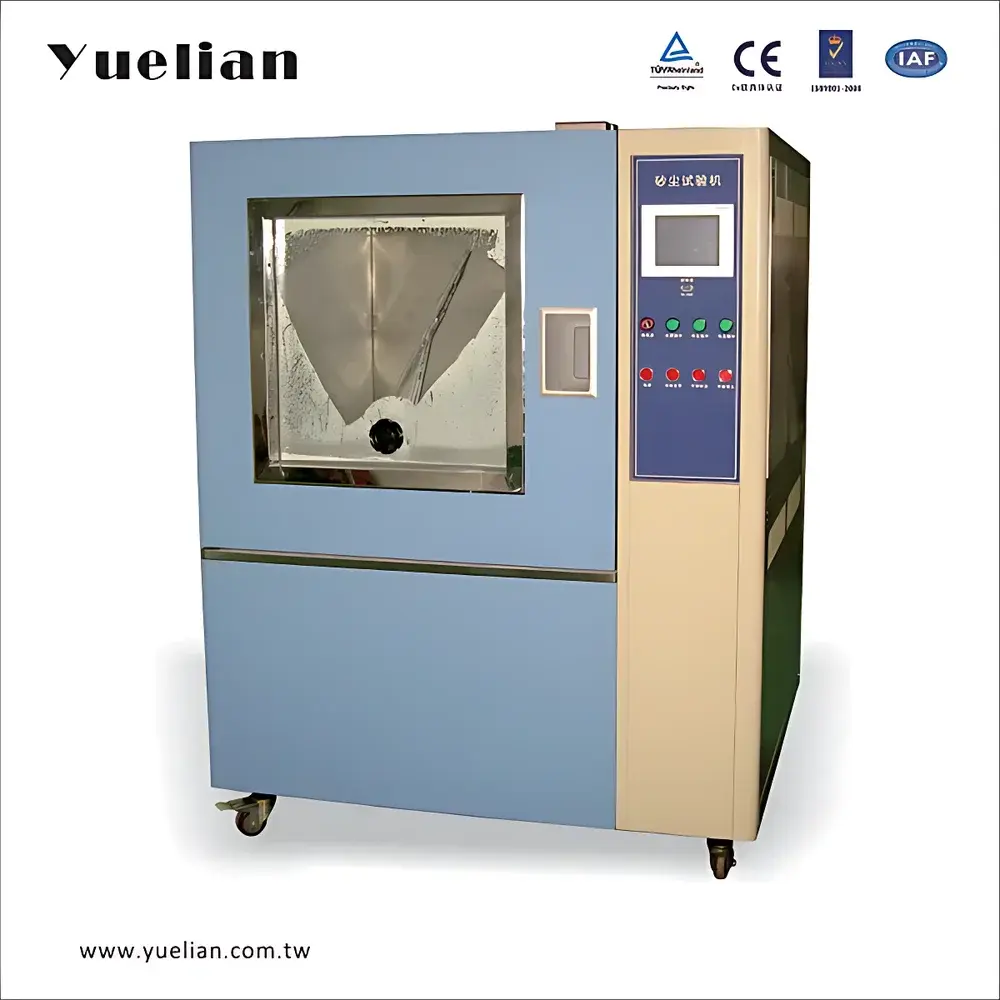
Yuelian SD Series Sand and Dust Test Chamber
| Brand | Yuelian |
|---|---|
| Model | SD-500 / SD-800 / SD-1000 / SD-1500 / SD-2600 |
| Chamber Volume | 500–2600 L |
| Mesh Wire Diameter | 50 µm |
| Mesh Opening | 75 µm |
| Talcum Powder Loading | 2–4 kg/m³ |
| Dust Delivery Modes | Free-fall sedimentation & Pneumatic sand-blowing (3-pressure adjustable) |
| Internal Dimensions (W×D×H, mm) | 800×800×800 to 1200×1200×1800 |
| Construction | Interior – brushed stainless steel (AISI 304) |
| Control System | Digital intelligent PID controller with PT-100 sensor input |
| Safety Features | Overload fuse protection, grounding protection, thermal cutoff |
| Power Supply | AC 220 V / 380 V ±10%, 50 Hz |
| Total Power Consumption | 0.3–0.5 kW |
| Compliance | GB 4208-93, GB/T 2423.37-2008, GJB 150.12A-2009, GB 10485-2008 |
Overview
The Yuelian SD Series Sand and Dust Test Chamber is an engineered environmental simulation system designed to evaluate the ingress protection (IP) performance of enclosures—particularly against non-abrasive particulate matter such as talcum powder—under standardized dust exposure conditions. Based on the principles of gravitational sedimentation and controlled pneumatic dispersion, the chamber replicates two critical operational environments defined in international and national test standards: (1) low-velocity, free-fall dust deposition simulating indoor or sheltered outdoor conditions; and (2) dynamic, pressurized sand-dust circulation mimicking high-wind, arid field environments. Its dual-mode delivery mechanism—comprising a top-mounted centrifugal disperser for uniform free-fall distribution and a bottom-mounted, three-stage adjustable air-pressure nozzle array for directed particle impingement—ensures reproducible exposure profiles across test specimens. The chamber’s architecture adheres strictly to the physical constraints and procedural requirements outlined in IEC 60529 (IP5X/IP6X), GB/T 4208-2017 (equivalent to IEC 60529), GB/T 2423.37-2008 (sand and dust testing for electrotechnical products), and GJB 150.12A-2009 (military-grade environmental testing). It is widely deployed in R&D validation, quality assurance, and compliance certification workflows for automotive lighting assemblies (e.g., LED headlamps, fog lamps), electronic control units (ECUs), instrumentation housings, aerospace avionics enclosures, and industrial IoT sensors.
Key Features
- Robust dual-material construction: Interior chamber fabricated from brushed AISI 304 stainless steel for corrosion resistance and ease of powder residue removal; exterior housing made of cold-rolled steel with epoxy-based anti-rust primer and electrostatic powder coating.
- Dual dust delivery methodology: Programmable free-fall mode using centrifugal dispersion to achieve uniform volumetric dust concentration (2–4 kg/m³); independent pneumatic blow mode with three-level pressure regulation (0.1–0.3 MPa) for targeted particle impact simulation.
- Precision mesh specification: Stainless-steel wire mesh conforming to nominal wire diameter of 50 µm and nominal opening of 75 µm—aligned with GB/T 2423.37-2008 and IEC 60529 Annex B requirements for IP5X/IP6X testing.
- Intelligent digital control interface: Microprocessor-based PID controller with PT-100 temperature feedback, real-time parameter display, and programmable timer function for unattended operation up to 999 hours.
- Integrated auxiliary systems: Built-in talcum powder drying unit to maintain consistent particle moisture content (<0.5% w/w); mechanical vibration plate (optional) for simulating transport-induced dust agitation; reinforced wide-angle observation window with double-sealed tempered glass.
- Comprehensive safety architecture: Dual-layer overcurrent protection (thermal fuse + circuit breaker), dedicated earth-ground terminal, and automatic cut-off upon door interlock disengagement or abnormal temperature rise.
Sample Compatibility & Compliance
The SD Series accommodates a broad range of sample geometries—from compact PCB modules and automotive lamp housings to full-size ECUs and instrument clusters—within its scalable chamber volumes (500 L to 2600 L). All models support static mounting via adjustable stainless-steel sample racks, with optional tilt-angle fixtures available for angled exposure alignment per GB/T 2423.37 Clause 6.2. The system fully satisfies regulatory requirements for dust ingress verification under multiple frameworks: GB/T 4208-2017 (IP5X/IP6X classification), GB/T 2423.37-2008 (test method A: free-fall; test method B: fluidized bed), GJB 150.12A-2009 (Method I: blowing sand; Method II: dust settling), and GB 10485-2008 (road vehicle lighting equipment dust resistance). Documentation packages include traceable calibration records for airflow velocity, powder concentration, and chamber temperature—supporting GLP-compliant audit trails and FDA 21 CFR Part 11–ready data integrity protocols when integrated with validated software.
Software & Data Management
While the base configuration employs a stand-alone digital controller, optional Ethernet-enabled data logging modules are available for seamless integration into centralized laboratory information management systems (LIMS). These modules record time-stamped parameters—including elapsed test duration, real-time chamber temperature, operational mode status, and cycle completion signals—at user-defined intervals (1 s to 60 min resolution). Export formats include CSV and XML, compatible with statistical process control (SPC) platforms and automated report generation tools. For regulated environments, optional 21 CFR Part 11–compliant firmware upgrades provide electronic signature capability, role-based access control, and immutable audit logs—ensuring full traceability from test initiation through final pass/fail determination.
Applications
- Automotive lighting validation: Sealing integrity assessment of LED headlamp modules, daytime running lights (DRLs), and adaptive driving beam (ADB) assemblies exposed to desert or off-road dust conditions.
- Electronics enclosure certification: IP rating verification for industrial HMIs, motor drives, battery management systems (BMS), and railway signaling equipment operating in dusty rail yards or mining sites.
- Aerospace component qualification: Environmental stress screening of cockpit displays, flight control interface units, and UAV payload housings per MIL-STD-810H Method 510.6.
- Consumer electronics durability testing: Dust resistance evaluation of smart home sensors, outdoor security cameras, and ruggedized tablets intended for agricultural or construction use.
- Research-grade particulate interaction studies: Controlled investigation of dust adhesion mechanisms, filter media efficiency degradation, and electrostatic charge accumulation on insulating surfaces.
FAQ
What standards does the SD Series comply with?
It meets GB/T 4208-2017 (IP5X/IP6X), GB/T 2423.37-2008, GJB 150.12A-2009, and GB 10485-2008—covering both civilian and defense-grade dust ingress testing requirements.
Can the chamber operate continuously for extended durations?
Yes—equipped with thermal overload protection and stable PID temperature regulation, it supports uninterrupted operation up to 999 hours per test cycle.
Is talcum powder included with the system?
No—talcum powder must be procured separately per GB/T 2423.37 specifications (particle size ≤75 µm, moisture content <0.5%). A recommended supplier list is provided upon request.
Does the system support automated reporting?
With the optional Ethernet data logger and compliant software package, it generates timestamped CSV reports and supports integration with LIMS and SPC platforms.
What maintenance is required for long-term reliability?
Routine tasks include mesh cleaning after each test cycle, periodic verification of airflow nozzles, and annual calibration of the PT-100 sensor and pressure regulators—full service documentation is included.



