
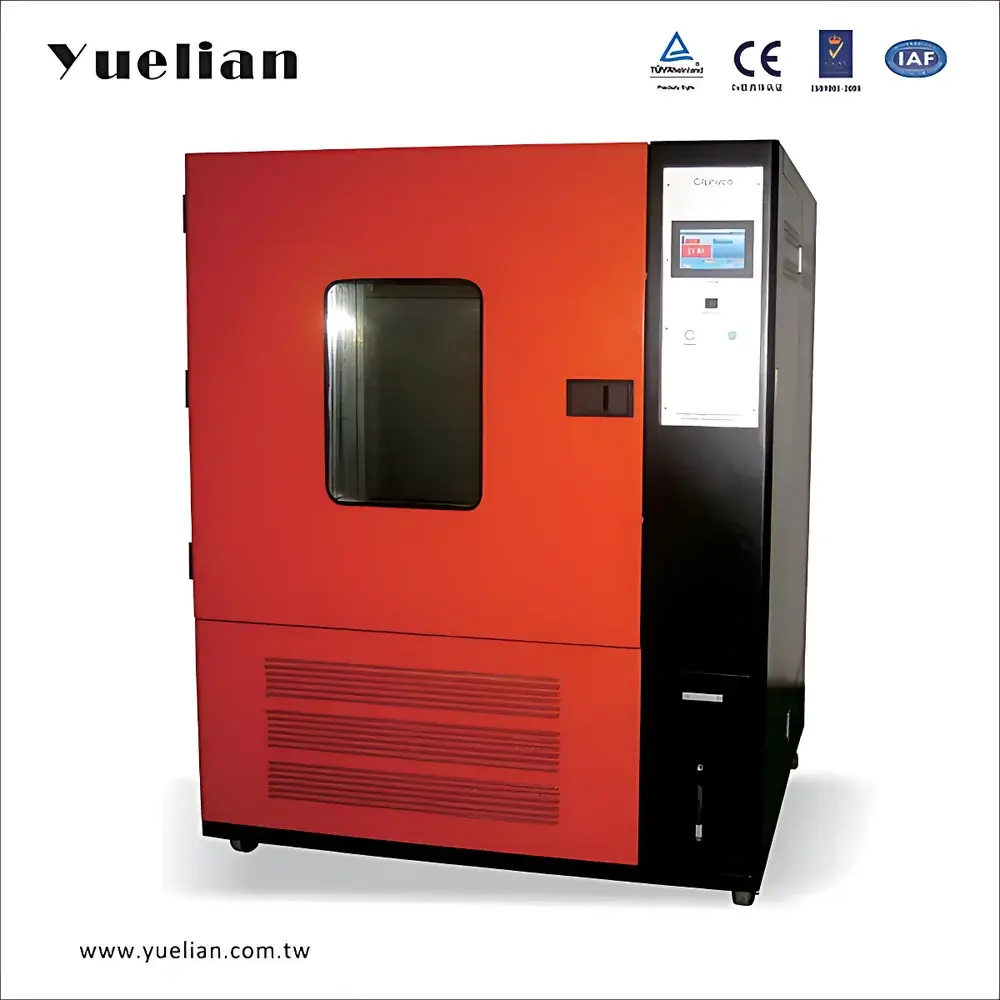
Yuelian TS Series High-Low Temperature Alternating Environmental Test Chamber
| Brand | Yuelian |
|---|---|
| Model | TS Series |
| Type | Environmental Test Chamber |
| Application | Thermal & Humidity Stress Testing for Plastics and Polymeric Materials |
| Temperature Range | –70 °C to +150 °C |
| Humidity Range | 20–98 %RH (optional low-humidity down to 5 %RH) |
| Temperature Uniformity | ±0.5 °C |
| Temperature Stability | ±0.3 °C |
| Humidity Uniformity | ±3 %RH |
| Humidity Stability | ±2.5 %RH |
| Heating Rate | ~20 min (0 °C → 100 °C), ~60 min (–70 °C → 100 °C) |
| Cooling Rate | ~90 min (20 °C → –70 °C) |
| Internal Volume Options | 80 L, 150 L, 225 L, 408 L, 800 L, 1000 L |
| Control System | PID + SSR/SCR bidirectional output with slope logic |
| Programmability | 150 programs × 1500 segments, 9999 cycles × 999 repeats, 5 independent sub-cycles |
| Safety Monitoring | 15-point real-time fault detection with auto-diagnostic logging |
| Construction | SUS#304 stainless steel interior & exterior, rock wool + rigid PU foam insulation |
| Refrigeration | Twin-stage hermetic air-cooled system (R404A/R507) for ≤ –40 °C models |
| Humidification | Surface evaporation type with auto water generation from tap supply |
| Compliance | Designed per ISO 17025 laboratory environmental control prerequisites |
Overview
The Yuelian TS Series High-Low Temperature Alternating Environmental Test Chamber is an engineered solution for accelerated thermal and hygrothermal stress evaluation of polymeric materials—including thermoplastics, thermosets, elastomers, and composite resins—under rigorously controlled climatic conditions. Based on the principle of forced-air convection combined with precision refrigeration and steam-saturated humidification, the chamber replicates real-world environmental extremes to assess dimensional stability, embrittlement onset, softening behavior, hydrolytic degradation, and long-term aging effects in accordance with standardized test protocols. Its dual-range capability—from –70 °C to +150 °C and 5–98 %RH—enables simulation of operational environments spanning arctic storage, tropical field deployment, automotive under-hood exposure, and aerospace thermal cycling. The chamber’s architecture adheres to fundamental metrological requirements for environmental testing equipment as defined in ISO 16750-4 (road vehicles), ASTM D618 (conditioning plastics), and IEC 60068-2-1/2/14/30 (environmental testing procedures).
Key Features
- Robust dual-stage refrigeration system using environmentally compliant R404A/R507 refrigerants, optimized for rapid thermal transitions and stable low-temperature hold performance below –40 °C.
- Intelligent PID + SSR/SCR bidirectional temperature/humidity control with adaptive slope logic, minimizing overshoot and ensuring reproducible ramp profiles across all volume configurations.
- High-fidelity observation window with anti-condensation electric heating film and high-lumen fluorescent lighting, enabling real-time visual monitoring without thermal or optical interference.
- Integrated tap-water-compatible humidification system featuring automatic pure-water generation, self-contained reservoir recovery, and dual-level dry-run protection.
- 15-point real-time safety monitoring subsystem, logging fault timestamps, diagnostic codes, and recommended remediation steps—critical for audit readiness in regulated industries.
- Modular program architecture supporting up to 150 multi-segment test sequences, nested cycle structures, and time-synchronized external device triggering via three configurable TTL/relay outputs.
Sample Compatibility & Compliance
The TS Series accommodates standard ASTM D638, ISO 527, and ISO 11357-compliant specimen fixtures and mounting plates within its uniformly conditioned workspace. Internal dimensions range from 40 × 50 × 40 cm (80 L) to 100 × 100 × 100 cm (1000 L), permitting full-size automotive interior components, medical device housings, and structural polymer panels. All models meet mechanical and electrical safety requirements per IEC 61000-6-2/6-4 (EMC immunity/emission), UL 61010-1 (lab equipment safety), and CE marking directives. Optional RS-232 serial interface enables integration into centralized lab management systems compliant with FDA 21 CFR Part 11 for electronic records and signatures when paired with validated software.
Software & Data Management
Embedded controller firmware supports full-cycle data logging at user-selectable intervals (1 s to 60 min), storing temperature, humidity, setpoint deviations, and alarm events internally for ≥30 days. Exportable CSV files facilitate post-test statistical analysis in MATLAB, JMP, or Minitab. Optional PC-based software provides remote monitoring, multi-chamber synchronization, automated report generation (PDF/Excel), and GLP-aligned audit trails—including operator ID, parameter changes, and calibration history. All logged data retains traceability to NIST-traceable reference sensors calibrated annually per ISO/IEC 17025 requirements.
Applications
- Thermal endurance evaluation of engineering plastics (e.g., PEEK, PPS, PC, PA66) per UL 746B Relative Thermal Index (RTI) protocols.
- Accelerated moisture absorption/desorption kinetics studies for hygroscopic polymers under cyclic humidity conditions.
- Validation of solder mask and conformal coating integrity on printed circuit assemblies exposed to thermal shock and condensation.
- Pre-conditioning of packaging materials prior to seal strength and permeability testing per ASTM F1249 and ISO 15106.
- Qualification of medical-grade polymer components per ISO 10993-12 extraction and aging guidelines.
- Supporting failure analysis workflows by correlating microstructural changes (via post-test SEM/DSC/TGA) with specific thermal-humidity exposure histories.
FAQ
What temperature and humidity uniformity specifications are guaranteed across the working volume?
The chamber maintains ±0.5 °C temperature uniformity and ±3 %RH humidity uniformity (at 25 °C / 60 %RH steady-state) as verified per IEC 60068-3-5 during factory acceptance testing.
Can the TS Series be configured for extended low-humidity operation below 20 %RH?
Yes—low-humidity variants are available with enhanced desiccant-assisted dehumidification, achieving stable operation down to 5 %RH at 25 °C.
Is the control system compliant with FDA 21 CFR Part 11 for electronic records?
The base controller meets data integrity fundamentals; full Part 11 compliance requires optional validated software, role-based access control, and electronic signature modules.
What maintenance intervals are recommended for refrigeration and humidification subsystems?
Compressor oil and filter replacement every 24 months; humidifier tank cleaning weekly; annual calibration of Pt100 sensors and RH capacitive probes.
Does the chamber support custom test profiles required by OEM-specific automotive standards?
Yes—programmable ramp/soak sequences, multi-zone cycling, and trigger-based auxiliary outputs enable direct implementation of GMW16265, Ford CETP, and VW TL226 protocols.



