
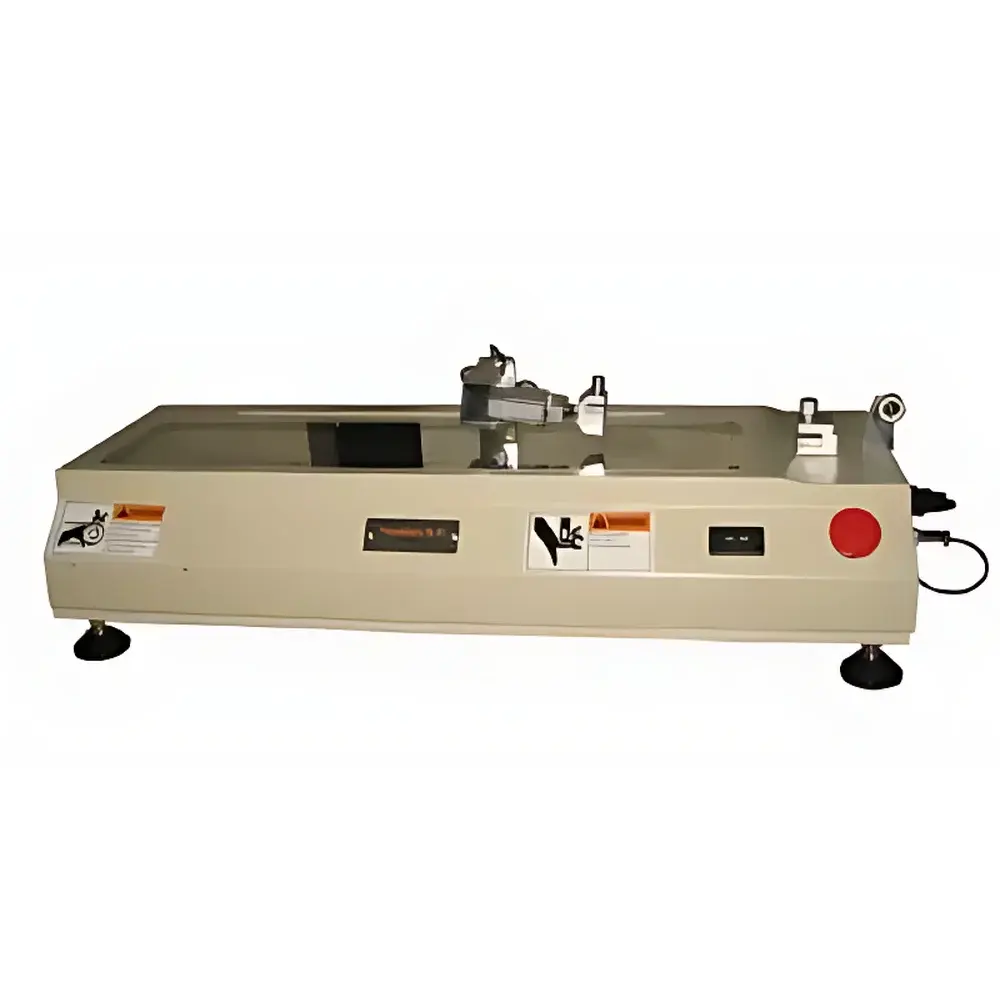
Yuelian YL-1103 Horizontal Tensile Testing Machine Compliant with GB/T 20808–2011
| Brand | Yuelian |
|---|---|
| Model | YL-1103 |
| Type | Electronic Horizontal Tensile Tester |
| Load Capacity Options | 10 N, 20 N, 50 N, 100 N, 200 N (dual-range configuration available) |
| Force Resolution | 1/250,000 full scale |
| Force Accuracy | ±0.5% of reading |
| Stroke Resolution | 0.005 mm |
| Test Speed Range | 5–500 mm/min (PC-programmable) |
| Maximum Stroke | 500 mm |
| Test Width | Ø140 mm |
| Control System | PC-based closed-loop control with USB interface |
| Data Acquisition | Real-time sampling via dedicated interface board |
| Software Platform | Windows-compatible test management software with MS Access database backend |
| Compliance | Designed and validated per GB/T 20808–2011 (Chinese national standard for tissue paper tensile strength testing) |
| Power Supply | 220 V AC, 50/60 Hz, 5 A |
| Motor Drive | Stepper motor + precision ball screw + synchronous timing belt |
| Dimensions (W×D×H) | 1063 × 300 × 200 mm |
| Weight | ~45 kg |
| Standard Accessories | One set of pneumatic/mechanical grips, USB cable, software license |
Overview
The Yuelian YL-1103 Horizontal Tensile Testing Machine is an ISO-aligned, standards-compliant mechanical testing system engineered for precise static tensile, peel, and elongation measurements—primarily intended for soft, flexible materials such as tissue paper, nonwovens, thin films, adhesive tapes, and lightweight packaging substrates. Its horizontal configuration satisfies the geometric and loading-path requirements specified in GB/T 20808–2011, China’s national standard for determining the tensile strength and elongation at break of facial, toilet, and household tissue papers. Unlike vertical universal testers, the YL-1103 eliminates gravitational sag and clamping-induced bending moments during specimen alignment, ensuring consistent axial load application and minimizing parasitic stress components. The system operates on a closed-loop motion control architecture driven by a high-torque stepper motor, coupled to a ground-precision ball screw and reinforced timing belt transmission—delivering stable velocity profiles and repeatable displacement positioning across its full 500 mm stroke range.
Key Features
- Horizontal load frame geometry optimized for low-force, high-elongation specimens per GB/T 20808–2011 and aligned with ASTM D828/D882 principles for thin-film tensile behavior;
- Selectable dual-range load cells (10 N / 200 N standard; optional configurations support simultaneous high-sensitivity and high-capacity measurement);
- Force resolution of 1 part in 250,000 full scale, enabling sub-milligram force detection critical for tissue and hydrophilic web characterization;
- Precision stroke control with 0.005 mm positional resolution and programmable speed profiles (5–500 mm/min), supporting both quasi-static and accelerated test protocols;
- Integrated automatic return-to-start function after test completion, reducing operator intervention and improving throughput in QC labs;
- Dedicated grip adjustment mechanism with rapid vertical positioning buttons—facilitating fast specimen alignment without recalibration;
- Comprehensive overload protection suite: hardware-based emergency stop, software-defined upper/lower force limits, specimen rupture-triggered halt, and real-time torque monitoring;
- Modular I/O architecture supporting future expansion with environmental chambers, extensometers, or digital image correlation (DIC) modules.
Sample Compatibility & Compliance
The YL-1103 accommodates specimens up to Ø140 mm in width and 500 mm in active gauge length, making it suitable for standardized strip specimens (e.g., 25 mm × 150 mm per GB/T 20808–2011) as well as custom geometries used in R&D settings. It supports manual and pneumatic jaw types—including serrated, rubber-coated, and self-tightening variants—for secure gripping of low-modulus, fibrous, or slippery substrates without slippage or premature failure. All firmware, calibration routines, and reporting templates are traceable to GB/T 20808–2011 Annex B verification procedures. While not certified to ISO/IEC 17025, the system’s metrological chain—including factory calibration certificates for load cell and encoder—is documented per GLP-aligned internal QA protocols. Optional audit trail logging and electronic signature modules enable alignment with FDA 21 CFR Part 11 requirements when deployed in regulated manufacturing environments.
Software & Data Management
The included Windows-native test control software provides full instrument orchestration—from test parameter definition and real-time curve visualization to post-test statistical analysis and report generation. Raw data streams are acquired at ≥1 kHz via a dedicated PCIe/USB interface card and stored in structured MS Access databases, permitting cross-batch querying, trend analysis, and SPC charting. The software computes standard mechanical parameters including peak tensile force (N), elongation at break (%), average peel force (N/25 mm), modulus at defined strain offsets, and energy-to-break (mJ). Curve processing tools support baseline correction, yield point detection (0.2% offset method), and multi-curve overlay with delta comparison. Export options include CSV, PDF, and XML formats compatible with LIMS integration. All user actions—including method edits, calibration events, and result approvals—are timestamped and logged in an immutable audit trail.
Applications
- Tensile strength and elongation testing of tissue paper, wet wipes, and medical gauze per GB/T 20808–2011, ISO 12625-3, and TAPPI T494;
- Peel adhesion evaluation of pressure-sensitive tapes, labels, and laminated packaging structures (ASTM D903, FINAT FTM 1);
- Breaking strength assessment of nonwoven fabrics used in hygiene products and filtration media;
- Quality control of extruded polymer films, metallized foils, and coated papers where low-force, high-ductility response dominates;
- R&D screening of bio-based substrates, hydrogels, and electrospun nanofibers requiring fine-resolution force-displacement mapping.
FAQ
Does the YL-1103 meet international standards beyond GB/T 20808–2011?
Yes—it implements core mechanical and algorithmic principles consistent with ASTM D882 (thin plastics), ISO 527-3 (films), and ISO 1798 (foam tensile), though formal certification requires third-party validation.
Can the system be integrated into an existing laboratory network or MES?
Yes—the software supports OPC UA and TCP/IP-based data streaming, and raw database files are directly queryable via ODBC drivers for ERP/LIMS interoperability.
Is calibration traceable to national metrology institutes?
Factory calibration uses NIST-traceable reference standards; end-user recalibration kits and accredited service partnerships are available upon request.
What safety certifications does the unit carry?
It complies with CE machinery directive (2006/42/EC) and EMC directive (2014/30/EU); electrical safety conforms to IEC 61000-6-2/6-4.
Is technical support available outside mainland China?
Yuelian provides remote diagnostics and English-language documentation; regional distributors in Southeast Asia, the Middle East, and Latin America offer localized service contracts.



