
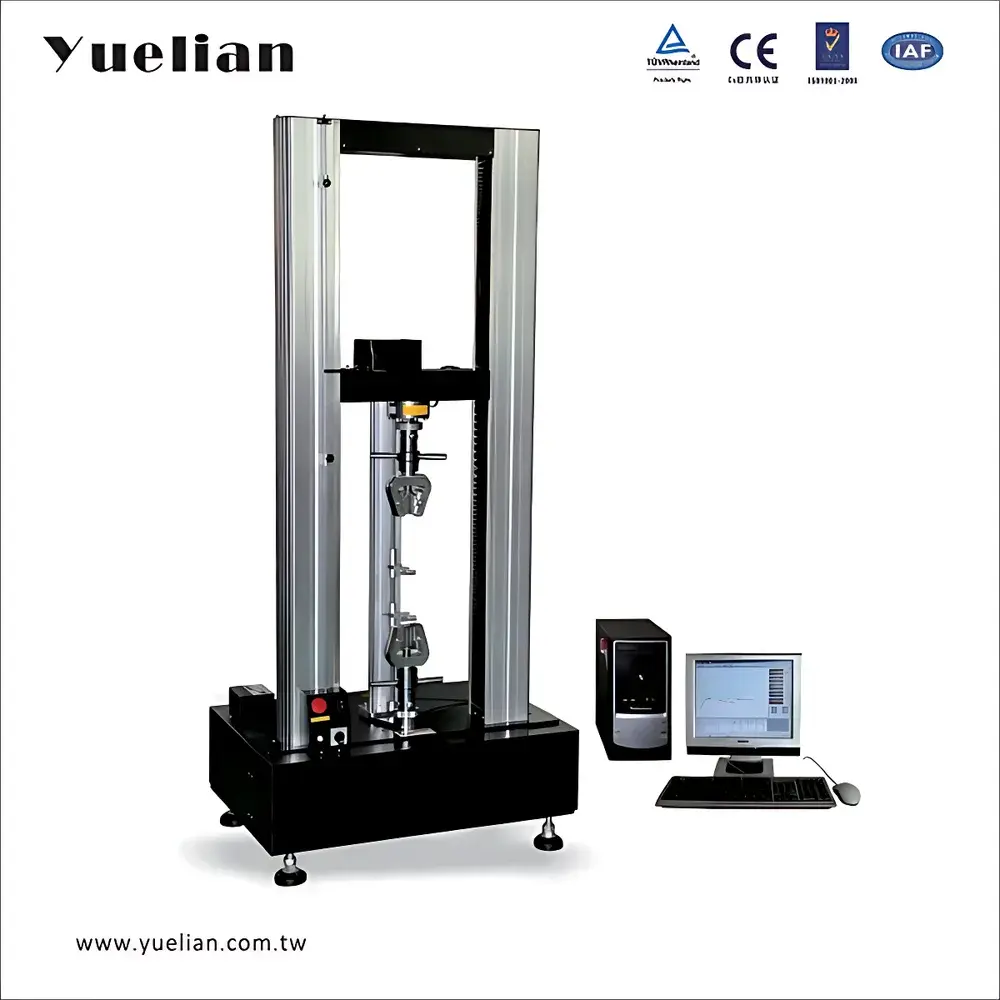
Yuelian YL-1125 Four-Point Static Pressure Tester for Mobile Phone Lens Modules
| Brand | Yuelian |
|---|---|
| Origin | Guangdong, China |
| Manufacturer Type | Authorized Distributor |
| Country of Origin | China |
| Model | YL-1125 |
| Quotation | Upon Request |
| Load Capacity Options | 10 N to 50 kN (dual-range configuration available) |
| Force Resolution | 1/500,000 full scale |
| Force Accuracy | ±0.3% of reading |
| Displacement Resolution | 1/500,000 full stroke |
| Test Speed Range | 0.01–1000 mm/min (software-controlled) |
| Maximum Stroke | 1200 mm |
| Test Width | 420 mm |
| Drive System | Servo motor + precision ball screw + timing belt transmission |
| Power Supply | 220 V, 50/60 Hz, 10 A |
| Rated Power | 750 W |
| Dimensions (W×D×H) | 920 × 620 × 1990 mm |
| Weight | ~422 kg |
| Compliance Standards | ISO 7500-1, ASTM E4, EN 10002-1, GB/T 228, JJG 475, DIN 5122, JIS B7721/B7733, BS 1610 |
Overview
The Yuelian YL-1125 Four-Point Static Pressure Tester is a precision-engineered mechanical testing system specifically designed for evaluating the structural integrity and deformation resistance of optical lens modules used in mobile phone cameras. Unlike general-purpose compression testers, this instrument implements a standardized four-point loading configuration—two outer support points and two inner load application points—to generate controlled, uniform bending stress across thin, brittle, and dimensionally constrained lens substrates (e.g., sapphire, chemically strengthened glass, or polymer-based optics). The test principle conforms to beam bending mechanics under static loading conditions, enabling quantification of flexural strength, yield onset, and catastrophic failure thresholds without localized indentation artifacts. Its rigid frame architecture, high-resolution force transduction, and sub-micron displacement control make it suitable for R&D validation, incoming material inspection, and production-line quality assurance in optoelectronic component manufacturing.
Key Features
- Four-point static pressure configuration optimized for flat, thin optical lens assemblies—minimizing edge effects and ensuring repeatable stress distribution per ISO 7500-1 calibration traceability.
- High-fidelity dual-range load cell options (10 N to 50 kN), supporting both micro-scale lens substrate qualification and full-module mechanical robustness verification.
- Servo-driven motion control with precision ball screw and timing belt transmission ensures smooth, low-vibration actuation across the full 1200 mm stroke range.
- Force resolution of 1 part in 500,000 full scale and displacement resolution at equivalent fidelity enable detection of subtle pre-failure creep and non-linear elastic response.
- Software-configurable test speed (0.01–1000 mm/min) accommodates quasi-static fracture analysis as well as accelerated durability screening protocols.
- Integrated emergency stop, overload cutoff, specimen rupture auto-halt, and programmable upper/lower limit triggers ensure operator safety and test repeatability.
- Modular fixture interface supports rapid tooling changes for varying lens module footprints (e.g., 6 mm to 25 mm diagonal formats) and mounting configurations (adhesive-bonded, clip-retained, or carrier-mounted).
Sample Compatibility & Compliance
The YL-1125 is validated for testing rigid and semi-rigid optical components including cover lenses, IR filter substrates, and stacked lens modules up to 420 mm wide. It accommodates standard industry lens carriers and custom jig fixtures via T-slot base plate integration. All mechanical and metrological performance parameters comply with international standards governing materials testing instrumentation: ISO 7500-1 (static calibration of force-proving instruments), ASTM E4 (load verification of testing machines), EN 10002-1 (tensile testing of metallic materials), and GB/T 228 (Chinese national standard for metallic tensile testing). The system’s force measurement chain is traceable to national metrology institutes, and its software architecture supports audit-ready data logging aligned with GLP and GMP documentation requirements.
Software & Data Management
The embedded PC-based control software provides full test sequence programming, real-time curve visualization (force vs. displacement, stress vs. strain), and automated parameter extraction—including peak load, deflection at yield, flexural modulus, and failure energy. Raw data are stored in MS-ACCESS relational database format with timestamped metadata (operator ID, sample ID, environmental conditions, calibration status). The interface supports multi-sensor synchronization (e.g., optional extensometer or acoustic emission input), graphical report generation (PDF/Excel export), and configurable pass/fail criteria with statistical process control (SPC) charting. Software design adheres to FDA 21 CFR Part 11 principles, offering user-level access control, electronic signature capability, and immutable audit trails for regulated environments.
Applications
- Qualification of sapphire and aluminosilicate glass lens modules against drop-induced bending stress per IEC 60068-2-32.
- Evaluation of adhesive bond strength between lens layers under sustained static load (ISO 11339).
- Verification of lens housing mechanical tolerance stack-up during assembly compression cycles.
- Comparative analysis of thermal aging effects on lens substrate stiffness retention.
- Supporting DOE studies for optimizing lens thickness-to-strength ratios in next-generation compact camera modules.
- Compliance testing for OEM mechanical specification sheets (e.g., Apple MFi, Samsung QCP, or Huawei HES standards).
FAQ
What distinguishes four-point bending from conventional compression testing for lens modules?
Four-point bending applies distributed moment loading without direct contact at the center, eliminating localized plastic deformation and enabling accurate assessment of flexural strength—critical for brittle optical materials.
Is the system compatible with third-party data acquisition hardware?
Yes—the USB interface and open API allow integration with external DAQ systems, laser displacement sensors, or thermal imaging cameras for multimodal failure analysis.
Does the software support automated batch testing for high-volume QC?
Yes—scriptable test sequences, barcode-triggered sample ID assignment, and configurable pass/fail logic enable unattended operation across hundreds of lens units per shift.
Can the machine be calibrated in-house?
While field verification using certified reference load cells is supported, full traceable calibration requires accredited service by Yuelian-authorized metrology partners per ISO/IEC 17025.
What maintenance intervals are recommended for long-term accuracy?
Servo drive and ball screw lubrication every 1,000 operational hours; annual force transducer linearity verification; biannual alignment check of support/load pin geometry.



