
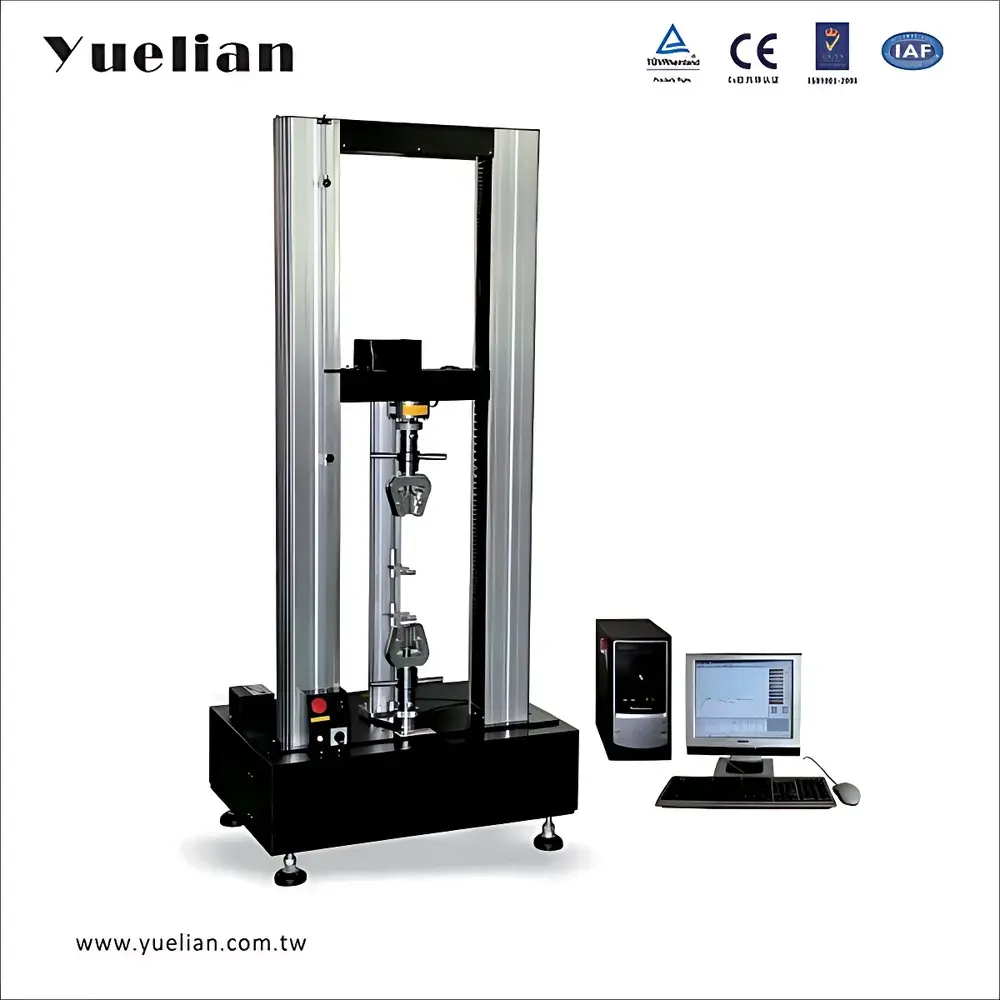
Yuelian YL-1125 Universal Testing Machine for Textile Webbing Tensile Testing
| Brand | Yuelian |
|---|---|
| Origin | Guangdong, China |
| Model | YL-1125 |
| Instrument Type | Electromechanical Universal Testing Machine |
| Load Capacity Options | 10 N to 50 kN (dual-range configuration available) |
| Force Resolution | 1/500,000 full scale |
| Force Accuracy | ±0.3% of reading |
| Crosshead Travel | 1200 mm |
| Test Width | 420 mm |
| Speed Range | 0.01–1000 mm/min (programmable) |
| Displacement Resolution | 1/500,000 full scale |
| Control Interface | PC-based with USB connectivity |
| Compliant Standards | ISO 7500-1, ASTM E4, ASTM D6109, ASTM D3330, GB/T 228.1, GB/T 1449, GB/T 9341, JJG 475 |
| Power Supply | 220 V, 50/60 Hz, 10 A |
| Motor | Servo-driven with precision ball screw and synchronous timing belt transmission |
| Dimensions (W×D×H) | 92 × 62 × 199 cm |
| Weight | ~422 kg |
| Software | Windows-compatible test control & analysis suite with MS Access database backend, real-time curve plotting, multi-sensor support, GLP-compliant audit trail (optional), automatic parameter derivation per ISO/ASTM/GB standards |
Overview
The Yuelian YL-1125 Universal Testing Machine is an electromechanical force-testing system engineered for high-reproducibility mechanical characterization of textile webbing, fibers, tapes, and other flexible or semi-rigid materials under uniaxial tension, compression, bending, peel, shear, and tear loading conditions. Based on the fundamental principles of static load application via servo-controlled crosshead displacement and high-fidelity load cell transduction, the system delivers traceable force measurement in accordance with ISO 7500-1 Class 0.5 and ASTM E4 verification protocols. Its rigid C-frame architecture, coupled with precision-ground ball screws and low-backlash synchronous drive transmission, ensures minimal deflection and exceptional positional repeatability—critical for evaluating small-strain behavior in narrow-width webbing specimens where edge effects and clamping-induced stress concentrations must be rigorously controlled.
Key Features
- Modular load capacity selection from 10 N to 50 kN, including optional dual-range configurations for enhanced resolution across wide dynamic ranges—ideal for testing both lightweight polyester webbing (e.g., 25 mm width, <500 N failure load) and heavy-duty nylon lifting slings (up to 20 kN ultimate tensile strength).
- High-resolution displacement sensing (1/500,000 full scale) and force measurement (±0.3% accuracy) compliant with international calibration standards, enabling precise determination of yield points, modulus transitions, and elongation-at-break in heterogeneous woven structures.
- Programmable speed control from 0.01 to 1000 mm/min, supporting quasi-static tensile tests per ISO 13934-1 and high-speed rupture evaluation per ASTM D5035, with automatic stop triggers upon specimen failure, overload, or user-defined displacement limits.
- PC-integrated control system featuring real-time load–displacement curve acquisition, multi-channel sensor synchronization (e.g., extensometer + load cell + environmental chamber output), and automated parameter extraction—including tensile strength, breaking elongation, initial modulus, and energy-to-break—per GB/T 228.1, ASTM D638, and ISO 10319.
- Robust mechanical design with 420 mm test width and 1200 mm vertical travel accommodates standard webbing grip lengths (100–300 mm), custom jaw geometries (pneumatic, wedge, or serrated), and auxiliary fixtures for 3-point and 4-point bending per GB/T 1449 and ASTM D6109.
Sample Compatibility & Compliance
The YL-1125 supports standardized mechanical testing of flat, woven, braided, or knitted webbing specimens—commonly used in safety harnesses, automotive seatbelts, military load-bearing equipment, and medical restraint systems. It meets dimensional and procedural requirements for ISO 20743 (antibacterial textile evaluation under tension), EN 12195-2 (cargo lashing strap certification), and MIL-STD-2062 (webbing tensile performance for parachute systems). All test routines adhere to Good Laboratory Practice (GLP) principles: raw data are time-stamped, digitally signed, and stored in encrypted MS Access databases with configurable audit trails—fully compatible with FDA 21 CFR Part 11 requirements when paired with validated electronic signature modules. Calibration certificates follow JJG 475-2018 (Chinese national verification regulation) and are traceable to NIM (National Institute of Metrology, China).
Software & Data Management
The proprietary Windows-based software provides a deterministic, scriptable test environment supporting ASTM-standardized test method templates (e.g., D5035 for grab tensile, D2268 for seam strength), customizable report generation (PDF/Excel), and batch-mode execution for incoming inspection workflows. Raw force–displacement data are acquired at ≥1 kHz sampling rate and post-processed using built-in algorithms for offset correction, yield point detection (0.2% offset method), and tangent/secant modulus calculation. Data export includes CSV-compatible metadata headers (specimen ID, operator, date/time, standard reference, environmental conditions), facilitating integration into LIMS platforms or statistical process control (SPC) dashboards. Optional GLP module enables role-based access control, electronic signatures, and change history logging—essential for ISO/IEC 17025-accredited laboratories.
Applications
- Tensile strength and elongation testing of seatbelt webbing per FMVSS 209 and ECE R16.
- Peel adhesion evaluation of laminated safety straps (e.g., coated polyester–polyurethane composites) per ASTM D903.
- Creep and stress-relaxation profiling of aramid-reinforced webbing under constant load at elevated temperatures (when integrated with environmental chamber).
- Mechanical validation of recycled PET webbing for circular economy compliance (e.g., ISO 14021 declarations).
- Interlaminar shear strength assessment of hybrid fiber architectures using specialized double-lap shear fixtures.
- Quality conformance screening against supplier specifications in automotive Tier-1 supplier QA labs.
FAQ
What standards does the YL-1125 support for textile webbing tensile testing?
It natively implements ISO 13934-1, ASTM D5035, GB/T 3923.1, and EN ISO 13934-1, with configurable test profiles for preload ramping, dwell periods, and strain-rate control.
Can the system accommodate non-standard webbing widths or thicknesses?
Yes—the 420 mm test width and modular grip system accept specimens from 10 mm to 150 mm wide; custom jaw inserts and alignment fixtures are available for asymmetric or highly compressible substrates.
Is third-party calibration and certification available?
Yuelian provides factory calibration with NIST-traceable load cells and offers ISO/IEC 17025-certified calibration services through accredited regional partners upon request.
How is data integrity ensured during long-duration creep tests?
The system employs battery-backed RAM buffering, automatic save-on-interrupt, and cyclic checksum verification of all acquired data packets—preventing loss during power fluctuation or unexpected shutdown.
Does the software support multi-user environments with audit-ready workflows?
Yes—the GLP-enabled version enforces user authentication, session logging, electronic signatures, and immutable record archiving compliant with 21 CFR Part 11 Subpart B requirements.



