
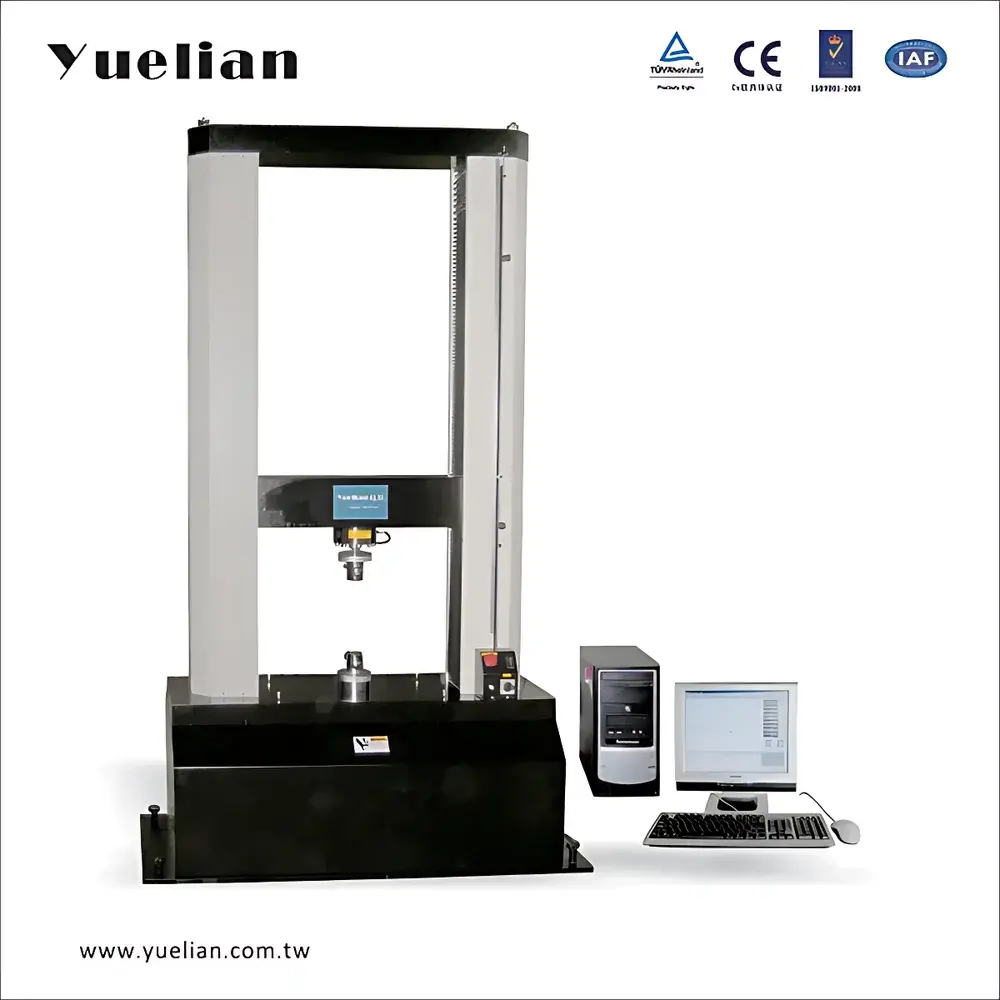
Yuelian YL-1152 Electronic Tensile Testing Machine for Ropes and Cables
| Brand | Yuelian |
|---|---|
| Origin | Guangdong, China |
| Model | YL-1152 |
| Instrument Type | Electronic Tensile Testing Machine |
| Capacity Options | 1 kN, 2 kN, 5 kN, 10 kN, 20 kN, 50 kN, 100 kN, 200 kN (dual-range configuration available) |
| Force Resolution | 1/250,000 full scale |
| Force Accuracy | ≤ ±0.5% of reading |
| Travel Resolution | 0.005 mm |
| Crosshead Speed Range | 0.5–500 mm/min (PC-programmable) |
| Maximum Test Stroke | 1000 mm |
| Test Width | 550 mm |
| Control Interface | PC-based with USB connection |
| Data Acquisition | Real-time sampling via dedicated interface board |
| Compliant Standards | ISO 7500-1, ASTM E4, EN 10002-1, JIS B7721/B7733, DIN 51221, GB/T 228.1, JJG 475 |
Overview
The Yuelian YL-1152 Electronic Tensile Testing Machine is a precision-engineered universal testing system designed specifically for high-reliability mechanical characterization of ropes, cables, synthetic fibers, wire ropes, and other high-strength linear materials. Operating on the principle of controlled uniaxial force application under displacement or load control, the system employs a servo motor-driven crosshead with a preloaded precision ball screw and synchronous timing belt transmission to ensure minimal backlash, high positional repeatability, and long-term mechanical stability. Its rigid four-column frame architecture—constructed from high-tensile steel with reinforced base and crossbeam—is optimized to minimize deflection during high-load tensile events up to 200 kN, thereby preserving measurement fidelity across extended test cycles. The machine is not limited to rope-specific applications; it serves as a foundational platform for standardized mechanical evaluation in QC laboratories, R&D centers, and third-party certification facilities where traceable, repeatable, and auditable tensile data are required per international regulatory frameworks.
Key Features
- Modular dual-capacity load cell configuration supports seamless switching between high-sensitivity (e.g., 1–10 kN) and high-force (e.g., 50–200 kN) ranges without hardware recalibration.
- Real-time closed-loop control with programmable ramp rates, dwell periods, and multi-step profiles compliant with ISO 6892-1 and ASTM D412 test sequences.
- Integrated emergency stop circuitry, overload cutoff, specimen fracture detection, and software-enforced upper/lower travel limits ensure operator safety and equipment protection.
- High-resolution optical encoder feedback (0.005 mm travel resolution) coupled with 24-bit A/D conversion enables precise strain tracking even at sub-millimeter displacements.
- Front-panel quick-adjust buttons allow manual crosshead positioning without interrupting software operation—critical for efficient fixture alignment and specimen preloading.
- Standardized M6 and M8 threaded mounting interfaces accommodate ASTM D4268-compliant rope grips, wedge-action clamps, and custom jaw inserts for braided, twisted, or coated cable geometries.
Sample Compatibility & Compliance
The YL-1152 accommodates rope diameters from 1 mm to 50 mm using interchangeable jaw sets with serrated, lined, or hydraulic clamping mechanisms. It supports static tensile tests—including breaking strength, elongation at break, modulus determination, and proof loading—as defined in ISO 2062 (textile yarns), ISO 1969 (steel wire ropes), EN 1492-1 (synthetic lifting slings), and MIL-STD-1260B (military-grade cordage). All force transducers are factory-calibrated per ISO 376 Class 0.5 requirements and include NIST-traceable calibration certificates. System-level validation meets ISO/IEC 17025 documentation standards for accredited testing laboratories, with audit-ready calibration logs, environmental condition records, and instrument verification reports stored in the native MS Access database.
Software & Data Management
The embedded PC-based control software provides ISO 17025-aligned data governance features: user-level access controls (administrator/operator/guest), electronic signatures, full audit trail (including timestamped parameter changes, test aborts, and re-runs), and automatic metadata embedding (operator ID, sample ID, ambient temperature/humidity, calibration due date). Raw force-displacement data is saved in .csv and proprietary binary formats; graphical overlays support comparative analysis of up to eight curves per report. Curve smoothing, tangent modulus calculation, yield point identification (0.2% offset method), and automatic peak-hold capture comply with ASTM E8/E21 and ISO 6892-1 post-processing conventions. Export modules generate PDF reports with embedded logos, test standard headers, and GLP/GMP-compliant footers suitable for regulatory submissions.
Applications
- Determination of ultimate tensile strength (UTS), breaking load, and elongation of marine mooring lines, aramid fiber ropes, and Dyneema®-based high-modulus polyethylene (HMPE) cables.
- Validation of splice efficiency and termination integrity in wire rope assemblies per API RP 2D and DNV-RP-F101 guidelines.
- Quality conformance testing of climbing ropes and personal protective equipment (PPE) against EN 892 and UIAA 101 standards.
- Mechanical screening of composite reinforcement cables used in civil engineering prestressed concrete structures.
- Long-term creep and stress relaxation studies under constant load conditions (with optional environmental chamber integration).
- Interlaboratory round-robin trials supporting ISO/TC 38 textile mechanics standard development.
FAQ
Does the YL-1152 support ASTM D632 tensile testing for elastomeric ropes?
Yes—the system’s programmable speed profile and real-time load feedback enable full compliance with ASTM D632 Annex A1 for dynamic tensile behavior of rubber-coated ropes.
Can test data be exported directly to LIMS or SAP QM modules?
Yes—via configurable ODBC drivers and XML-based data exchange templates compatible with major laboratory information management systems.
Is FDA 21 CFR Part 11 compliance available?
The software includes optional 21 CFR Part 11 add-on modules featuring electronic signature workflows, biometric authentication integration, and immutable audit log archiving.
What maintenance intervals are recommended for the servo drive and ball screw assembly?
Servo motor firmware updates every 12 months; ball screw lubrication and preload verification every 2,000 operational hours or annually—whichever occurs first.
Are calibration certificates issued with each shipment?
Each unit ships with a factory-issued ISO/IEC 17025-accredited calibration certificate covering load, displacement, and speed channels, valid for 12 months from date of issue.



