
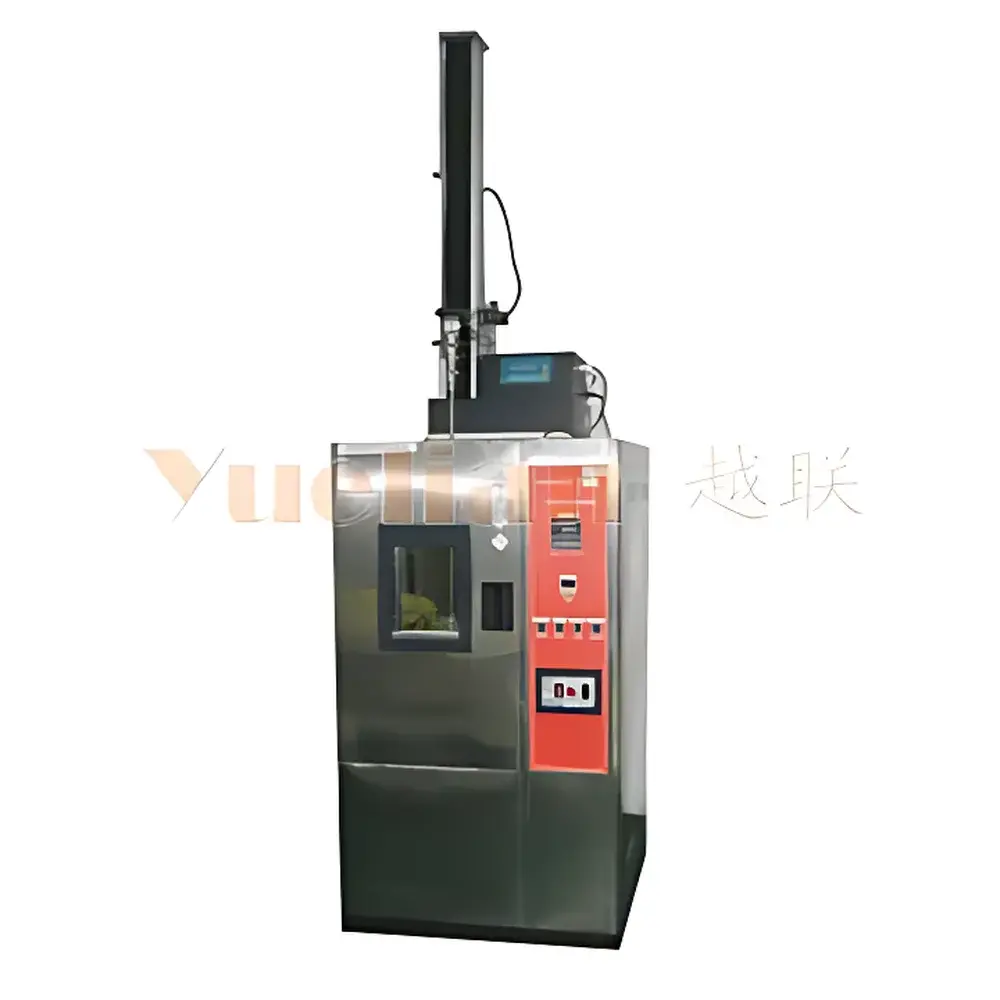
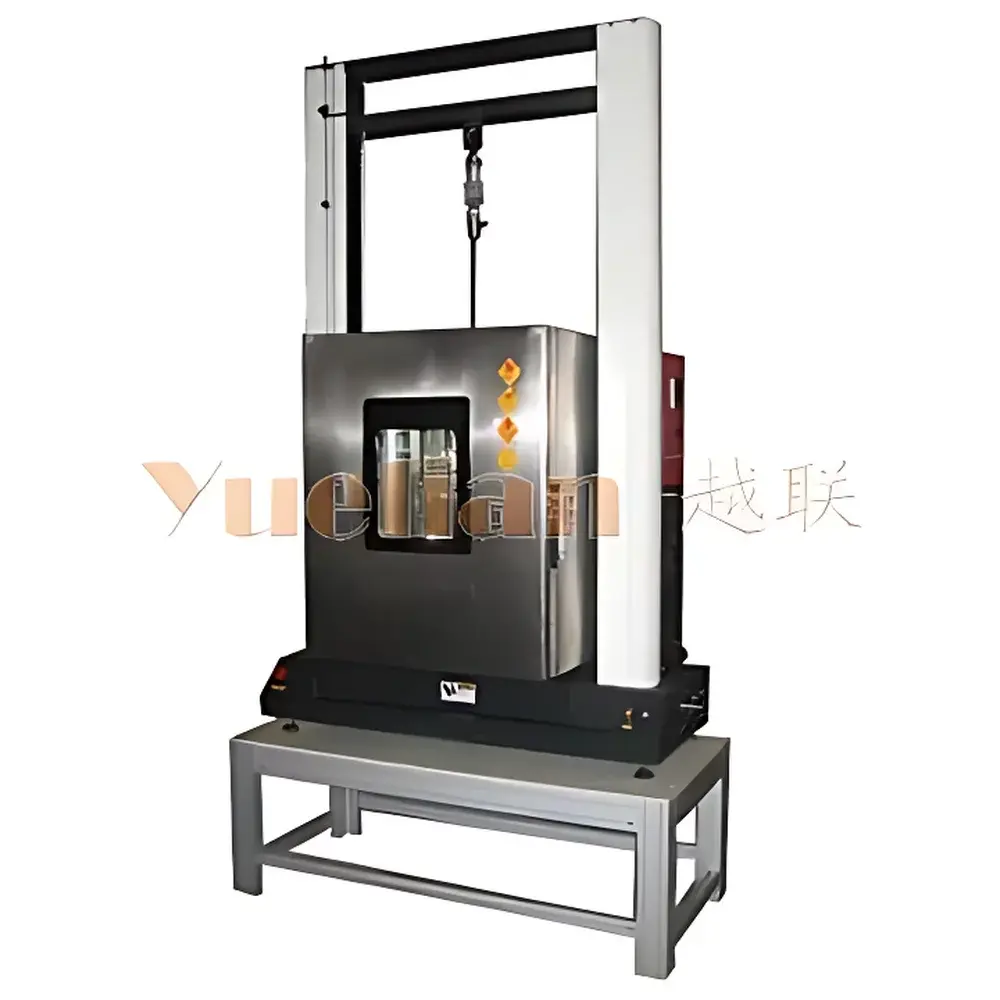
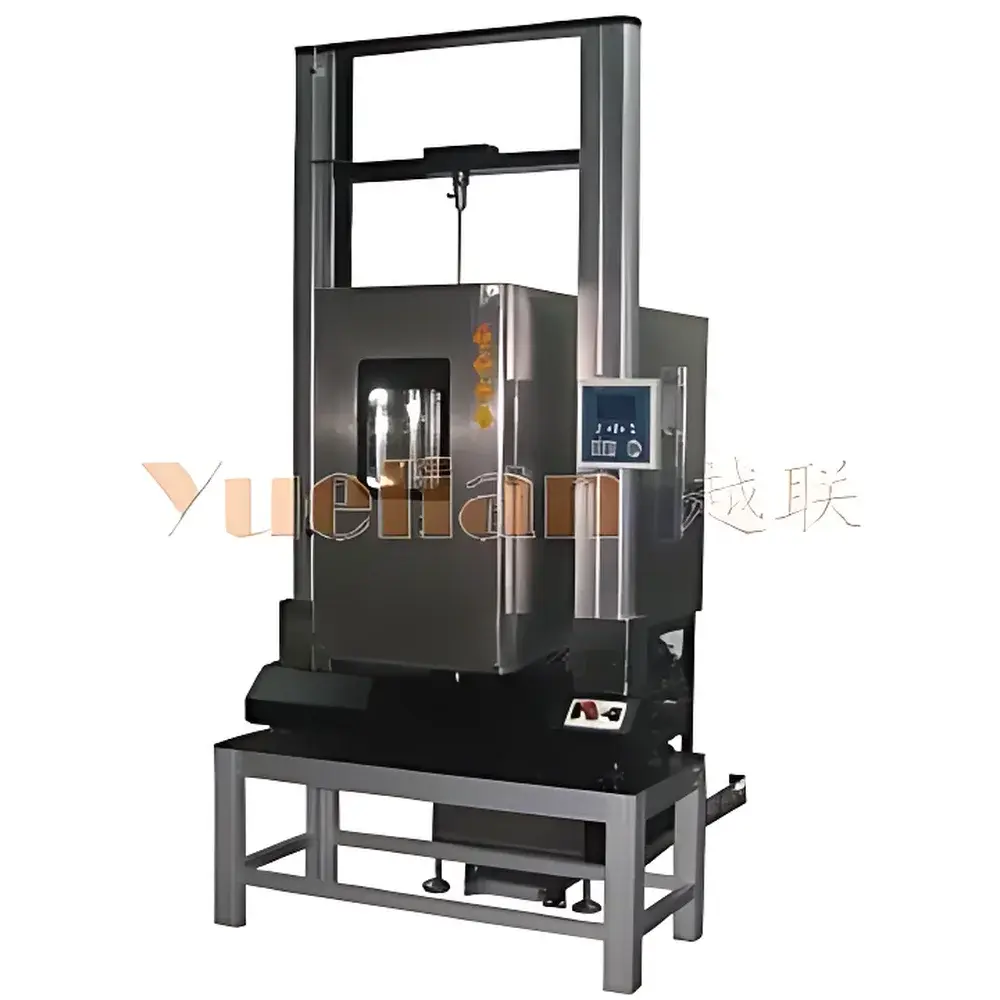
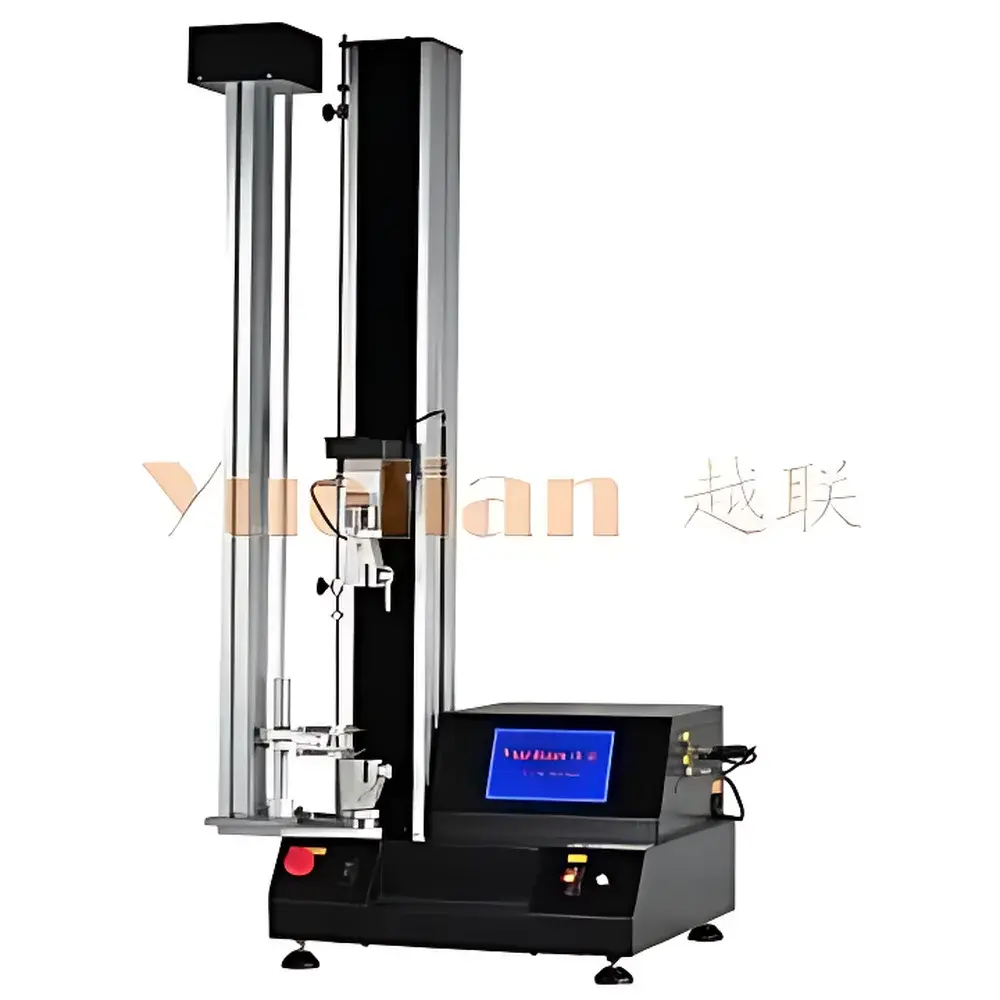
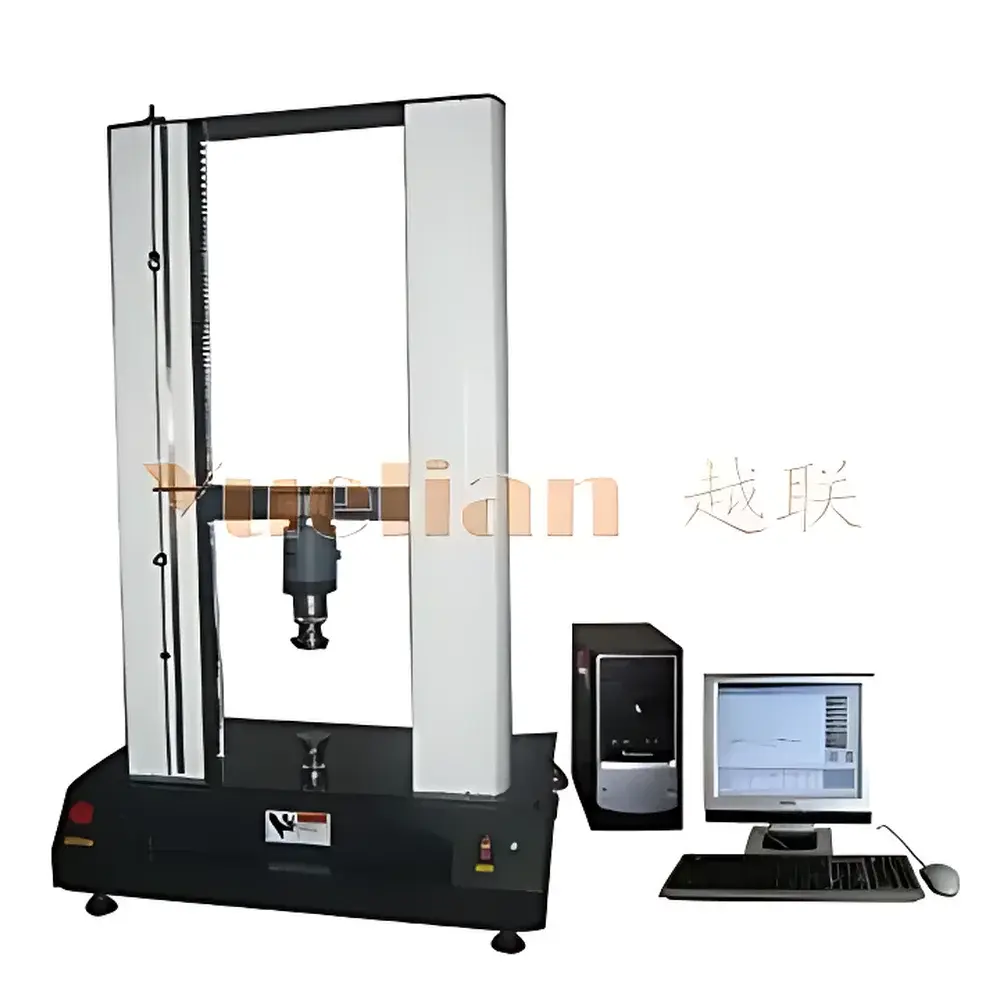
Yuelian YL-1161 High-Low Temperature Universal Testing Machine
| Brand | Yuelian |
|---|---|
| Origin | Guangdong, China |
| Model | YL-1161 |
| Instrument Type | Electronic Universal Testing Machine |
| Temperature Range | −70 °C to +150 °C |
| Force Capacity Options | 10 N to 2 kN (dual-range configurable) |
| Force Resolution | 1/250,000 full scale |
| Force Accuracy | ≤ ±0.5% of reading |
| Travel Resolution | 0.005 mm |
| Test Speed | 0.5–500 mm/min (PC-controlled) |
| Crosshead Travel | 650 mm |
| Test Chamber Internal Dimensions | 400 × 400 × 800 mm (W×D×H) |
| Chamber Material | SUS304 stainless steel |
| Heating System | SUS304 finned electric heater |
| Cooling System | High-efficiency compressor with eco-friendly refrigerant |
| Temperature Control | PID auto-tuning, stability deviation < ±1 °C, display resolution 0.1 °C |
| Circulation | Forced-air fan system |
| Power Supply | 220 V, 50/60 Hz, 30 A |
| Rated Power | 400 W |
| Net Weight | ~420 kg |
| Standard Accessories | One set of fixtures, extension rods, cooling module, USB interface cable, proprietary test software |
Overview
The Yuelian YL-1161 High-Low Temperature Universal Testing Machine is an integrated electromechanical testing platform engineered for precise mechanical property evaluation under controlled thermal conditions. It combines a high-resolution electronic universal testing frame with a fully enclosed, independently operated environmental chamber—enabling standardized tensile, compression, flexural, shear, tear, peel, and unwind force measurements across temperatures ranging from −70 °C to +150 °C. Unlike ambient-only testers, the YL-1161 supports ASTM D882 (tensile properties of thin plastic sheeting), ISO 1133 (melt flow rate correlation), ASTM D903 (peel resistance), ISO 8510-2 (adhesive peel strength), and ISO 6892-1 (metallic materials tensile testing at elevated or sub-ambient temperatures). The system operates on a servo-motor-driven, precision ball-screw transmission architecture, delivering repeatable displacement control and high-fidelity load acquisition—critical for material qualification in R&D, quality assurance, and regulatory submission workflows.
Key Features
- Modular thermal chamber design: Removable chamber enables rapid reconfiguration for ambient-only testing, optimizing lab floor space and workflow flexibility.
- Dual-range force sensor configuration: Supports selectable capacities (10 N–2 kN) with automatic range switching—ideal for multi-material labs handling both delicate films and rigid composites.
- High-stability temperature control: PID-regulated heating/cooling system achieves ±1 °C uniformity within the 400 × 400 × 800 mm working volume; forced-air circulation ensures thermal homogeneity per IEC 60068-3-5.
- Sub-micron motion fidelity: 0.005 mm travel resolution and closed-loop speed control (0.5–500 mm/min) enable compliant strain-rate protocols required by ISO 527-1 and ASTM D638.
- Comprehensive safety architecture: Integrated overcurrent, overload, compressor overheat, thermal runaway, and mechanical limit protection—designed to meet EN 61000-6-2 EMC and EN ISO 12100 functional safety requirements.
- Robust mechanical construction: SUS304 stainless steel chamber housing, hardened alloy crosshead guides, and preloaded ball screws ensure long-term dimensional stability and minimal hysteresis.
Sample Compatibility & Compliance
The YL-1161 accommodates specimens up to 140 mm wide and 650 mm active travel length—suitable for films, foils, laminates, elastomers, adhesives, biomedical tubing, and polymer composites. Fixture adaptability includes pneumatic, wedge-grip, peel arm, and custom mandrel options. All thermal and mechanical test sequences comply with GLP documentation standards, supporting audit-ready data traceability. The system’s force accuracy (≤ ±0.5%) and temperature uniformity meet minimum thresholds specified in ISO/IEC 17025 for accredited testing laboratories. While not FDA 21 CFR Part 11–certified out-of-the-box, its software architecture supports ALCOA+ principles (Attributable, Legible, Contemporaneous, Original, Accurate, Complete, Consistent, Enduring, Available) when deployed with validated IT infrastructure and procedural controls.
Software & Data Management
The embedded Windows-based test software provides real-time visualization of load–displacement, stress–strain, and peel-force–distance curves. It supports multi-channel acquisition (load, displacement, chamber temperature, optional extensometer), automated parameter calculation (peak load, yield point, modulus, average peel force, elongation at break), and export to CSV, PDF, or MS Access databases. Graphical curve overlay, interpolation, tangent modulus derivation, and statistical batch reporting are natively supported. Raw data files include embedded metadata (operator ID, timestamp, calibration certificate ID, environmental chamber log), ensuring full chain-of-custody integrity. The software permits user-defined test methods, pass/fail criteria, and report templates aligned with internal SOPs or external standards such as ASTM E4 or ISO 7500-1.
Applications
- Adhesion performance validation of pressure-sensitive tapes, labels, and medical transdermal patches across storage and application temperatures.
- Tensile behavior mapping of thermoplastic elastomers (TPEs) and shape-memory polymers through glass transition regions.
- Peel strength assessment of laminated packaging structures (e.g., PET/Alu/PE) under accelerated aging conditions.
- Mechanical reliability screening of battery electrode coatings, flexible printed circuits (FPCs), and microfluidic device substrates.
- Quality conformance testing of automotive interior trim materials per GMW14872 or Ford CETP 00.00-L-467.
- Research-grade characterization of biodegradable films (PLA, PHA) under simulated composting or refrigerated distribution environments.
FAQ
Can the environmental chamber be used independently of the testing frame?
Yes—the chamber is mechanically decoupled and features independent power, control, and safety interlocks, allowing standalone use for thermal cycling or conditioning per ISO 188 or ASTM D3045.
Does the system support extensometer integration?
Yes—via standard analog voltage input (±10 V) and digital trigger lines; compatible with contact and non-contact extensometers meeting ISO 9513 Class 1 or better.
Is calibration traceable to national standards?
Force calibration is performed using NIST-traceable deadweight standards; temperature calibration uses PT100 sensors verified against certified reference thermometers per ISO/IEC 17025.
What operating system versions are supported?
Windows 10 (64-bit) and Windows 11 (64-bit); legacy support for Windows 7 SP1 ends Q4 2025 per vendor lifecycle policy.
Can test methods be password-protected or version-controlled?
Yes—user roles (Operator, Technician, Administrator) govern method editing, execution, and deletion; all method changes are logged with timestamps and operator IDs.



