
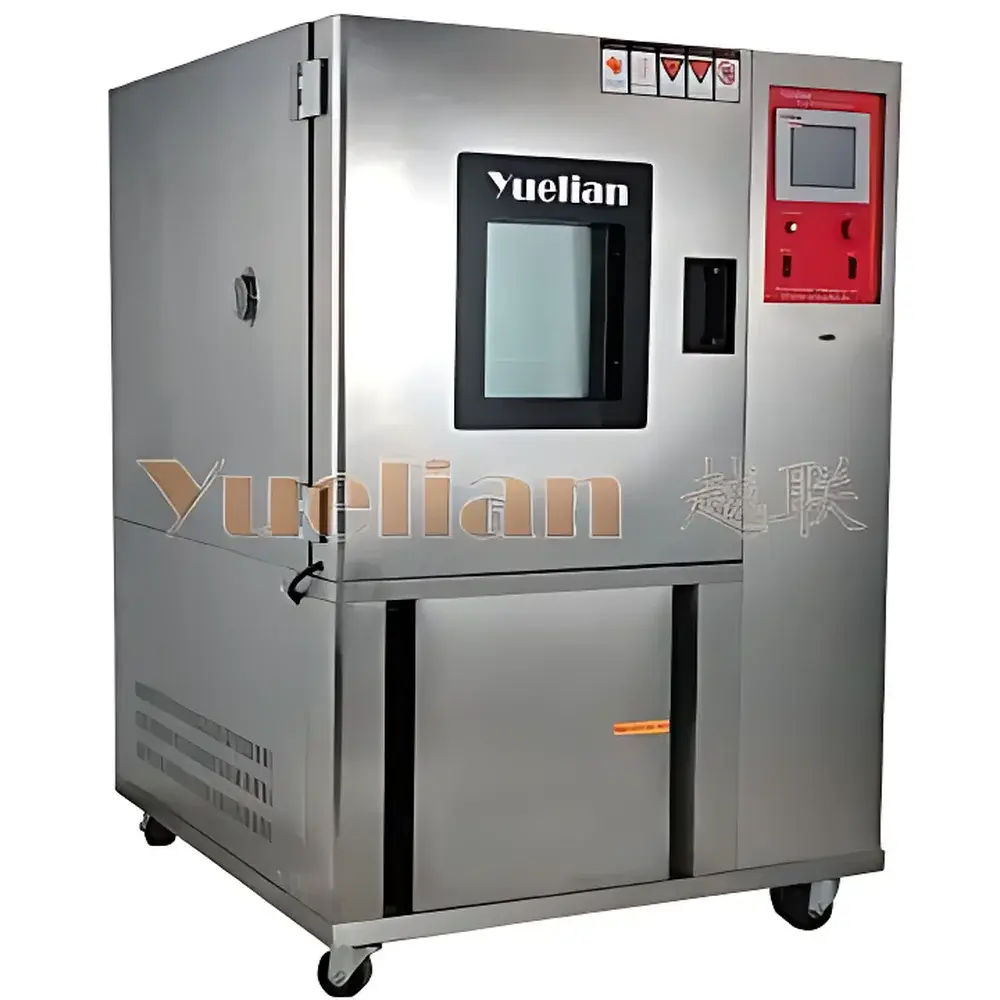
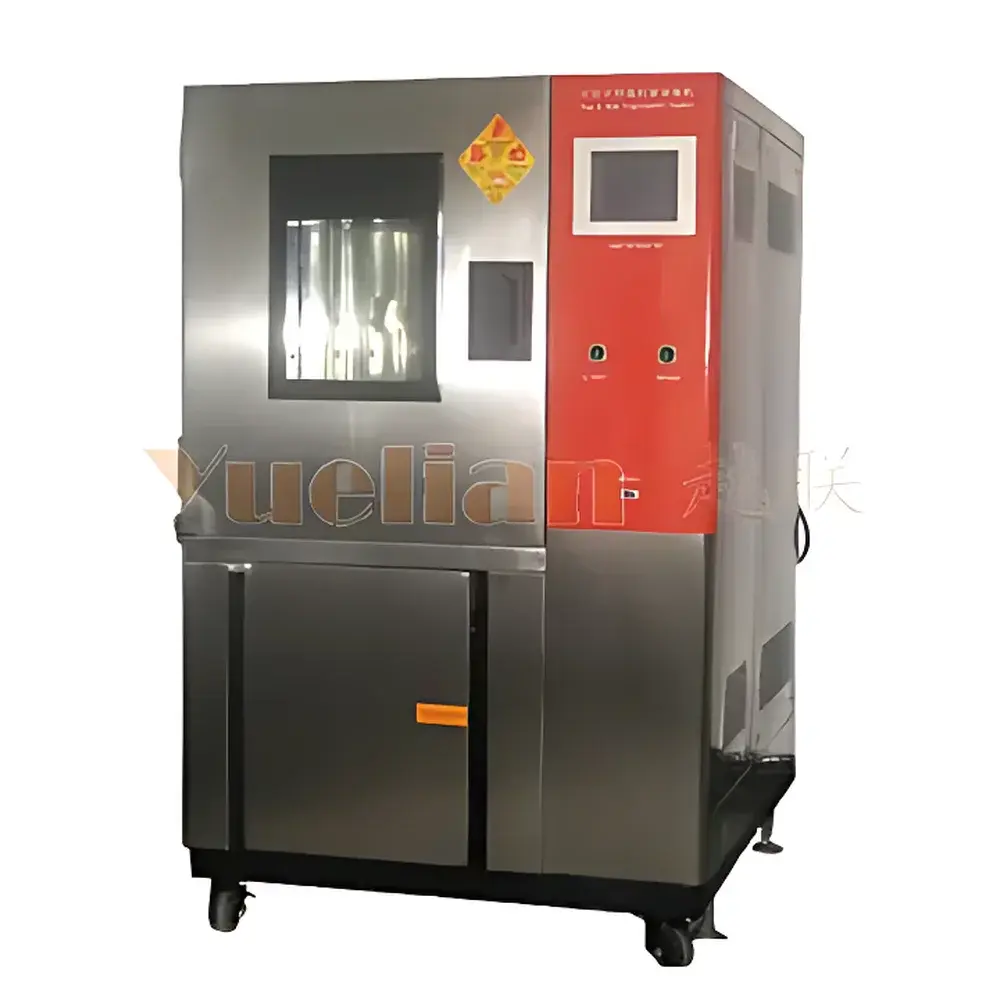
Yuelian YL-2236A High-Low Temperature Alternating Humidity Test Chamber
| Brand | Yuelian |
|---|---|
| Origin | Guangdong, China |
| Model | YL-2236A-0 |
| Internal Dimensions (W×H×D) | 40×50×40 cm |
| Volume | 80 L |
| Temperature Range | −70 °C to +150 °C |
| Humidity Range | 20–98 %RH (optional low-humidity configuration down to 5 %RH) |
| Temperature Uniformity | ±0.5 °C |
| Humidity Uniformity | ±3 %RH |
| Temperature Stability | ±0.3 °C |
| Humidity Stability | ±2.5 %RH |
| Heating Rate | −70 °C → +100 °C in approx. 60 min |
| Cooling Rate | +20 °C → −70 °C in approx. 90 min |
| Refrigerant | R404A / R507 |
| Compressor | Tecumseh (France) |
| Control System | PID + SSR/SCR bidirectional synchronous output with slope logic |
| Programming Capacity | 120 programs × 1200 segments, 999 cycles, multi-PID tuning |
| Interface | RS-232 |
| Construction | Full SUS#304 stainless steel interior & exterior |
| Insulation | Rockwool + rigid polyurethane foam |
| Safety Protections | 15-point real-time monitoring (over-temperature, over-pressure, dry-run, phase failure, compressor overload, etc.) |
| Compliance | GB/T 10586, ISO 16750-4, ASTM D4332, IEC 60068-2-1, IEC 60068-2-2, IEC 60068-2-30, UL 1598, EN 60068-2-78 |
Overview
The Yuelian YL-2236A High-Low Temperature Alternating Humidity Test Chamber is an engineered environmental simulation system designed for precise, repeatable evaluation of material and component performance under dynamically varying thermal and hygrothermal stress conditions. Operating on the principle of balanced temperature and humidity control—where independent heating, refrigeration, humidification, and dehumidification subsystems operate in coordinated equilibrium—the chamber enables programmable cycling between extreme cold (−70 °C), elevated heat (+150 °C), and controlled relative humidity (20–98 %RH). Its dual-refrigeration architecture (unary air-cooled above −20 °C; binary air-cooled below −40 °C), coupled with Tecumseh compressors and environmentally compliant R404A/R507 refrigerants, ensures stable thermodynamic response across wide operating envelopes. This architecture supports rigorous compliance testing per international standards including IEC 60068-2 series, ISO 16750-4 (road vehicles), ASTM D4332 (conditioning of plastics), and GB/T 10586 (Chinese national standard for environmental test chambers).
Key Features
- High-Fidelity Environmental Simulation: Achieves ±0.3 °C temperature stability and ±2.5 %RH humidity stability via platinum resistance temperature sensors (PT100) and capacitive RH transducers, calibrated traceably to NIST-traceable references.
- Advanced Programmable Logic Controller: Equipped with a bilingual (English/Chinese) LCD touchscreen interface supporting up to 120 multi-segment programs, each configurable with ramp rates, dwell times, and conditional transitions—enabling complex profiles such as thermal shock with concurrent humidity modulation.
- Dual-Mode Refrigeration Architecture: Optimized for both energy efficiency and transient response: single-stage cooling for milder sub-zero operation (≥ −20 °C); cascaded two-stage cooling for deep-cold capability (down to −70 °C), minimizing oil carryover and enhancing long-term compressor reliability.
- Integrated Pure-Water Generation: Onboard reverse-osmosis–based water purification eliminates dependence on external distilled water sources; automatically supplies the surface-evaporation humidifier while incorporating dry-run and overheat cutouts for fail-safe operation.
- Full-Stainless Steel Construction: Interior and exterior fabricated from SUS#304 stainless steel with 80 mm thick composite insulation (rockwool + rigid PU foam), ensuring structural integrity, corrosion resistance, and thermal inertia suitable for GLP/GMP-aligned validation protocols.
- Comprehensive Safety Monitoring: Real-time diagnostics across 15 critical parameters—including refrigerant high-pressure, chamber over-temperature, humidifier dry-out, power phase loss, and door interlock status—with timestamped fault logging and actionable remediation guidance displayed on-screen.
Sample Compatibility & Compliance
The YL-2236A accommodates diverse sample geometries through its 80 L working volume (40×50×40 cm internal dimensions) and standardized 50 mm test port. Removable, height-adjustable stainless steel shelves facilitate flexible load configuration for PCB assemblies, automotive ECUs, polymer films, pharmaceutical packaging, and sealed electronic enclosures. The chamber’s performance validation adheres to ISO/IEC 17025-accredited methodology, with temperature and humidity uniformity verified per IEC 60068-3-5 using 9-point sensor mapping. It satisfies functional safety requirements of UL 1598 (luminaires), EN 60068-2-78 (damp heat, cyclic), and ASTM B117 (corrosion pre-conditioning). Optional IQ/OQ documentation packages support FDA 21 CFR Part 11–compliant validation for regulated industries.
Software & Data Management
Native RS-232 serial communication enables direct integration with laboratory information management systems (LIMS) or SCADA platforms. Optional Windows-based PC software provides remote monitoring, real-time graphing of up to four simultaneous channels (T₁, T₂, RH, alarm status), automated report generation (PDF/CSV), and audit-trail-enabled user access control. All data logs—including setpoints, actual values, alarm events, and system diagnostics—are time-stamped with UTC synchronization and stored with cryptographic integrity checks. The controller firmware supports firmware updates via USB and retains full program memory during power interruption, meeting GLP data integrity requirements for long-duration qualification runs.
Applications
- Accelerated aging of lithium-ion battery modules under combined thermal cycling and humidity exposure per UN 38.3 Section 4.4.
- Qualification of automotive infotainment displays per ISO 16750-4 (temperature/humidity cycling with vibration overlay).
- Stability testing of sterile medical device packaging (ISO 11607-1) under accelerated moisture ingress conditions.
- Evaluation of adhesive bond strength degradation in structural composites exposed to damp-heat cycling (ASTM D2247).
- Pre-conditioning of optical coatings and MEMS sensors prior to laser-induced damage threshold (LIDT) assessment.
- Environmental stress screening (ESS) of avionics components per MIL-STD-810H Method 502.7 (low temperature) and Method 507.6 (humidity).
FAQ
What standards does the YL-2236A comply with for validation and routine operation?
The chamber meets core performance verification requirements of IEC 60068-3-5 (environmental test methods—guidance), GB/T 10586 (Chinese national standard), and supports validation against ISO/IEC 17025 for accredited labs. Calibration certificates are issued with NIST-traceable instrumentation.
Can the chamber achieve sub-10% RH for desiccation testing?
Yes—upon request, a low-humidity option with enhanced dehumidification capacity (e.g., desiccant wheel integration or extended freezing coil surface area) can be configured to reliably sustain 5 %RH at +25 °C.
Is remote monitoring and alarm notification supported?
Standard RS-232 enables local PC connection; optional Ethernet module adds TCP/IP support, SMTP email alerts, and SNMP trap integration for enterprise-level facility monitoring systems.
How is temperature and humidity uniformity validated inside the workspace?
Uniformity is confirmed using a 3×3×1 spatial grid of calibrated PT100 and capacitive RH probes during SAT (System Accuracy Tests), per IEC 60068-3-5 Annex A, with results documented in the Factory Acceptance Test (FAT) report.
What maintenance intervals are recommended for long-term reliability?
Compressor oil analysis every 2,000 operational hours; refrigerant leak check annually; humidifier tank cleaning weekly; full calibration verification every 12 months or after major component replacement.
Related Products



