
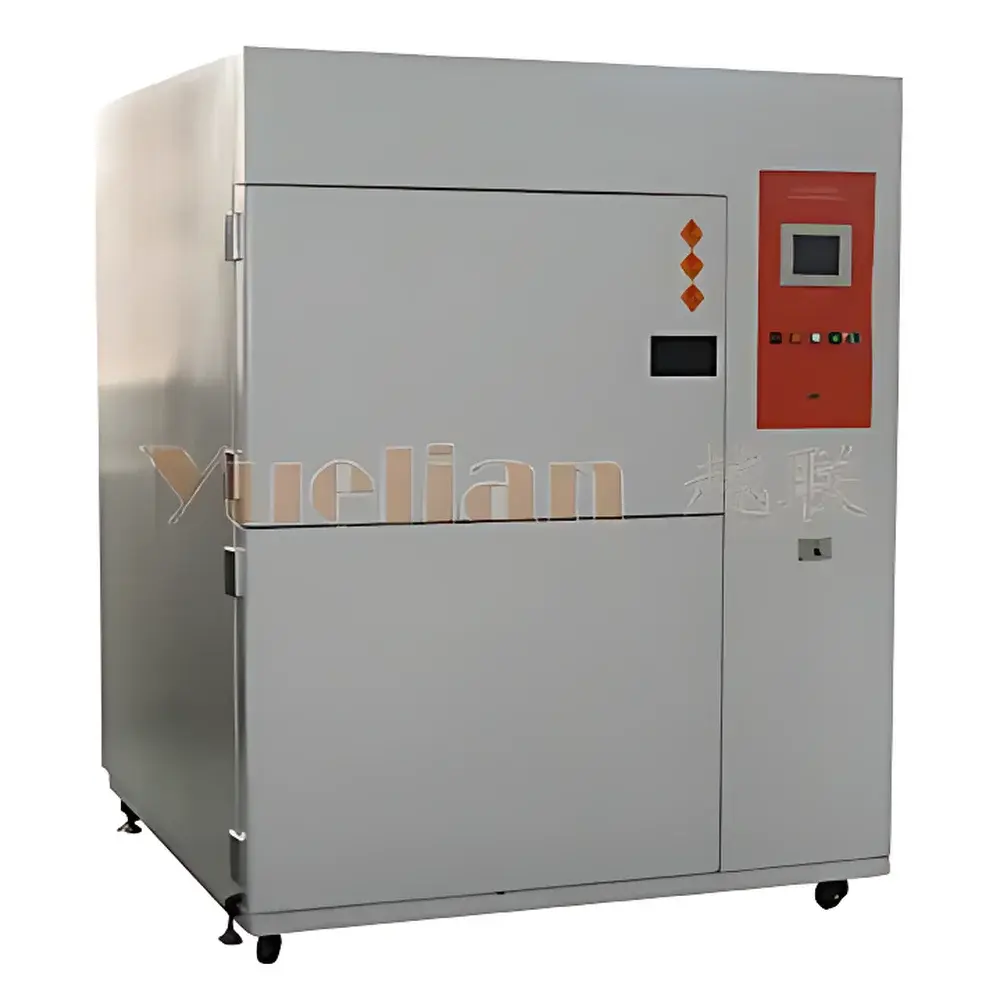
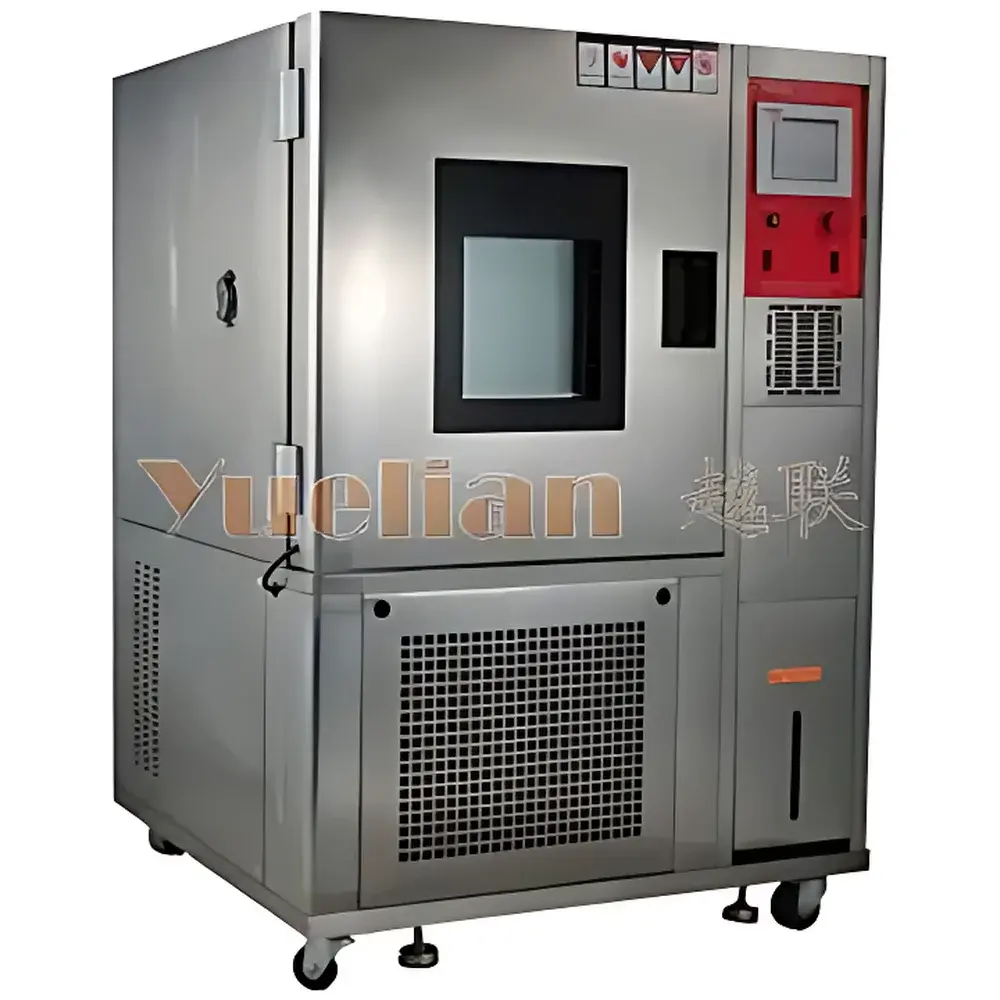
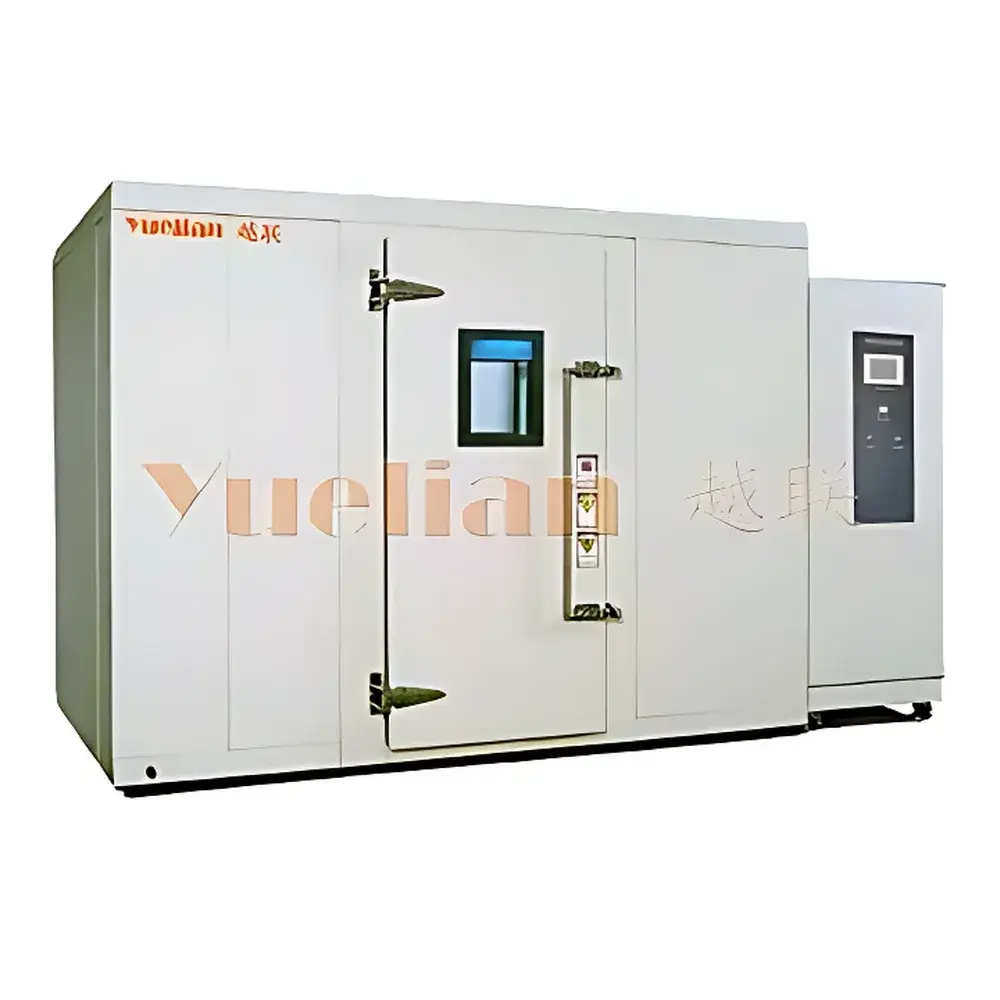
Yuelian YL-2280 Series Three-Zone Thermal Shock Chamber
| Brand | Yuelian |
|---|---|
| Origin | Guangdong, China |
| Model | YL-2280A / YL-2280B / YL-2280C / YL-2280D |
| Interior Dimensions (W×D×H, cm) | 40×30×35 |
| Exterior Dimensions (W×D×H, cm) | 162×200×142 |
| Temperature Range | High Temp. Zone: +60 °C to +150 °C |
| Low Temp. Zone | −10 °C to −65 °C (A: −45 °C, B: −55 °C, C/D: −65 °C) |
| High Temp. Ramp | RT to +200 °C in ≈30 min |
| Low Temp. Ramp | RT to −70 °C in ≈90 min |
| Temperature Recovery Time | ≤5 min |
| Temperature Uniformity | ±2.0 °C |
| Stability | ±0.2 °C |
| Insulation | High-density amino acid ethyl ester foam |
| Control System | PID + SSR + microcomputer-balanced thermostat (OYO-8226 controller, 320×240 LCD, bilingual interface) |
| Refrigeration | Semi-hermetic two-stage cascade system, water-cooled |
| Power Supply | 3Φ 220VAC±10% 50/60Hz or 3Φ 380/415VAC±10% 50Hz |
| Weight | 1000 kg / 1550 kg / 1680 kg / 1900 kg |
Overview
The Yuelian YL-2280 Series Three-Zone Thermal Shock Chamber is an engineered environmental test system designed for accelerated reliability assessment of electronic components, aerospace materials, automotive assemblies, and advanced packaging under rapid, repetitive thermal transitions. It operates on the principle of gas-switched thermal shock, utilizing physically isolated high-temperature, low-temperature, and test chambers—each thermally insulated with high-density amino acid ethyl ester foam—to eliminate thermal mass interference and ensure precise, repeatable exposure profiles. Unlike single-chamber cycling systems, the three-zone architecture enables true step-change thermal transitions without mechanical movement of the test specimen, minimizing vibration-induced artifacts and preserving test integrity. The system conforms to core thermal shock test methodologies defined in IEC 60068-2-14, MIL-STD-810H Method 503.6, JESD22-A104, and AEC-Q200, supporting both two-zone (dual-chamber) and three-zone operational modes to accommodate diverse qualification protocols—including lead-free solder joint evaluation (e.g., tin whisker growth per IPC-9701), conformal coating adhesion validation, and die-attach delamination screening.
Key Features
- Triple-chamber configuration (preheat, precool, and test zones) with independent temperature control and zero-specimen motion during transition—ensuring mechanical stability and measurement fidelity.
- High-fidelity thermal recovery: ≤5 minutes to achieve target temperature stabilization within ±0.2 °C tolerance across the test zone, verified per ASTM E742 calibration guidelines.
- Cascade refrigeration system using semi-hermetic two-stage compressors and environmentally compliant refrigerants (R404A/R23 blend), water-cooled for consistent low-temperature performance down to −65 °C.
- OYO-8226 microprocessor-based controller with 320×240-pixel bilingual LCD interface, supporting up to 120 programmable test profiles, 9999 cycles per profile, and time segments configurable to 1-minute resolution.
- Real-time data logging via RS-232 serial interface; compatible with third-party SCADA platforms and GLP/GMP-compliant audit trail software (e.g., LabVIEW, WinCC, or custom FDA 21 CFR Part 11–validated applications).
- Integrated safety architecture including high/low pressure cutouts, refrigerant leak detection, overtemperature shutdown, and emergency power-fail response with automatic thermal ramp hold.
- Test chamber constructed entirely from SUS#304 stainless steel; internal airflow managed via motorized damper valves with ≤10-second switching latency between thermal zones.
Sample Compatibility & Compliance
The YL-2280 accommodates static mounting of PCBs, IC packages, sensors, battery modules, optical housings, and molded plastic enclosures—up to 10 kg simulated load (model-dependent). Its fixed-position test methodology satisfies requirements for non-vibratory thermal stress validation under ISO 16750-4 (road vehicles), JEDEC J-STD-020 (moisture sensitivity level reflow simulation), and NASA-STD-8739.5 (electronics solder joint reliability). Humidity control is not integrated; however, the system maintains ambient-relative humidity compliance (<60% RH at 25 °C) during non-shock phases per IEC 60068-1 environmental conditioning prerequisites. All models are CE-marked and comply with EN 61000-6-2 (immunity) and EN 61000-6-4 (emission) standards.
Software & Data Management
The embedded OYO-8226 controller supports full-cycle traceability through timestamped event logging—including setpoint changes, alarm triggers, compressor status, and door-open interventions. Optional PC-based software enables remote program creation, live parameter monitoring, CSV export of temperature vs. time datasets, and automated report generation aligned with ISO/IEC 17025 documentation frameworks. When deployed in regulated environments, the system can be configured with user-level access controls, electronic signatures, and 21 CFR Part 11–compliant audit trails—supporting GxP-aligned validation protocols (IQ/OQ/PQ) and long-term data retention policies.
Applications
- Accelerated life testing of solder interconnects subjected to Pb-free reflow thermal profiles.
- Evaluation of coefficient-of-thermal-expansion (CTE) mismatch-induced cracking in multilayer ceramic capacitors (MLCCs) and BGAs.
- Validation of hermetic seal integrity in MEMS devices and optoelectronic housings.
- Qualification of adhesive bondlines in composite airframe structures per Airbus ABD0100 or Boeing D6-17487.
- Thermal fatigue screening of power electronics modules operating in hybrid/electric vehicle inverters.
- Reliability verification of medical device PCBs exposed to sterilization–cooling cycles (e.g., EtO or gamma processing).
FAQ
What is the difference between two-zone and three-zone thermal shock operation?
In two-zone mode, specimens shuttle mechanically between hot and cold chambers; in three-zone mode, specimens remain stationary while conditioned air is routed via damper-controlled ducts—reducing mechanical stress and improving repeatability.
Does the YL-2280 support liquid nitrogen (LN₂) assist for ultra-fast cooling?
Yes—optional LN₂ injection nozzles can be integrated into the low-temperature zone for sub-−70 °C capability and reduced thermal transition times, subject to site-specific utility infrastructure review.
Can this chamber perform steady-state high-temperature or low-temperature soak tests independently?
Yes—the system functions as a dual-purpose environmental chamber: it supports standalone high-temp (+60 °C to +150 °C) or low-temp (−10 °C to −65 °C) conditioning without initiating shock sequences.
Is calibration certification included with shipment?
NIST-traceable factory calibration certificates for all PT100 sensors and controller outputs are provided; on-site IQ/OQ validation support is available upon request.
What maintenance intervals are recommended for the cascade refrigeration system?
Compressor oil analysis and refrigerant purity checks every 12 months; condenser coil cleaning and damper actuator lubrication every 6 months—documented in the included maintenance logbook.



