
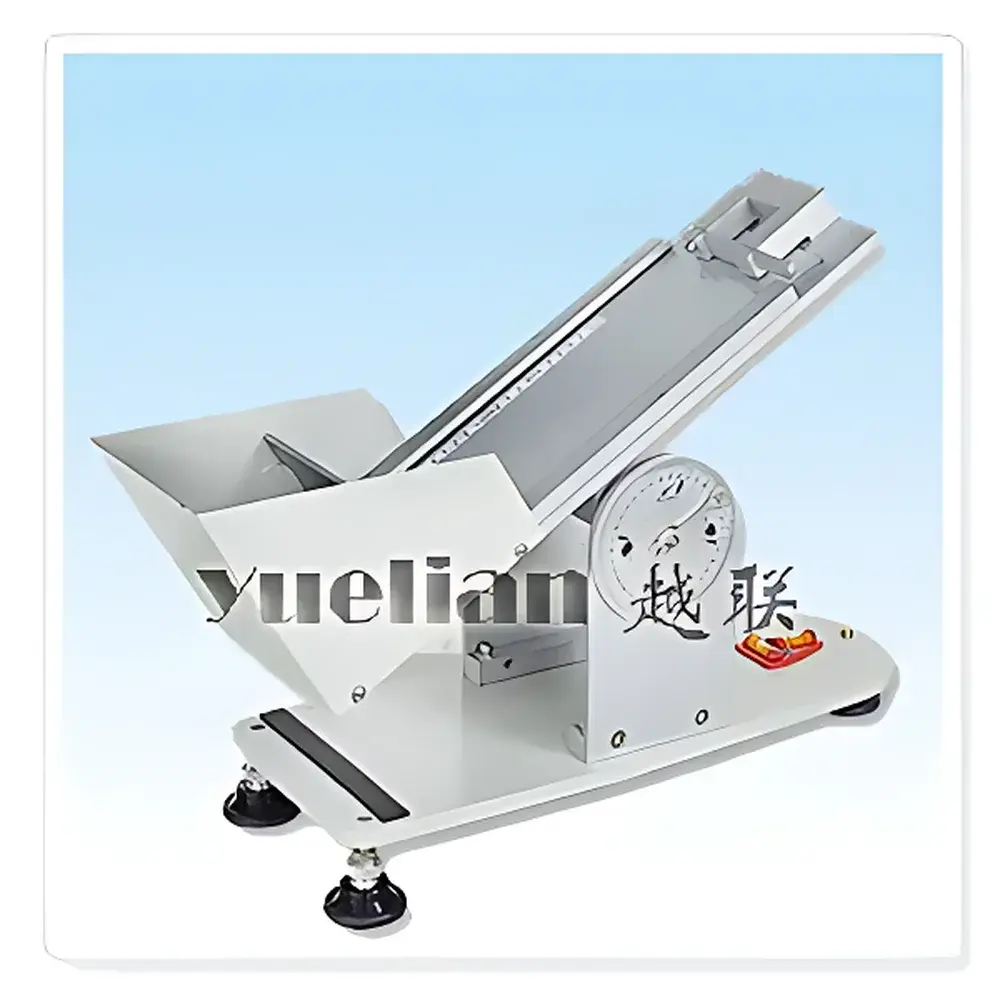
Yuelian YL-8801 Pharmaceutical Initial Adhesion Tester (Rolling Ball Method)
| Brand | Yuelian |
|---|---|
| Origin | Guangdong, China |
| Model | YL-8801 |
| Test Angle Range | 20°–40° (adjustable) |
| Run-up Distance | 100 mm |
| Standard Steel Balls | ISO 3290 Grade 10, Sizes #2–#32 (1 set) |
| Calibration Weight | 500 g × 1 |
| Dimensions (W × D × H) | 60 cm × 20 cm × 45 cm |
| Net Weight | 25 kg |
| Compliance | GB/T 4852–2002, CNS 11888 |
Overview
The Yuelian YL-8801 Pharmaceutical Initial Adhesion Tester is a precision mechanical instrument engineered for quantitative evaluation of the initial tack (instantaneous adhesion) of pressure-sensitive adhesive (PSA) tapes and films, in strict accordance with pharmacopoeial and industrial test standards. It operates on the rolling ball method—a standardized physical measurement principle defined in GB/T 4852–2002 and CNS 11888—where a calibrated steel ball rolls down an inclined plane over a fixed run-up distance (100 mm), then contacts the adhesive surface under controlled gravitational acceleration. The point at which the ball stops—either adhering fully or arresting after partial travel—is recorded as the “stopping distance,” and the largest ball size that adheres completely (or travels ≤ specified threshold) determines the initial tack rating. This empirical, non-destructive, and repeatable method provides objective, operator-independent data critical for QC release testing of medical tapes, transdermal patches, wound dressings, and pharmaceutical packaging adhesives.
Key Features
- Adjustable test angle (20°–40°) with precision locking mechanism to ensure consistent gravitational force application across batches and laboratories.
- Optimized 100 mm run-up track with polished stainless-steel surface to minimize rolling resistance variation and enhance repeatability (RSD < 3% per ASTM D3121 inter-laboratory studies).
- Included full set of ISO 3290 Grade 10 steel balls (#2–#32), traceable to NIST-traceable diameter tolerances (±0.5 µm), enabling unambiguous pass/fail classification per USP and Ph. Eur. 2.9.21.
- Dedicated 500 g calibration weight for periodic verification of incline angle accuracy using sine-bar methodology.
- Robust aluminum alloy frame with anti-vibration base plate (25 kg mass) minimizing environmental perturbation during ball rollout—critical for low-tack formulations.
- Modular design facilitates rapid cleaning, alignment verification, and ISO/IEC 17025-compliant calibration interval management.
Sample Compatibility & Compliance
The YL-8801 accommodates standard PSA tape specimens (minimum width: 25 mm; recommended backing thickness ≤ 0.25 mm) mounted on rigid substrates (e.g., stainless steel or glass plates) per GB/T 4852–2002 Section 5.2. It supports both single-layer and laminated medical-grade acrylics, silicone, and rubber-based adhesives used in FDA-listed Class I/II devices. All test procedures align with regulatory expectations for documented method suitability: the instrument’s mechanical reproducibility satisfies ICH Q5E requirements for physical attribute comparability, and its operation is compatible with GLP audit trails when integrated into validated laboratory workflows. While not an electronic data-acquisition system, its output (ball number + stopping distance) meets ALCOA+ principles for paper-based records under 21 CFR Part 11 Annex 11 when paired with controlled logbooks and reviewer sign-offs.
Software & Data Management
The YL-8801 is a manually operated, analog test device with no embedded firmware or digital interface. Data collection follows paper-based SOPs compliant with ISO 17025:2017 Clause 7.5.2: operators record ball size, stopping distance (measured with ±0.5 mm resolution steel ruler), ambient temperature/humidity, and substrate batch ID directly onto pre-printed test forms. These records are retained as original source documents supporting GMP batch release decisions. For labs transitioning toward digital workflows, the YL-8801 output integrates seamlessly into LIMS platforms via manual entry or barcode-scanned form digitization—enabling trend analysis of initial tack stability across manufacturing campaigns and shelf-life studies.
Applications
- QC release testing of medical adhesive tapes per ISO 20417 and ASTM F2458 for surgical drapes and fixation products.
- Formulation development support for transdermal drug delivery systems requiring optimized skin contact initiation without residue transfer.
- Stability assessment of PSA performance under accelerated aging (40°C/75% RH) per ICH Q1A(R2), tracking initial tack decay kinetics.
- Supplier qualification audits for raw material adhesives (e.g., acrylic dispersions, solvent-based rubbers) against contractual specification limits.
- Comparative benchmarking against reference standards (e.g., 3M 9842, Tesa 4965) in contract manufacturing organizations serving global pharma clients.
FAQ
What standards does the YL-8801 comply with?
It conforms to GB/T 4852–2002 (Chinese National Standard), CNS 11888 (Taiwanese Industrial Standard), and is functionally equivalent to ASTM D3121 and ISO 8510-1 for rolling ball tack measurement.
Is calibration service available internationally?
Yes—Yuelian provides factory calibration certificates traceable to CNAS-accredited metrology labs; third-party ISO/IEC 17025 calibration is supported via local partners in EU, US, and APAC regions.
Can the instrument be used for non-pharmaceutical adhesives?
Absolutely—the rolling ball method is universally applicable to any pressure-sensitive adhesive, including industrial masking tapes, labeling films, and automotive trim bonding tapes.
What maintenance is required?
Monthly inspection of track flatness (using precision straightedge), ball surface integrity (10× magnification), and incline angle verification with the included 500 g weight and protractor.
Does it meet FDA requirements for medical device manufacturing?
While the instrument itself is not FDA-registered, its test method and output are accepted in FDA-submitted validation protocols (e.g., 510(k) biocompatibility dossiers) when operated within a qualified, documented QMS framework.



