
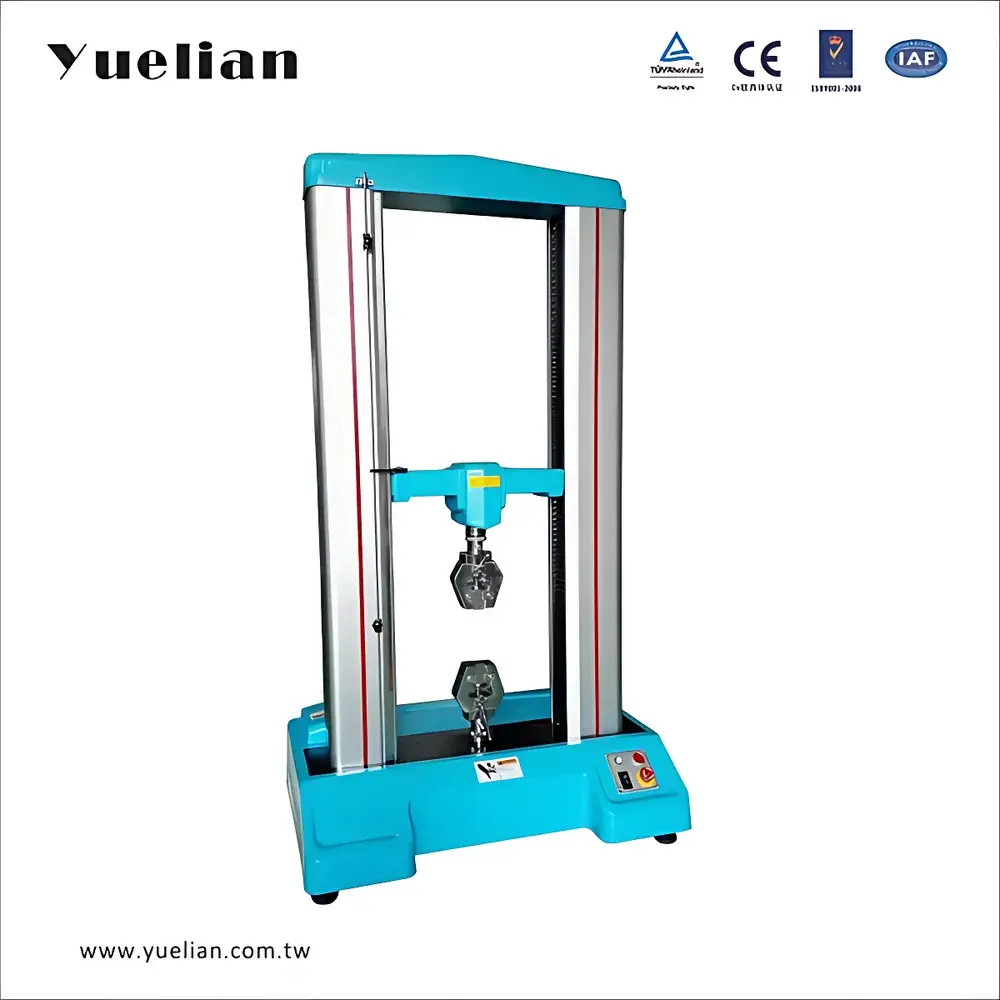
Yuelian YL-D23 Dual-Column Universal Tensile Testing Machine
| Brand | Yuelian |
|---|---|
| Origin | Guangdong, China |
| Manufacturer Type | Authorized Distributor |
| Country of Origin | China |
| Model | YL-D23 |
| Quotation | Upon Request |
| Capacity Options | 10N–20kN (dual-range configurable) |
| Display | PC-based GUI |
| Force Resolution | 1/500,000 full scale |
| Force Accuracy | ±0.3% of reading |
| Stroke Resolution | 1/500,000 |
| Test Speed Range | 0.01–500 mm/min (programmable) |
| Maximum Stroke | 800 mm |
| Test Width | 420 mm |
| Drive System | Servo motor + precision ball screw + timing belt |
| Power Supply | 220 V, 50/60 Hz, 10 A |
| Rated Power | 400 W |
| Dimensions (W×D×H) | 88 × 60 × 160 cm |
| Weight | ~115 kg |
| Compliance Standards | ISO 7500-1, ASTM E4, EN 10002-1, GB/T 228.1, GB/T 2792, ASTM D3330, JJG 475 |
Overview
The Yuelian YL-D23 Dual-Column Universal Tensile Testing Machine is an electromechanical materials testing system engineered for precision mechanical property evaluation across a broad spectrum of industrial and research applications. Based on the fundamental principles of uniaxial force–displacement transduction, the instrument applies controlled tensile, compressive, flexural, shear, peel, tear, and adhesion loads to specimens while continuously measuring load and displacement with high fidelity. Its dual-column rigid frame architecture ensures minimal deflection under load, supporting repeatable measurements up to 20 kN. Designed for laboratory environments in quality assurance, R&D, and incoming inspection workflows, the YL-D23 complies with internationally recognized static mechanical testing standards—including ISO 7500-1 (class 0.5), ASTM E4 (verification of force-measuring systems), EN 10002-1 (tensile testing of metallic materials), and GB/T 228.1 (Chinese national standard for metallic tensile testing). The system’s modular design allows seamless integration into GLP-compliant laboratories where traceability, audit readiness, and data integrity are mandatory.
Key Features
- Rigid dual-column steel frame with reinforced crosshead and precision-ground guide columns for minimal lateral deflection and long-term dimensional stability
- Servo motor-driven actuation system coupled with preloaded ball screws and synchronous timing belts—ensuring smooth, low-noise motion and high positional repeatability
- Force measurement via high-stability load cell with 1/500,000 internal resolution and verified accuracy of ±0.3% of reading per ISO 7500-1
- Fully programmable test speed range from 0.01 to 500 mm/min, enabling quasi-static, creep, and rate-dependent mechanical characterization
- Integrated safety logic including overload shutdown, emergency stop, specimen rupture detection, and user-defined upper/lower travel limits
- Automatic return-to-start and zero-reset functions for streamlined multi-specimen throughput
- Standard USB interface for direct connection to Windows-based host PCs; no proprietary hardware dongles or legacy serial adapters required
Sample Compatibility & Compliance
The YL-D23 accommodates diverse specimen geometries and material classes—including polymers (PET straps, PE films, PVC tubing), elastomers, textiles, paperboard, composites, thin metallic foils, and adhesive tapes—via interchangeable mechanical grips and fixtures. Its 420 mm test width and 800 mm stroke support both standard coupons (e.g., ASTM D638 Type I, ISO 527-2) and custom-shaped components used in packaging, automotive trim, and construction sealant validation. All calibration and verification procedures adhere to metrological traceability requirements defined in JJG 475 (Chinese national verification regulation for universal testing machines) and ISO/IEC 17025-accredited practices. The system supports compliance documentation packages aligned with FDA 21 CFR Part 11 (electronic records/signatures) when deployed with validated software configurations and audit-trail-enabled database logging.
Software & Data Management
The embedded PC-based control and analysis software provides full test sequence programming, real-time curve visualization (load vs. displacement, stress vs. strain), and automated parameter extraction—including ultimate tensile strength, yield point (0.2% offset), Young’s modulus, elongation at break, peel strength (ASTM D3330), and 180° peel adhesion (GB/T 2792). Data is stored natively in MS Access format with timestamped metadata, operator ID fields, and version-controlled test method templates. Export options include CSV, PDF reports with embedded graphs, and XML for LIMS integration. Multi-sensor capability allows simultaneous acquisition from extensometers, environmental chambers, or video extensometry modules—enabling advanced deformation analysis without third-party middleware.
Applications
- Mechanical validation of PET strapping used in logistics and palletizing—measuring tensile strength, elongation, and load retention under sustained tension
- Peel and shear adhesion testing of pressure-sensitive tapes and laminated packaging films per ASTM D3330 and GB/T 7124
- Compression testing of corrugated board and honeycomb structures per ISO 3037 and GB/T 6543
- Flexural modulus determination of thermoplastic sheets and composite panels using three-point bending per ISO 178
- Quality conformance checks for wire ropes, textile cords, and braided polymer filaments in automotive and aerospace supply chains
- Research-grade characterization of viscoelastic behavior through controlled-rate ramp-and-hold protocols
FAQ
Is the YL-D23 compliant with ISO/IEC 17025 calibration requirements?
Yes—when operated with certified reference load cells and traceable displacement calibrators, the system meets ISO/IEC 17025 clause 6.5 for equipment verification.
Can the software generate 21 CFR Part 11-compliant audit trails?
Audit trail functionality—including user login logs, test parameter change history, and electronic signature capture—is available upon configuration with validated database permissions and Windows Group Policy controls.
What is the maximum recommended specimen thickness for wedge-action grips?
Standard pneumatic or mechanical wedge grips accommodate specimens up to 25 mm thick; thicker sections require custom jaw inserts or vise-type fixtures.
Does the system support high-speed video extensometry integration?
Yes—the USB 2.0 interface and software SDK enable synchronization with third-party digital image correlation (DIC) systems for non-contact strain mapping.
Are calibration certificates included with shipment?
Factory calibration certificates (force and displacement) are provided; accredited third-party calibration is optional and scheduled separately per customer site requirements.



