
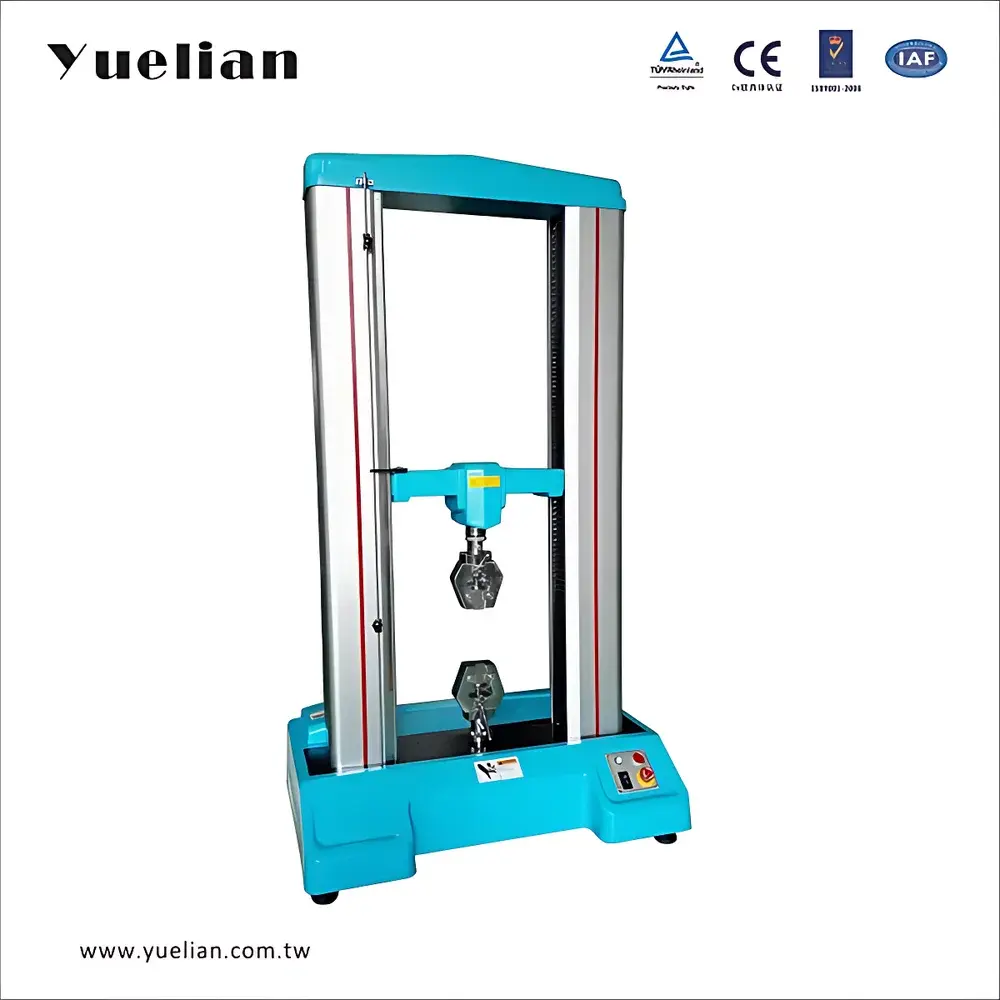
Yuelian YL-D23 Servo-Controlled Universal Compression and Tensile Testing Machine
| Brand | Yuelian |
|---|---|
| Origin | Guangdong, China |
| Model | YL-D23 |
| Max. Test Load | 20 kN |
| Load Frame Stroke | 800 mm |
| Test Width (Distance Between Columns) | 420 mm |
| Crosshead Speed Range | 0.01–500 mm/min |
| Force Resolution | 1/500,000 of full scale |
| Force Accuracy | ±0.3% of reading |
| Displacement Resolution | 1/500,000 of stroke |
| Control System | PC-based servo control with USB interface |
| Compliant Standards | ISO 7500-1, ASTM E4, EN 10002-1, GB/T 228.1, GB/T 2792, ASTM D3330, JJG 475 |
Overview
The Yuelian YL-D23 is a dual-column, servo-motor-driven universal testing machine engineered for high-reproducibility mechanical characterization of polymeric, elastomeric, metallic, composite, and fibrous materials under compression, tension, bending, shear, peel, tear, and adhesion loading conditions. It operates on the principle of closed-loop electro-mechanical force and displacement control, utilizing a precision preloaded ball screw transmission system coupled with synchronous belt drive and a high-resolution rotary encoder. The system delivers stable load application across its full 20 kN capacity range, with programmable crosshead velocity spanning three orders of magnitude (0.01–500 mm/min), enabling both quasi-static and moderate-rate mechanical testing in accordance with international standard test methods.
Key Features
- Servo-motor actuation with real-time PID feedback ensures precise control of load, displacement, and strain rate—critical for ISO 7500-1 Class 1 compliance and repeatable material property derivation.
- Robust dual-column frame with 420 mm test width and 800 mm vertical stroke accommodates large-format specimens, including rubber sheets, molded elastomer components, laminated composites, and packaged goods per ASTM D3330 and GB/T 2792.
- High-resolution measurement architecture: force resolution of 1 part in 500,000 full scale and displacement resolution at equivalent fidelity support accurate determination of yield point, modulus, elongation at break, and compressive strength.
- PC-based control system with USB-connected interface enables deterministic data acquisition at configurable sampling rates, synchronized with real-time curve plotting and event-triggered stop logic (e.g., specimen rupture, upper/lower limit breach, overload shutdown).
- Integrated safety mechanisms include emergency stop button, automatic post-failure return-to-start, software-enforced travel limits, and hardware interlocks—meeting CE machinery directive principles and supporting GLP-compliant laboratory operation.
Sample Compatibility & Compliance
The YL-D23 supports standardized test configurations for rubber vulcanizates (ASTM D412, ISO 37), thermoplastic elastomers (ISO 527), pressure-sensitive adhesives (ASTM D3330, GB/T 7124), packaging films (GB/T 2792), and structural polymers (EN ISO 178, ISO 604). Its mechanical design conforms to metrological requirements specified in ISO 7500-1 (static calibration) and JJG 475 (Chinese verification regulation), while force accuracy (±0.3% FS) satisfies ASTM E4 criteria for verified testing systems. The machine is routinely deployed in QC laboratories performing incoming inspection, R&D material screening, and regulatory submission testing aligned with ISO/IEC 17025 documentation practices.
Software & Data Management
The proprietary Windows-compatible software provides a graphical interface for test method definition, real-time monitoring, and post-test analysis. It supports multi-curve overlay, automatic calculation of mechanical parameters—including ultimate tensile strength, yield stress, Young’s modulus, fracture energy, and average peel force—and exports tabular results in CSV or Excel format. Raw data are stored in an embedded MS Access database with timestamped audit trails, user access logging, and version-controlled test templates—facilitating 21 CFR Part 11 readiness when paired with institutional electronic signature protocols. Calibration coefficients, sensor IDs, and environmental metadata (e.g., lab temperature, operator ID) are embedded in each test record.
Applications
- Evaluation of vulcanized rubber compounds per ASTM D412 and ISO 37: tensile strength, elongation, permanent set.
- Compression set testing of elastomeric seals and gaskets (ASTM D395, ISO 815).
- Peel adhesion assessment of pressure-sensitive tapes and laminates (ASTM D3330, GB/T 7124).
- Mechanical validation of polymer blends, thermosets, and fiber-reinforced composites under uniaxial loading.
- Quality assurance of automotive rubber bushings, HVAC ducting, conveyor belts, and medical tubing per OEM specifications.
- Academic research into viscoelastic behavior, time-dependent deformation, and failure mode analysis under controlled strain rates.
FAQ
What standards does the YL-D23 comply with for force calibration and verification?
It meets ISO 7500-1 Class 1 requirements for static force verification and is traceably calibrated against national standards referenced in JJG 475-2008.
Can the system perform cyclic or fatigue testing?
No—the YL-D23 is optimized for static and quasi-static monotonic tests; it does not support programmed load reversal or high-cycle fatigue protocols.
Is third-party certification available for GMP or ISO/IEC 17025 environments?
Yes—documentation packages including IQ/OQ protocols, uncertainty budgets, and traceable calibration certificates can be supplied upon request for audit support.
What data security and audit trail capabilities are included?
The software logs all user actions, test parameter changes, and result modifications with timestamps and operator IDs, satisfying basic ALCOA+ principles for regulated data integrity.
Are custom fixtures or grips available beyond the standard set?
Yes—custom-designed pneumatic, wedge-action, or environmental chamber-compatible fixtures can be integrated via ISO-standard mounting interfaces.
Related Products



