
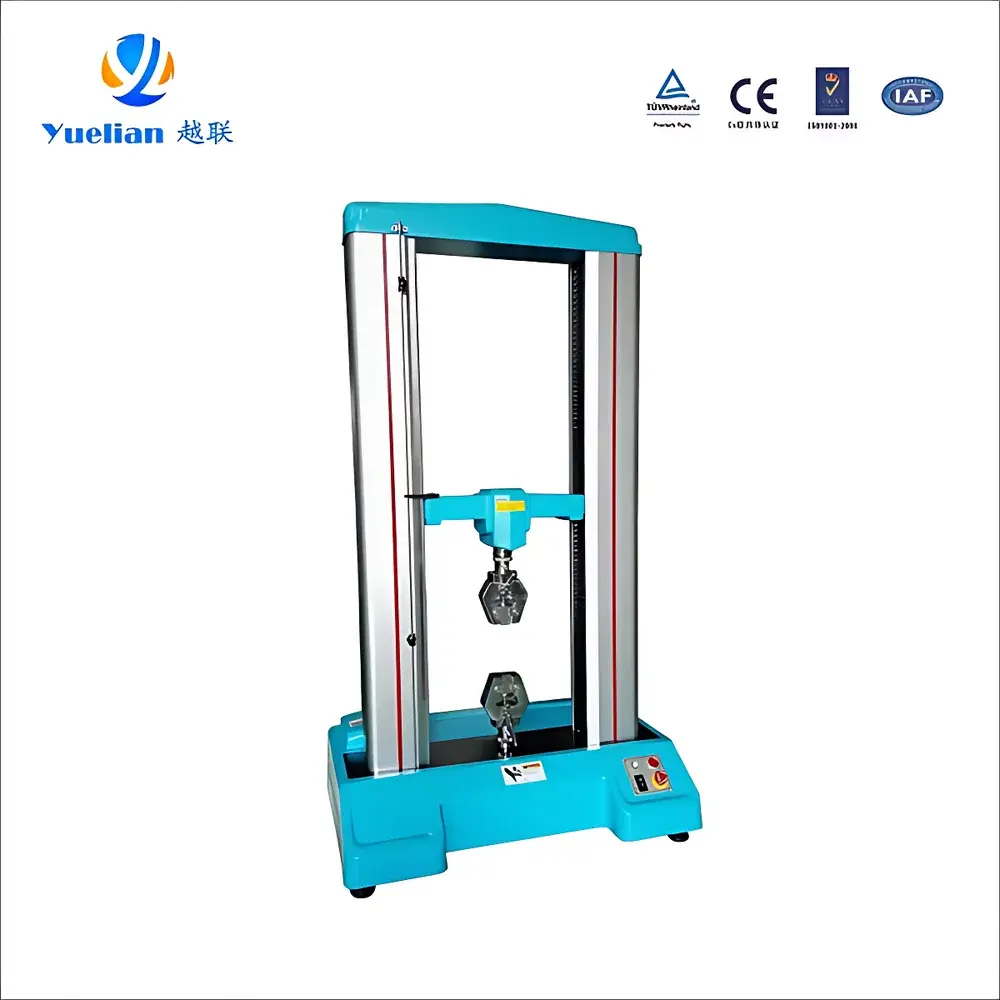
Yuelian YL-D231 Dual-Column Electronic Tensile Testing Machine
| Brand | Yuelian |
|---|---|
| Origin | Guangdong, China |
| Manufacturer Type | Authorized Distributor |
| Country of Origin | China |
| Model | YL-D231 |
| Instrument Type | Electronic Tensile Testing Machine |
| Maximum Test Force | 20 kN |
| Force Measurement Range | 20 kN (Full Scale) |
| Force Accuracy | ±0.5% FS |
| Test Stroke | 800 mm |
| Displacement Resolution | 1/500,000 mm |
| Force Resolution | 1/500,000 FS |
| Speed Range | 0.01–500 mm/min (PC-controlled) |
| Test Width | 420 mm |
| Drive System | Servo Motor + Precision Ball Screw |
| Power Supply | 220 V, 50/60 Hz, 10 A |
| Dimensions (W×D×H) | 880 × 600 × 1600 mm |
| Weight | ~115 kg |
| Standard Accessories | One set of universal grips, PC-based control software, USB interface cable |
Overview
The Yuelian YL-D231 Dual-Column Electronic Tensile Testing Machine is a precision-engineered universal testing system designed for static mechanical property evaluation of solid materials under controlled uniaxial loading conditions. Based on the fundamental principles of Hooke’s Law and standardized force-displacement transduction, it delivers high reproducibility in tensile, compression, flexural, shear, peel, tear, and adhesion testing across diverse material classes—including textiles, leather, rubber, plastics, paper, composites, thin metals, and polymer films. Its dual-column rigid frame architecture ensures minimal deflection during high-load operation (up to 20 kN), while the servo-motor-driven ball-screw actuation system enables precise stroke control and dynamic speed modulation from 0.01 to 500 mm/min. The system conforms to core mechanical testing metrology standards including ISO 7500-1 (static calibration of force-proving instruments), ASTM E4 (verification of force-measuring systems), and EN 10002-1 (tensile testing of metallic materials), ensuring traceable measurement integrity suitable for QA/QC laboratories, R&D centers, and third-party certification facilities.
Key Features
- Rigid dual-column steel frame with reinforced crosshead and base plate, engineered for structural stability under full-scale 20 kN loading
- High-resolution force transduction: 1/500,000 full-scale resolution with ±0.5% FS accuracy—validated per ISO 7500-1 Class 0.5 requirements
- Precision displacement measurement: 1/500,000 mm resolution via encoder-coupled ball screw feedback, supporting sub-micron deformation tracking
- Wide-speed servo control: Programmable test velocity range (0.01–500 mm/min) with real-time closed-loop adjustment and automatic speed ramping
- Integrated overload protection suite: Hardware-triggered emergency stop, software-defined upper/lower force limits, specimen failure detection, and auto-return-to-initial-position function
- Modular grip compatibility: Standard universal wedge-action grips included; optional fixtures available for film clamping, pneumatic vise, peel arms, and custom jigs per ASTM D3330 or GB/T 2792
Sample Compatibility & Compliance
The YL-D231 supports specimens ranging from ultra-thin textile fibers (e.g., nylon monofilaments) to rigid structural composites, accommodating widths up to 420 mm and strokes up to 800 mm. It meets essential regulatory and industry-standard compliance frameworks: ISO 13934-1 (tensile properties of textiles), ASTM D638 (plastics), ASTM D882 (thin plastic sheeting), GB/T 228.1 (metallic materials), GB/T 7124 (adhesives), and JIS Z 0237 (peel strength). All calibration and verification procedures align with GLP documentation requirements, and raw data acquisition supports audit-ready timestamped logs compliant with FDA 21 CFR Part 11 when deployed with validated software configurations.
Software & Data Management
The Windows-based control and analysis platform provides full instrument integration via USB interface, enabling real-time acquisition, visualization, and post-processing of force–displacement curves. Core computational outputs include ultimate tensile strength (UTS), yield point (offset method), elongation at break, Young’s modulus, average peel force, and energy absorption (area under curve). Data export formats include CSV, XLSX, and PDF reports with embedded metadata (operator ID, date/time, standard reference, environmental notes). The software natively supports MS Access relational database storage, multi-sensor synchronization (e.g., extensometer input), and customizable pass/fail criteria based on user-defined thresholds. Graphical overlays, curve smoothing filters, and batch statistical summaries (mean, SD, CV%) are built-in for comparative material screening.
Applications
- Textile & Apparel: Breaking strength and elongation of woven/knitted fabrics, yarns, elastic bands, and nonwovens per ISO 13934 or AATCC 20
- Packaging Materials: Seal strength of laminated pouches, peel resistance of pressure-sensitive labels (ASTM D903), and puncture resistance of corrugated board
- Automotive Interiors: Tensile integrity of seat fabrics, airbag webbing, gasket compression set, and trim adhesion durability
- Medical Devices: Burst strength of surgical drapes, suture tensile performance (ISO 10555), and catheter shaft stiffness
- Electronics Manufacturing: Bond strength of flexible printed circuits (FPC), solder joint shear resistance, and conformal coating adhesion
- Academic Research: Constitutive modeling of viscoelastic polymers, fracture mechanics parameter extraction, and interfacial debonding kinetics
FAQ
What standards does the YL-D231 comply with for calibration and verification?
It complies with ISO 7500-1 (Class 0.5), ASTM E4, JJG 475-2008, and EN 10002-1 for force system verification, and supports test execution per over 15 international material-specific standards listed in its technical documentation.
Can the system be integrated into a LIMS or enterprise QA database?
Yes—the software exports structured CSV/XLSX files with metadata headers and supports ODBC connectivity to MS Access or SQL Server environments for automated ingestion into LIMS or ERP platforms.
Is an external extensometer supported for strain measurement?
Yes—dedicated analog/digital inputs accept LVDT or video extensometer signals for true strain measurement independent of crosshead motion, critical for low-modulus materials like elastomers or hydrogels.
What safety certifications does the hardware carry?
The unit meets CE marking requirements under Machinery Directive 2006/42/EC and EMC Directive 2014/30/EU; electrical safety conforms to IEC 61000-6-2/6-4 and GB/T 17626 series immunity standards.
Does the software support 21 CFR Part 11 compliance?
Out-of-the-box functionality includes electronic signatures, audit trails, and user access levels; full Part 11 validation requires site-specific IQ/OQ/PQ protocols executed by qualified personnel.



