
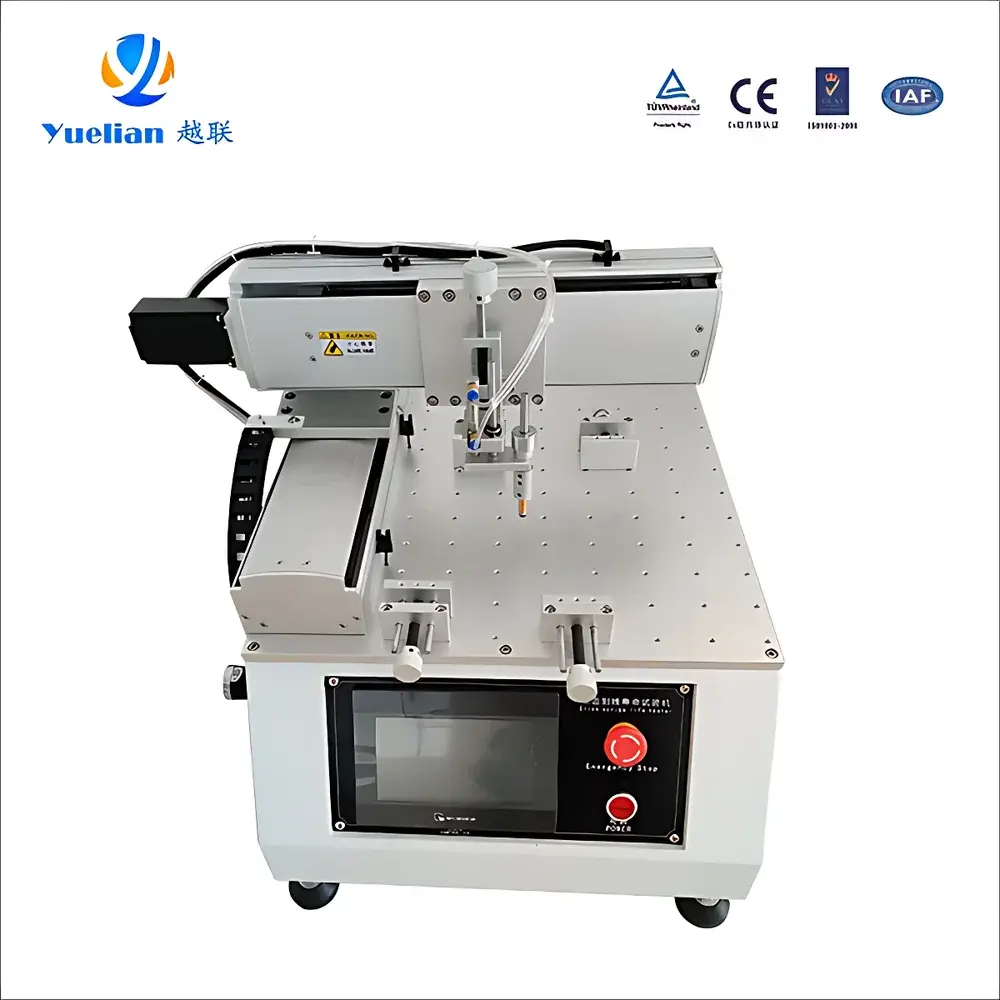
Yuelian YL-RLD150 Scratch & Tap Durability Tester
| Brand | Yuelian |
|---|---|
| Origin | Guangdong, China |
| Manufacturer Type | Authorized Distributor |
| Country of Origin | China |
| Model | YL-RLD150 |
| Quotation | Upon Request |
| Test Stations | Dual (X+Y axes) |
| Y-axis Travel Range | 100 mm |
| X-axis Travel Range | 150 mm |
| Drive Mechanism | Stepper Motor with Linear Guide Rails and Ball Screws |
| Stylus Stroke (Tap Axis) | 0–15 mm |
| Positioning Accuracy | ±0.05 mm |
| Translation Speed | 30–450 mm/min |
| Tap Frequency | 0–250 cycles/min |
| Applied Load Range | 0–800 gf |
| Standard Weights | 50 g, 100 g, 200 g, 300 g |
| Actuation Tools | Human finger or stylus (capacitive/resistive compatible) |
| Motion Trajectories | Line, Triangle, Rectangle, Square |
| Control Interface | Digital input for speed/position (X/Y/Z), 8-digit LCD counter (programmable 1–99,999,999), auto-stop on count completion |
| Alarm Function | Audible/visual alert + automatic halt at preset cycle count |
| Power Supply | AC 220 V, 50 Hz |
Overview
The Yuelian YL-RLD150 Scratch & Tap Durability Tester is an electromechanical test system engineered for quantitative evaluation of mechanical robustness in capacitive and resistive touch interfaces. It operates on the principle of controlled, repeatable surface interaction—applying calibrated normal force via interchangeable weights while executing programmable motion trajectories (linear, triangular, rectangular) across the active display area. Designed specifically for small-form-factor consumer electronics—including smartphones, handheld translators, and portable communication devices—the instrument replicates real-world usage patterns such as repeated tapping, stylus tracing, and edge-to-edge swiping. Its core architecture integrates a high-resolution stepper-driven Cartesian stage with precision linear guide rails and preloaded ball screws, ensuring sub-50 µm repeatability over extended test campaigns. Unlike manual or pneumatic alternatives, the YL-RLD150 delivers deterministic kinematics, enabling strict adherence to internal QC protocols and facilitating correlation with industry durability benchmarks.
Key Features
- Dual-axis (X/Y) programmable stage with 150 mm × 100 mm travel envelope, optimized for A-size and smaller touch panels
- Integrated Z-axis solenoid actuator with adjustable stroke (0–15 mm) and fine-tuned load application (0–800 gf) using standardized weights (50 g / 100 g / 200 g / 300 g)
- High-fidelity trajectory generation: user-defined points (2–4) automatically generate lines, triangles, or rectangles; saved profiles support rapid test method recall
- Digital control interface with 8-digit LCD counter, supporting cycle-based termination (1–99,999,999), real-time speed/position parameterization, and audible/visual alarm upon endpoint
- Low-noise, maintenance-free motion system featuring stepper motors, hardened linear guides, and ground ball screws—engineered for >50,000-cycle operational longevity
- Modular tooling interface accommodating both human finger simulators and industry-standard styluses (e.g., ASTM F2763-compliant tip geometries)
Sample Compatibility & Compliance
The YL-RLD150 accommodates rigid and flexible touch modules with active areas up to 150 mm (width) × 100 mm (height), including TFT-LCD, OLED, and AMOLED displays integrated into handheld enclosures. Fixture adaptability supports both bare glass substrates and fully assembled front-end assemblies (with bezel and housing). While not certified to ISO/IEC 17025, the system’s deterministic motion control and traceable load application align with common internal validation requirements for touch interface reliability testing per IEC 60950-1 (safety), IEC 62209-2 (RF exposure during operation), and IPC-J-STD-001 (solder joint integrity under mechanical stress). Its programmable counter and digital setpoints support GLP-aligned recordkeeping when paired with external lab documentation systems.
Software & Data Management
The YL-RLD150 operates via embedded firmware with no PC dependency—ensuring stability in production floor environments. All test parameters (speed, position, force, cycle count) are stored in non-volatile memory and recalled without recalibration. The 8-digit LCD provides immediate visibility of cumulative cycles, current axis positions, and error states. For integration into automated QA workflows, optional RS-232 or USB-to-serial adapters enable data logging to external SCADA or LIMS platforms. Audit trails—including start time, total cycles executed, and stop reason—are exportable as CSV files. Though not natively 21 CFR Part 11 compliant, the system supports manual verification logs required under GMP Annex 11 when used in regulated manufacturing settings.
Applications
- Touchscreen wear resistance validation during NPI (New Product Introduction) phase
- Comparative analysis of protective coating performance (oleophobic, anti-scratch, AR films)
- Verification of digitizer controller firmware responsiveness under sustained mechanical loading
- Failure mode identification: ghost touches, linearity drift, dead zones, or conductive layer delamination
- Pre-shipment quality gate testing for contract manufacturers serving Tier-1 OEMs
- Correlation studies between lab-scale scratch metrics and field return data (e.g., RMA rates linked to specific touch IC revisions)
FAQ
What types of touch technologies does the YL-RLD150 support?
It is compatible with surface-capacitive, projected-capacitive, and resistive touch sensors—provided the active area fits within the 150 mm × 100 mm test envelope and the device remains powered-on during testing.
Can test profiles be exported or backed up externally?
Profile parameters (coordinates, speeds, loads) are retained in onboard memory; full export requires connection to a host PC via optional serial interface and vendor-provided utility software.
Is calibration traceable to national standards?
Load calibration uses NIST-traceable gram weights; positional accuracy (±0.05 mm) is verified per manufacturer’s internal metrology protocol using laser interferometry—documentation available upon request.
Does the system meet any international safety standards?
The unit complies with GB 4793.1–2007 (Chinese equivalent of IEC 61010-1) for electrical safety in laboratory equipment; CE marking is not applicable as it is supplied exclusively for industrial use within controlled environments.
What maintenance intervals are recommended?
Linear guides require re-lubrication every 6 months or after 10,000 cycles; ball screw preload should be verified annually using torque measurement per maintenance manual section 4.2.
Related Products



