
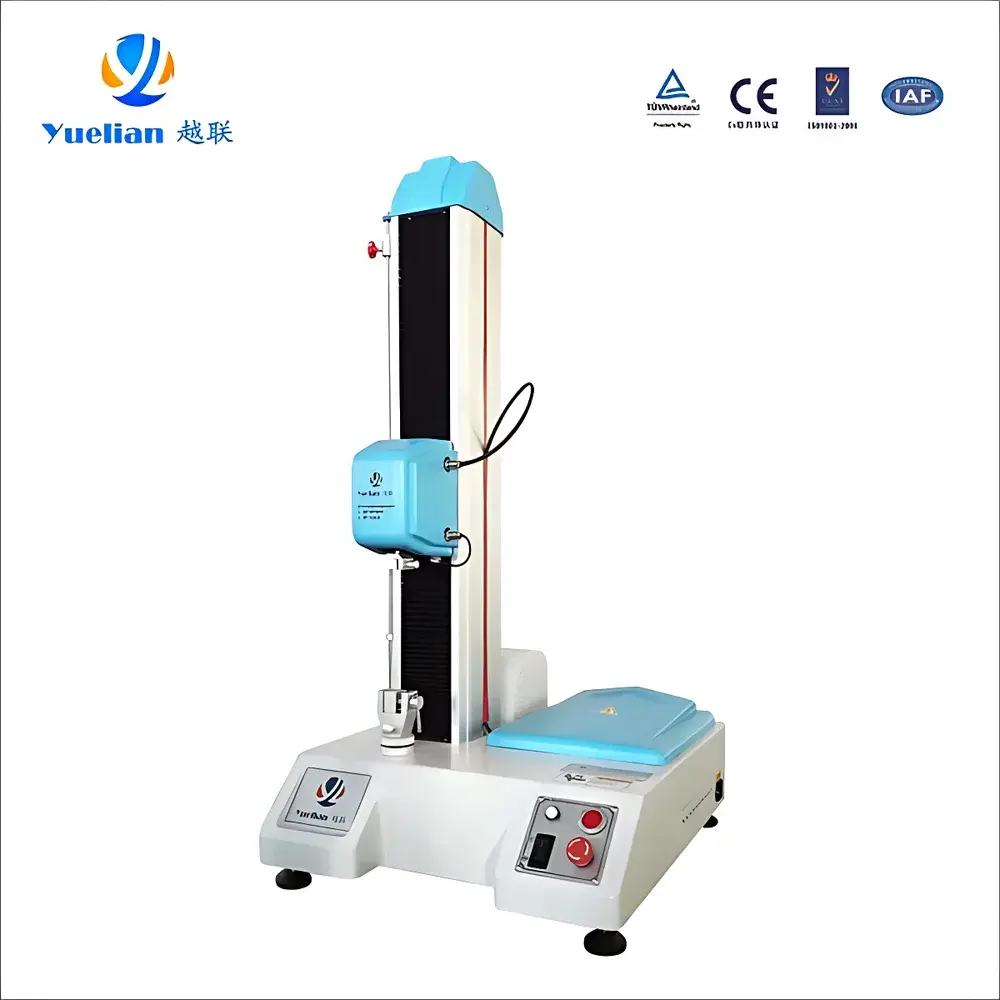
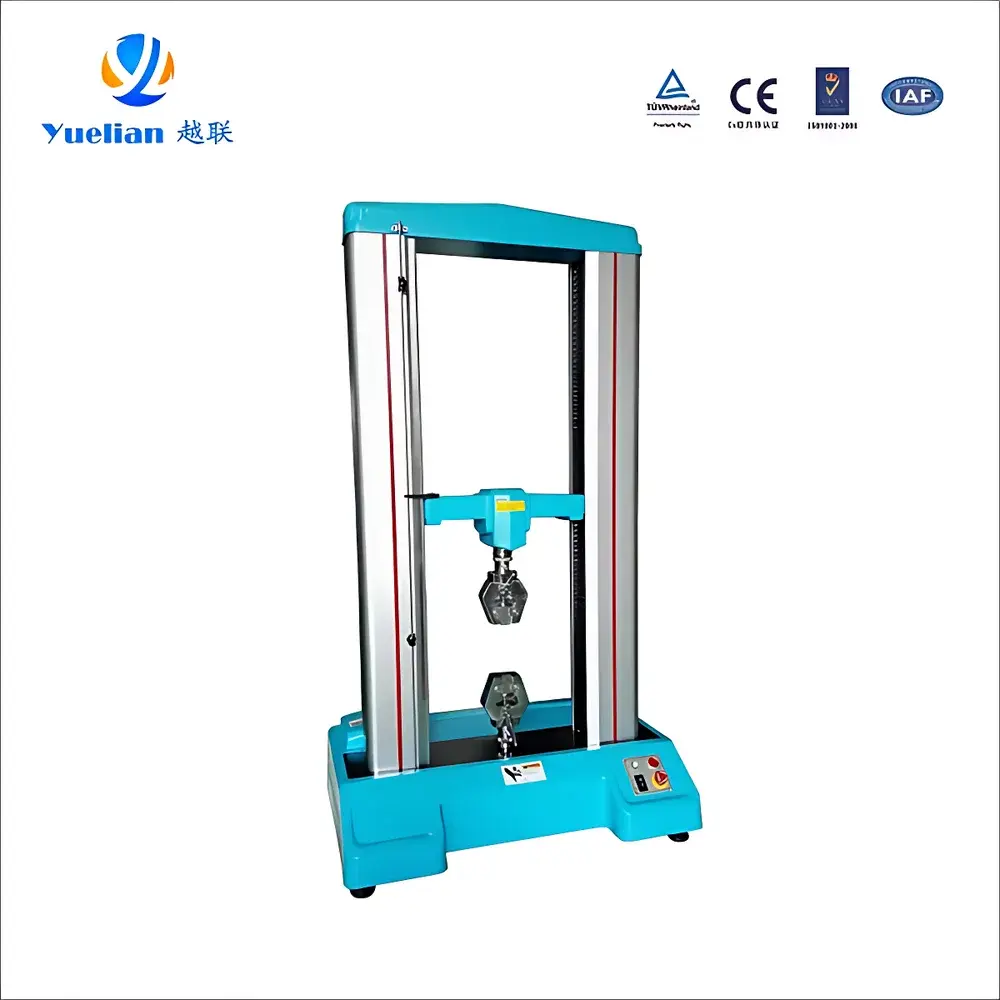
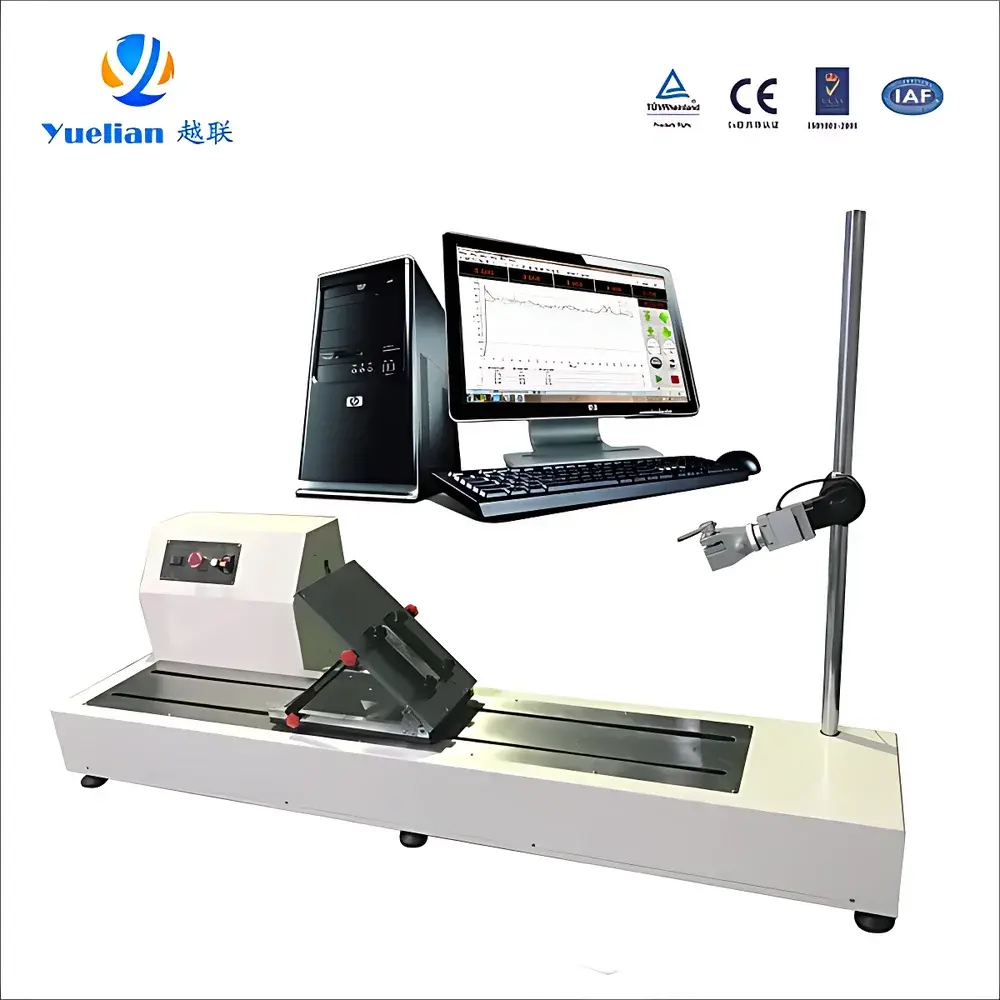
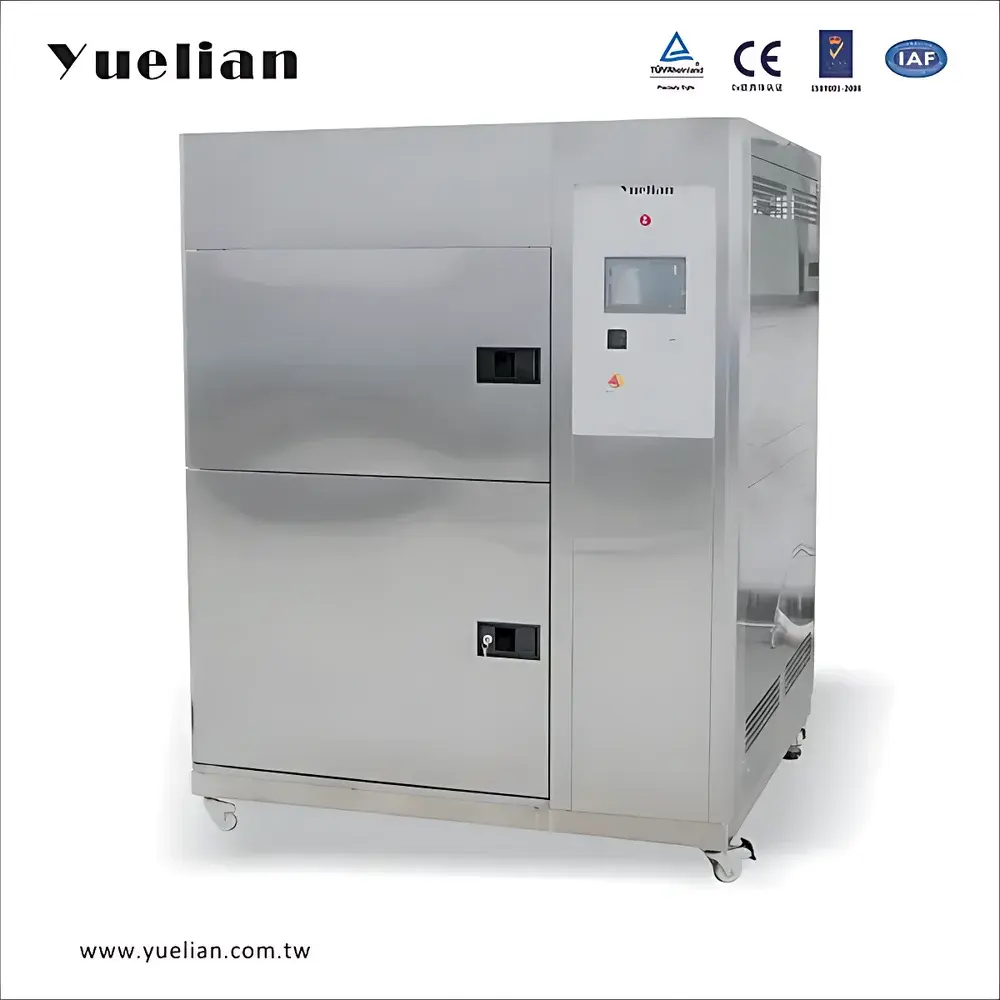
Yuelian YL-S72 GB/T 2791 T-Peel Adhesion Tester
| Brand | Yuelian |
|---|---|
| Origin | Guangdong, China |
| Manufacturer Type | Authorized Distributor |
| Region of Manufacture | Domestic (China) |
| Model | YL-S72 |
| Instrument Type | Electromechanical Tensile Testing Machine |
| Maximum Test Load | 5 kN |
| Load Measurement Range | 0.1–100% of Full Scale (FS) |
| Load Accuracy | ±0.5% of reading |
| Crosshead Travel | 600 mm |
| Displacement Resolution | 0.01 mm |
| Load Cell Options | 10 N to 5 kN (selectable) |
| Force Resolution | 1/250,000 full scale |
| Stroke Resolution | 0.005 mm |
| Test Speed Range | 0.01–1000 mm/min (programmable) |
| Test Width | 140 mm |
| Drive System | Servo Motor + Precision Ball Screw + Synchronous Belt |
| Power Supply | 220 V, 50/60 Hz, 10 A |
| Power Consumption | 400 W |
| Dimensions (W×D×H) | 500 × 520 × 1150 mm or 500 × 520 × 1500 mm |
| Net Weight | ~75 kg |
| Standard Accessories | One set of T-peel fixtures, USB cable, dedicated PC software |
| Optional | Customer-supplied Windows-based PC |
Overview
The Yuelian YL-S72 T-Peel Adhesion Tester is an electromechanical tensile testing system engineered for precise quantification of interfacial bond strength in laminated and bonded assemblies under standardized T-peel geometry. Designed in strict accordance with GB/T 2791–1998 (“Adhesives — Determination of Peel Resistance of Flexible-to-Rigid Bonds — T-Peel Method”), this instrument delivers repeatable, traceable force-displacement data essential for quality control, R&D validation, and regulatory documentation in adhesive manufacturing, packaging, medical device lamination, and flexible electronics production. Its dual-mode operation—standalone via embedded controller or computer-integrated via USB—supports both rapid shop-floor verification and GLP-compliant laboratory workflows. The system employs a high-efficiency servo motor coupled to a precision ground ball screw and synchronous belt transmission, achieving >85% mechanical transmission efficiency and minimizing hysteresis-induced error during dynamic load ramping.
Key Features
- Compliance-ready design: Fully aligned with GB/T 2791–1998 test geometry, fixture alignment tolerances, and specimen preparation requirements for T-peel evaluation.
- Modular load cell architecture: Supports interchangeable transducers from 10 N to 5 kN, enabling accurate measurement across low-force film adhesion (e.g., pressure-sensitive tapes) and high-strength structural laminates.
- High-resolution motion control: Programmable crosshead speed from 0.01 to 1000 mm/min with closed-loop feedback; displacement resolution of 0.005 mm ensures fidelity in peel front tracking and elongation-derived metrics.
- Dual operation interface: Local LCD panel with quick-setup presets for routine tests; optional PC integration via USB for advanced scripting, real-time curve overlay, and batch report generation.
- Robust mechanical architecture: Rigid C-frame construction with 140 mm test width clearance accommodates standard GB/T 2791 specimens (25 mm wide × ≥200 mm long) and custom multi-lane configurations.
- Safety-critical automation: Integrated overload cutoff, emergency stop, automatic halt upon specimen rupture, programmable upper/lower travel limits, and motor-driven auto-return to home position post-test.
Sample Compatibility & Compliance
The YL-S72 accommodates flexible-to-rigid and flexible-to-flexible bonded substrates per GB/T 2791 specifications, including but not limited to polymeric films (PET, PE, BOPP), aluminum foils, nonwovens, coated papers, elastomeric sheets, and composite laminates. Specimen clamping utilizes parallel pneumatic or mechanical grips with adjustable jaw pressure to prevent slippage without inducing edge damage. All test protocols adhere to the angular constraint (180° ± 5°) and constant-rate separation criteria defined in the standard. While GB/T 2791 is the primary reference, the system’s force accuracy (±0.5% FS), displacement linearity, and environmental stability also support method equivalency assessments against ISO 8510-2 and ASTM D1876 where applicable. Audit trails, user access logs, and electronic signature capability are enabled via optional software modules compliant with FDA 21 CFR Part 11 requirements.
Software & Data Management
The included Windows-based software provides ISO/IEC 17025-aligned data acquisition, visualization, and reporting functionality. Real-time force–displacement curves are plotted with selectable smoothing algorithms and derivative calculation (e.g., peak load, average peel force, energy per unit width). Statistical analysis includes mean, SD, CV%, min/max, and pass/fail threshold comparison against specification limits. Raw data exports to CSV, Excel, or PDF formats; reports embed metadata (operator ID, timestamp, calibration certificate ID, environmental conditions). Audit trail records all parameter changes, test executions, and result modifications with timestamps and user attribution. Software supports multi-user role assignment (admin, technician, reviewer) and integrates with LIMS environments via ODBC drivers.
Applications
- Quality assurance of hot-melt, solvent-based, and UV-curable adhesives used in food packaging laminates.
- Validation of peel performance in medical pouch seals (ISO 11607-2) and transdermal patch backing layers.
- R&D screening of pressure-sensitive adhesive (PSA) formulations on release liners and substrates.
- Comparative evaluation of surface pretreatment efficacy (corona, plasma, flame) on polymer films prior to lamination.
- Mechanical durability assessment of flexible printed circuit board (FPCB) coverlay adhesion under thermal cycling.
- Regulatory submission support for biocompatible adhesive systems requiring GB/T, ISO, or ASTM compliance evidence.
FAQ
What standards does the YL-S72 specifically support?
It is configured and validated for GB/T 2791–1998; its hardware and software architecture allow adaptation to ISO 8510-2 and ASTM D1876 with minor procedural adjustments.
Can the system perform other test types beyond T-peel?
Yes—when equipped with appropriate fixtures (tensile grips, compression platens, tear blades), it executes ASTM D882, ISO 527-3, GB/T 1040, and GB/T 13022, provided force and stroke limits remain within specification.
Is calibration traceability available?
Standard calibration certificates are issued against national metrological standards (CNAS-accredited labs); optional on-site recalibration and uncertainty budgeting are available.
What operating system versions are supported?
Windows 10 (64-bit) and Windows 11 (64-bit); legacy support for Windows 7 ends Q4 2025 per software maintenance policy.
Does the system meet electromagnetic compatibility (EMC) requirements for lab use?
Yes—it complies with GB/T 18268.1–2010 (IEC 61326-1) for industrial and laboratory environments, including conducted/radiated emissions and immunity testing.



