
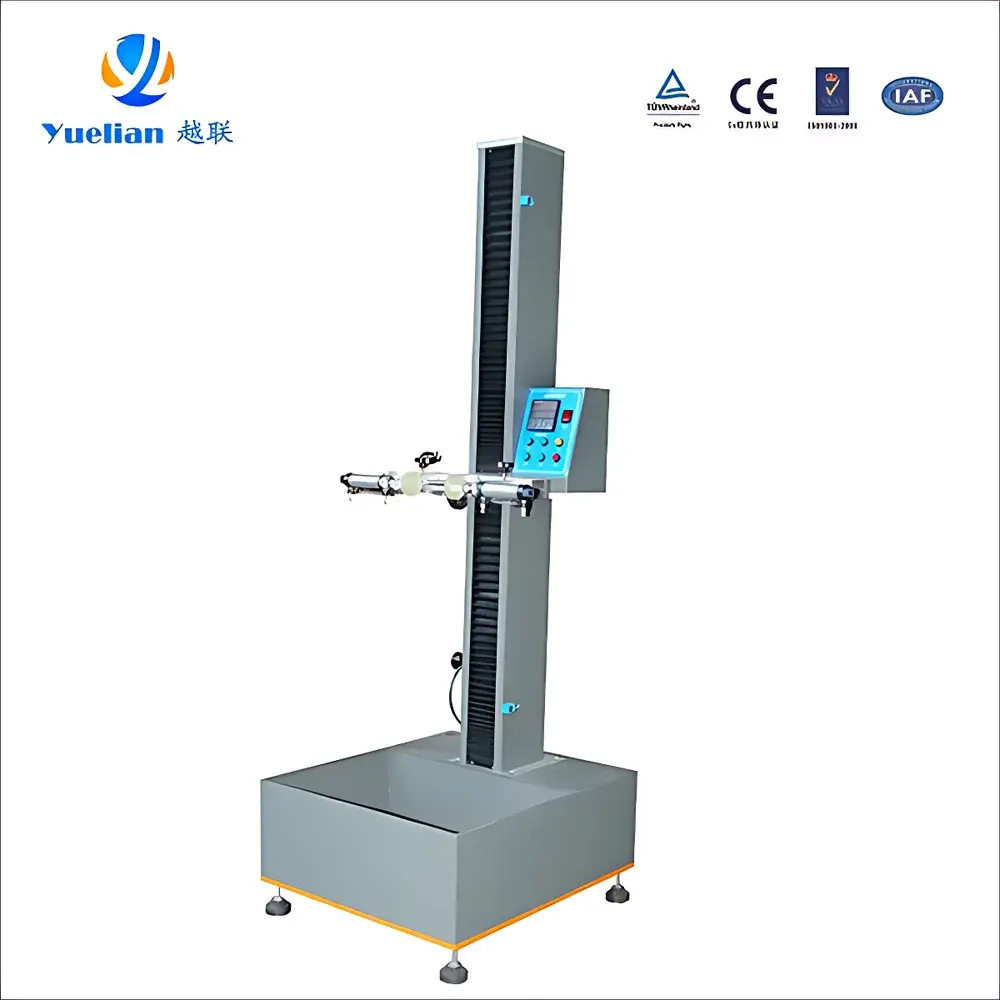
Yuelian YLB-6612 Battery Free-Fall Drop Tester
| Brand | Yuelian |
|---|---|
| Origin | Guangdong, China |
| Manufacturer Type | Authorized Distributor |
| Country of Origin | China |
| Model | YLB-6612 |
| Quotation | Upon Request |
| Max. Sample Weight | 2 kg ±100 g |
| Drop Height Range | 300–1500 mm (adjustable) |
| Height Scale Resolution | 1 mm |
| Clamping Mechanism | Pneumatic Fixture |
| Drop Surface Options | Marble (acrylic or stainless steel available on request) |
| Drop Method | Free-fall |
| Base Plate Dimensions | 560 × 410 mm |
| Operating Air Pressure | 0.4 MPa |
| Unit Dimensions (W×D×H) | 700 × 900 × 1650 mm |
| Net Weight | 80 kg |
| Power Supply | 1-phase, 220 V AC, 3 A |
Overview
The Yuelian YLB-6612 Battery Free-Fall Drop Tester is a precision-engineered mechanical test system designed to evaluate the structural integrity and impact resistance of lithium-ion and other rechargeable batteries used in portable electronic devices. It operates on the principle of controlled free-fall impact, where a battery cell or pack is released from a defined vertical height onto a rigid, standardized impact surface—simulating real-world mechanical shock events such as accidental drops during handling, transportation, or end-user operation. The tester complies with internationally recognized safety and performance evaluation protocols for electrochemical energy storage systems, including UN Manual of Tests and Criteria Part III, Subsection 38.3 (UN38.3), IEC 62133:2017 (Edition 2.0), GB/T 31241–2014 (Chinese standard for lithium batteries in portable equipment), GB/T 31485–2015 (safety requirements for traction batteries), QC/T 743–202X (automotive battery specifications), and GB/T 8897.4–2008 (primary and secondary lithium cells). Its pneumatic clamping architecture ensures consistent sample positioning and repeatable release timing, minimizing operator-induced variability and supporting GLP-compliant test documentation.
Key Features
- Pneumatically actuated clamping mechanism with adjustable stroke, enabling secure fixation of irregularly shaped battery cells, modules, or enclosures up to 2 kg (±100 g tolerance).
- Linearly adjustable drop height ranging from 300 mm to 1500 mm, calibrated via a high-contrast metric scale with 1 mm resolution for traceable test setup.
- Modular impact base plate (560 × 410 mm) compatible with interchangeable standardized surfaces: polished marble (default), acrylic (for low-energy absorption characterization), or stainless steel (for high-rigidity, minimal deformation testing).
- Sturdy welded steel frame with vibration-dampening feet, engineered for long-term dimensional stability under repeated impact loading.
- Integrated air pressure regulation system operating at 0.4 MPa nominal supply pressure—compatible with standard laboratory compressed air infrastructure.
- Fail-safe interlock design prevents unintended activation; emergency stop button and visual status indicators meet IEC 60204-1 functional safety requirements.
Sample Compatibility & Compliance
The YLB-6612 accommodates cylindrical (e.g., 18650, 21700), prismatic, and pouch-type lithium-ion/polymer cells, as well as assembled battery packs up to 2 kg. Its open-frame geometry allows unobstructed access for pre-test inspection, thermocouple placement, and post-drop disassembly. All test configurations adhere strictly to the specimen orientation, mounting, and environmental preconditioning stipulated in referenced standards—for example, UN38.3 Section 38.3.4.1 mandates six sequential drops onto each primary face and corner, while GB/T 31241–2014 specifies ambient temperature conditioning (20 ± 5 °C) prior to impact. The unit supports audit-ready compliance reporting when integrated with external data loggers for temperature, voltage, and surface temperature monitoring during and after impact.
Software & Data Management
While the YLB-6612 operates as a standalone electromechanical system without embedded firmware or touchscreen interface, it is fully compatible with third-party test management platforms. Users may integrate digital height sensors, high-speed cameras (≥1000 fps), and thermal imaging systems via analog voltage outputs or TTL triggers. All mechanical settings—including height, clamp pressure, and drop sequence—are manually recorded per test logsheet in accordance with ISO/IEC 17025 documentation requirements. For regulated environments (e.g., ISO 13485-certified medical device battery validation or IATF 16949 automotive qualification), the system supports 21 CFR Part 11-compliant electronic records when paired with validated LIMS or ELN software that captures operator ID, timestamp, and parameter verification signatures.
Applications
- Pre-certification mechanical safety testing of Li-ion cells prior to UN38.3 submission.
- R&D-stage robustness screening of new cell formats, thermal barrier materials, or mechanical housing designs.
- Quality control verification for battery manufacturers supplying consumer electronics (smartphones, wearables, power tools).
- Automotive Tier-1 supplier validation of module-level drop resistance per QC/T 743 and GB/T 31485.
- Academic research into failure modes induced by mechanical shock—e.g., internal short circuit initiation, separator fracture, or electrolyte leakage pathways.
- Contract testing laboratories performing accredited battery safety assessments under CNAS or A2LA scope.
FAQ
What standards does the YLB-6612 explicitly support?
It is configured and validated for full alignment with UN38.3, IEC 62133:2017, GB/T 31241–2014, GB/T 31485–2015, QC/T 743–202X, and GB/T 8897.4–2008.
Can the drop height be programmed or automated?
No—the YLB-6612 uses manual height adjustment and pneumatic release; it does not include programmable logic controllers or step-motorized elevation. Automation requires external PLC integration.
Is calibration certification included with shipment?
A factory-issued dimensional calibration report for the height scale is provided; users must perform periodic verification per ISO/IEC 17025 using traceable gauge blocks or laser interferometry.
What maintenance is required for long-term reliability?
Monthly inspection of pneumatic tubing, cylinder seals, and clamp jaw wear; annual torque verification of structural fasteners; and biannual replacement of air filter elements in the pressure regulator unit.
Does the system meet CE or UKCA marking requirements?
It conforms to the essential health and safety requirements of the EU Machinery Directive 2006/42/EC when installed with appropriate guarding and risk assessment documentation—but CE marking is not applied by default and must be performed by the end-user’s authorized representative.



