
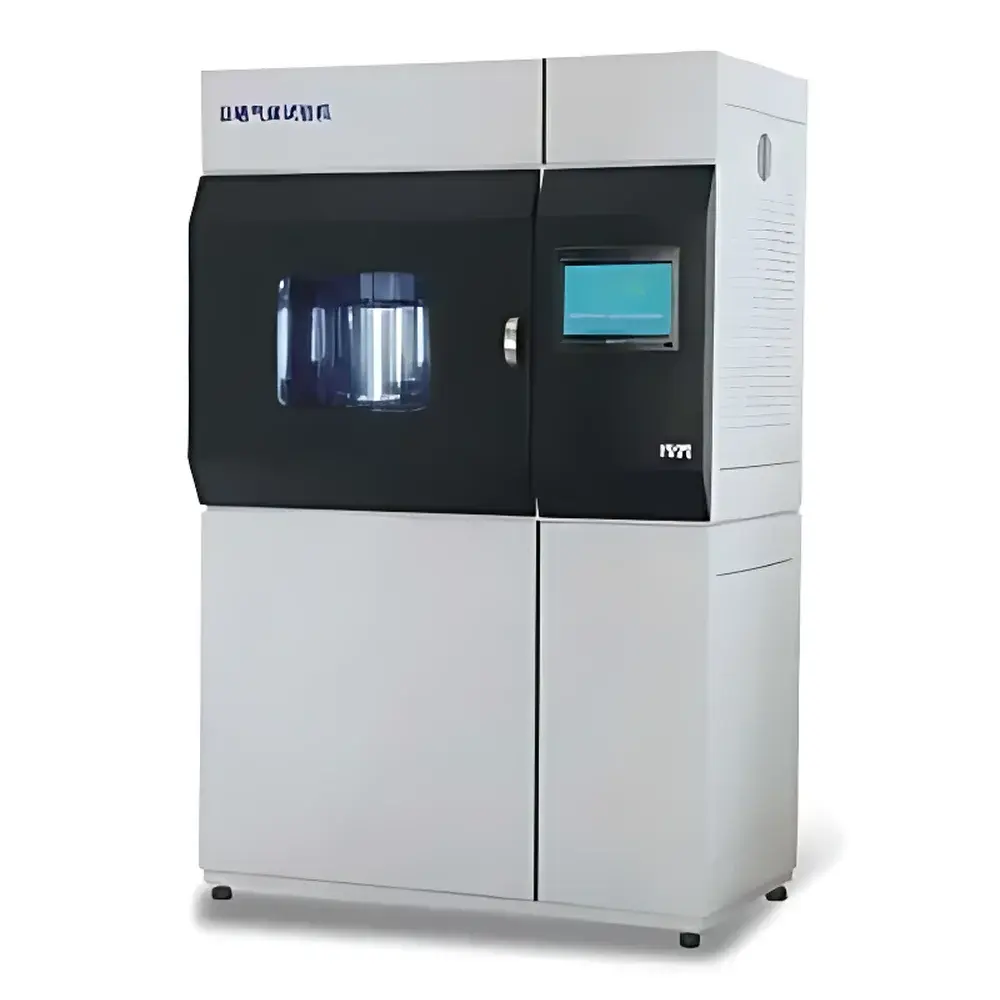
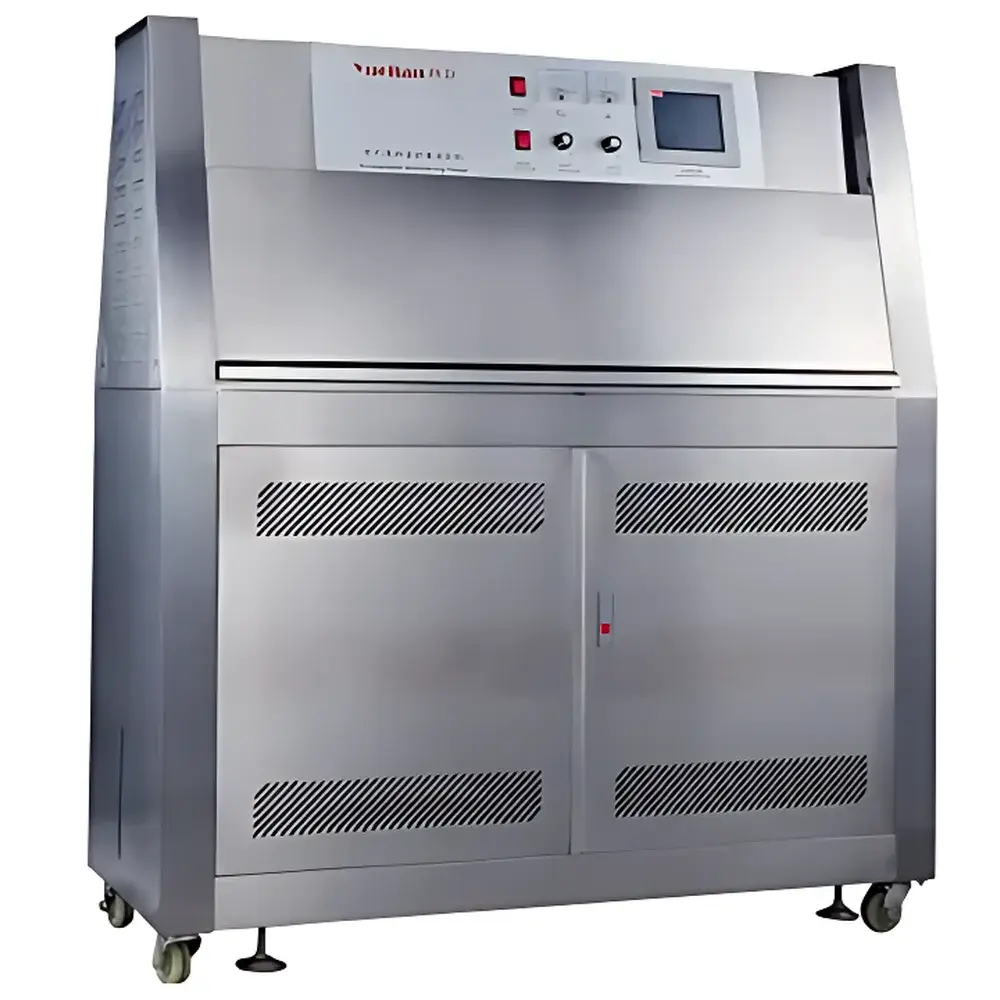
Yuelian YLB611-V Xenon Arc Weathering Test Chamber
| Brand | Yuelian |
|---|---|
| Origin | Guangdong, China |
| Model | YLB611-V |
| Temperature Control Range | 30–50°C (0.1°C resolution) |
| Humidity Control | Light cycle 10–65% RH (±3% RH), Dark cycle 40–95% RH (±5% RH) |
| Irradiance Control | 1.0–1.5 W/m² @ 420 nm (±0.03 W/m²) |
| Adjustable Monitoring Wavelengths | 340 nm, 420 nm, 300–400 nm, 300–800 nm |
| Xenon Lamp Power | 3.5 kW |
| Sample Rack Rotation Speed | 5 rpm |
| Max Exposure Area | 1170 cm² |
| Sample Capacity | 18 × 145×75 mm or 26 × 145×45 mm specimens |
| Independent Timer per Specimen Holder | up to 10,000 h |
| Light Cycle Duration | up to 10,000 h |
| Spray Cycle Duration | up to 10,000 h |
| Black Panel Temperature (BPT) | 40–75°C ±2°C |
| Standard Black Standard Temperature (BST) | 45–80°C ±2°C |
| Display | 10.4-inch color touchscreen |
| Power Supply | AC 380 V ±5%, 50 Hz, 6 kW |
| Dimensions (W×D×H) | 1250×1000×1800 mm |
| Weight | 400 kg |
Overview
The Yuelian YLB611-V Xenon Arc Weathering Test Chamber is an engineered solution for accelerated light aging and climate simulation testing in compliance with internationally recognized photostability and weathering standards. It employs a high-intensity long-arc xenon lamp to replicate full-spectrum solar irradiance—including UV, visible, and near-infrared regions—with spectral power distribution closely aligned to terrestrial sunlight (CIE No. 85, ISO 4892-2). This enables precise simulation of outdoor exposure conditions for evaluating colorfastness, gloss retention, chalking, cracking, embrittlement, and other degradation mechanisms induced by synergistic effects of UV radiation, temperature, humidity, and water spray. Designed for laboratories operating under ISO/IEC 17025, ASTM G155, ISO 105-B02/B04, AATCC TM16, GB/T 8427, and related textile, coating, polymer, and building material standards, the chamber supports both continuous and cyclic test protocols with traceable irradiance control and real-time environmental monitoring.
Key Features
- Long-arc xenon lamp system (3.5 kW) with calibrated spectral output matching natural daylight—enabling accurate correlation between laboratory testing and real-world service life.
- Dual-layer rotating sample rack (5 rpm) providing uniform irradiance distribution across a maximum exposure area of 1170 cm²; accommodates up to 18 specimens (145 × 75 mm) or 26 smaller samples (145 × 45 mm).
- Multi-wavelength irradiance sensing and feedback control at user-selectable bands: 340 nm, 420 nm, 300–400 nm, or 300–800 nm—ensuring compliance with diverse standard requirements (e.g., ISO 105-B04 mandates 420 nm monitoring; AATCC TM16 permits 340 nm).
- Co-located black panel thermometer (BPT) and black standard thermometer (BST), positioned at the same plane as test specimens, delivering spatially representative thermal loading data without interrupting operation.
- Wireless RF-based sensor telemetry powered by ambient light energy harvesting—eliminating wired connections and external power sources for embedded sensors.
- Industrial-grade refrigeration-assisted temperature control (30–50°C, ±0.1°C resolution) and ultrasonic humidification combined with dedicated dehumidification ensure stable, programmable humidity profiles across light/dark cycles.
- 10.4-inch color touchscreen interface supporting animated process visualization, numeric readouts, trend graphs, and dual-language (English/Chinese) menu navigation.
- Independent digital timers for each specimen holder—enabling heterogeneous test scheduling within a single run, reducing throughput time and operational overhead.
- Integrated air filtration and internal recirculation system minimizes dependency on ambient lab air quality, enhancing repeatability and reducing maintenance frequency.
- Continuous unattended operation capability up to 1000 hours per test sequence, validated for long-term stability under sustained irradiance and thermal load.
Sample Compatibility & Compliance
The YLB611-V is validated for use across a broad spectrum of organic and composite materials subject to photochemical degradation. Typical applications include textile dye evaluation (GB/T 8427, ISO 105-B02), architectural coatings (ISO 11341), automotive interior plastics (SAE J2527), flooring laminates (GB/T 15102), paper products (ISO 12042), and elastomeric sealants. All irradiance, temperature, and humidity control systems are calibrated against NIST-traceable reference instruments. The chamber’s architecture supports audit-ready documentation workflows compatible with GLP and GMP environments, including timestamped parameter logging, event-triggered alarms, and optional A4 printout functionality for raw data archiving. While not pre-certified to FDA 21 CFR Part 11, its data management structure permits integration with compliant LIMS platforms via RS-232 or parallel port interfaces.
Software & Data Management
Embedded firmware provides real-time acquisition and display of irradiance (W/m²), BPT/BST temperatures (°C), relative humidity (%RH), elapsed time (h:min), and spray cycle status. All parameters are logged at configurable intervals (default: 1-minute) into non-volatile memory with automatic overwrite protection. Data export is supported via USB storage or optional thermal printer (A4 format, bilingual English/Chinese labels). The system records calibration events, lamp usage hours, and fault codes for preventive maintenance planning. Though no proprietary PC software is bundled, ASCII-formatted CSV logs enable seamless import into MATLAB, Excel, or statistical analysis packages for Weibull lifetime modeling, Arrhenius acceleration factor calculation, or ISO 4892-1-compliant exposure dose reporting.
Applications
- Textile and apparel: Accelerated assessment of colorfastness to light and weathering per ISO 105-B series and AATCC TM16.
- Paints and coatings: Evaluation of chalking resistance, gloss loss, and pigment fading under simulated subtropical or desert climatic profiles.
- Automotive components: Validation of dashboard trim, seat fabrics, and exterior seals per SAE J2412 and J2527.
- Wood composites and laminates: Determination of surface degradation kinetics in engineered flooring under cyclic UV/humidity stress.
- Packaging materials: UV barrier performance verification for pharmaceutical blister foils and food-grade films.
- Research and development labs: Screening of UV stabilizers, HALS additives, and nanoparticle-based photoprotectants using controlled spectral irradiance dosing.
FAQ
What irradiance calibration standards does the YLB611-V support?
The chamber supports irradiance monitoring and closed-loop control at 340 nm (for polymer/weathering standards), 420 nm (for textile colorfastness), and broadband ranges (300–400 nm or 300–800 nm), aligning with ISO 4892-2 Annex B recommendations.
Is the xenon lamp output spectrally filtered to match CIE daylight?
Yes—the lamp system includes borosilicate inner and outer filters that approximate the global solar spectrum at AM1.5, meeting the spectral irradiance requirements of ISO 4892-2 Class A and ASTM G155 Cycle 1.
Can humidity be controlled independently during dark cycles?
Yes—humidity setpoints are fully programmable per phase (light/dark), with separate tolerance bands (±3% RH in light, ±5% RH in dark) to replicate diurnal condensation dynamics.
Does the system meet ISO/IEC 17025 traceability requirements?
All critical sensors (irradiance, temperature, humidity) are factory-calibrated against NIST-traceable references; users receive calibration certificates with uncertainty budgets and recommended recalibration intervals (typically annually).
What maintenance is required for long-term operational reliability?
Scheduled tasks include quarterly xenon lamp replacement (rated life: ~1500 h), biannual optical filter inspection, semi-annual cooling coil cleaning, and annual verification of humidity sensor drift using saturated salt solutions.



