
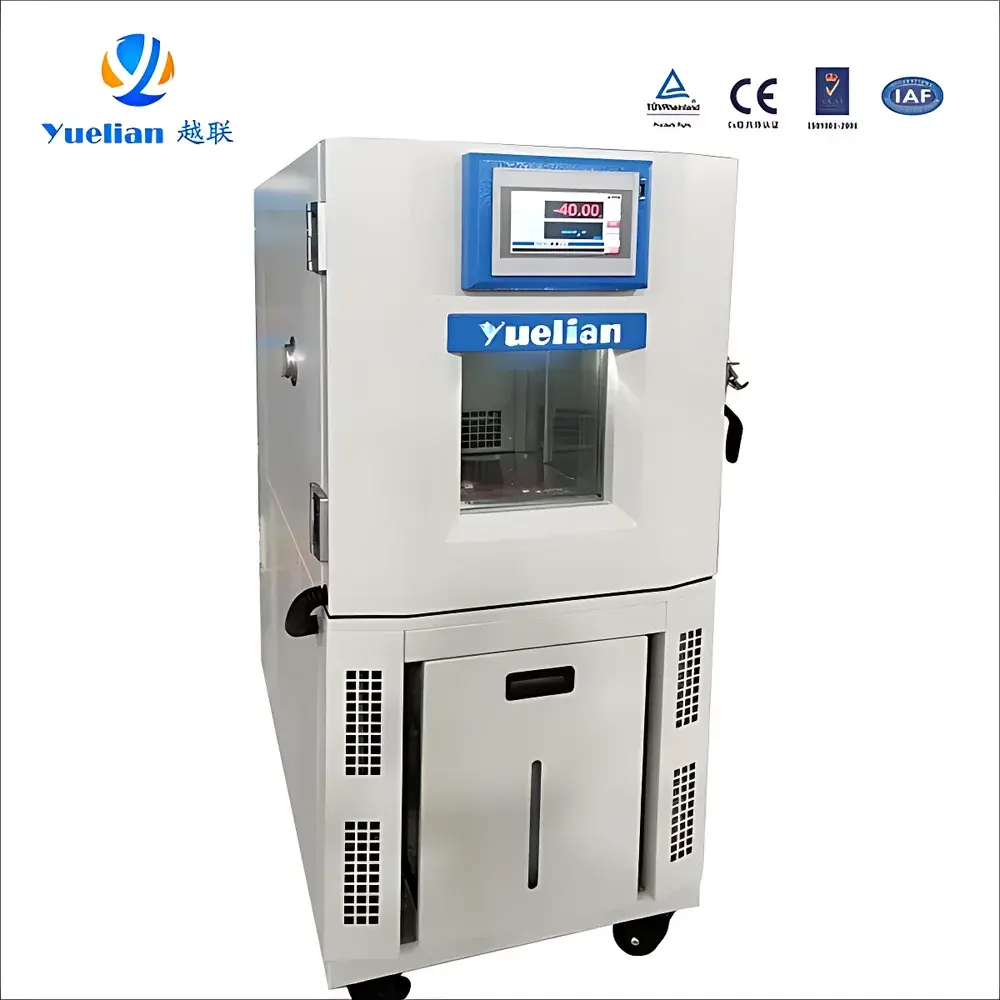
Yuelian YTS-100-40EC Energy-Efficient Temperature and Humidity Controlled Environmental Test Chamber
| Brand | Yuelian |
|---|---|
| Origin | Guangdong, China |
| Model | YTS-100-40EC |
| Chamber Type | Upright |
| Temperature Range | −55 °C to +150 °C |
| Humidity Range | 20–98 %RH |
| Temp. Uniformity | ±2.0 °C |
| Humidity Uniformity | ±3.0 %RH |
| Temp. Stability | ±1.0 °C |
| Humidity Stability | ±1.0 %RH |
| Heating Power | 1 kW (stainless steel finned heater) |
| Cooling System | Dual-stage cascade refrigeration (2 × 375 W hermetic compressors, R-404A) |
| Internal Dimensions | 400 × 500 × 500 mm (W×H×D) |
| External Dimensions | 650 × 1400 × 1150 mm (W×H×D) |
| Control Interface | 7-inch color touchscreen controller with PID auto-tuning, data logging, and RS485/USB communication |
Overview
The Yuelian YTS-100-40EC is an energy-optimized upright environmental test chamber engineered for precise, repeatable simulation of temperature and humidity conditions across demanding industrial and research applications. It employs a dual-stage cascade refrigeration system—comprising two imported Tecumseh (France) hermetic compressors—to achieve stable operation down to −55 °C, surpassing the thermodynamic limitations of single-stage systems using R-404A. Unlike conventional chambers that rely on high-power heating elements to counteract excessive cooling capacity, this model implements intelligent thermal load balancing: above −20 °C, only one 375 W compressor operates in tandem with a 1 kW stainless steel finned heater, significantly reducing energy consumption without compromising control fidelity. The chamber’s thermal architecture integrates 100 mm thick polyurethane foam insulation (density ≥40 kg/m³) combined with glass wool backing, minimizing heat transfer and supporting consistent internal uniformity (±2.0 °C temp, ±3.0 %RH humidity) under steady-state and dynamic cycling conditions.
Key Features
- Energy-efficient dual-stage cascade refrigeration: Two 375 W Tecumseh compressors enable reliable sub-zero performance while limiting peak electrical draw to ≤750 W during full-stage operation.
- High-fidelity 7-inch color touchscreen controller with ±0.1 °C / ±0.1 %RH measurement resolution, 12-user-programmable profiles (up to 120 segments), and automatic PID parameter self-tuning.
- Stainless steel (SUS#304) interior chamber with seamless welding and mirror finish—resistant to corrosion, easy to clean, and compliant with ISO 17025 laboratory hygiene requirements.
- Dual-mode humidification system featuring a non-condensing polymer water reservoir with integrated overflow diversion ducts; eliminates surface condensation and prevents sample wetting—a critical advantage over metal-tray designs.
- Optimized airflow design: 60 W centrifugal blower with extended shaft, multi-wing impeller, and adjustable louvered diffuser ensures laminar, uniform circulation without localized turbulence or hot/cold spots.
- Structural integrity: Reinforced carbon steel outer frame with electrostatic powder coating, precision-aligned triple-pane vacuum-insulated viewing window, and recessed flush-mount door handle with silicone gasket seal.
Sample Compatibility & Compliance
The YTS-100-40EC accommodates standard test specimens up to 10 kg per shelf (two included SUS#304 wire mesh shelves). Its internal volume (100 L) and compact external footprint (650 mm width) allow integration into space-constrained laboratories, including ISO Class 7 cleanrooms and GLP-compliant QC suites. The chamber meets mechanical safety requirements per IEC 61000-6-2 (EMC immunity) and IEC 61000-6-4 (EMC emissions). While not certified to UL/CSA standards out-of-the-box, its component-level sourcing—including ALCO (USA) dryers, Saginomiya (Japan) solenoid valves, and oil separators—supports third-party validation for ASTM D4329 (plastics UV/weathering), IEC 60068-2-1 (cold testing), IEC 60068-2-2 (dry heat), and IEC 60068-2-78 (damp heat, cyclic). Optional audit trail and electronic signature modules are available to support 21 CFR Part 11 compliance for regulated pharmaceutical or medical device validation.
Software & Data Management
The embedded controller supports real-time graphical display of setpoint vs. actual temperature/humidity curves, cumulative runtime logging, and programmable alarm thresholds (e.g., deviation >±2.0 °C for >5 min triggers audible/visual alert and relay output). Data export is enabled via USB mass storage or RS485 Modbus RTU protocol for integration with LabVIEW, MATLAB, or enterprise LIMS platforms. Optional PC-based software provides remote monitoring, historical trend analysis, PDF report generation (with timestamped operator ID), and CSV export compatible with JMP or Minitab for statistical process control (SPC). All logged data includes metadata: ambient conditions, power status, compressor duty cycle, and firmware revision—ensuring full traceability per ISO/IEC 17025 clause 7.5.2.
Applications
This chamber serves as a core tool for accelerated aging studies (e.g., IPC-9701 for printed circuit board reliability), material stability testing (ASTM E1980 for solar reflectance degradation), packaging permeability assessment (ASTM F1249 for water vapor transmission), and component qualification per MIL-STD-810H Method 502.2 (low temperature) and Method 507.6 (humidity). Its −55 °C capability enables validation of cryogenic adhesives, battery electrolyte behavior, and aerospace composite matrix resins under extreme thermal shock. In academic settings, it supports controlled hygrothermal conditioning of bio-based polymers, ceramic green bodies, and MOF sorbents prior to BET or TGA analysis.
FAQ
What is the lowest achievable temperature, and how is it verified?
The chamber achieves and maintains −55 °C at the chamber center under no-load conditions, verified per IEC 60068-3-4 using NIST-traceable PT100 sensors placed at nine standardized locations.
Does the controller support automated calibration verification?
Yes—the touchscreen interface includes a built-in sensor offset adjustment function with password-protected access, allowing lab technicians to perform routine zero/span checks against reference hygrometers and dry-well calibrators.
Can the chamber be integrated into a facility-wide BMS?
It supports Modbus RTU over RS485; optional analog 4–20 mA outputs (temperature/humidity) and digital dry-contact alarms are available for direct BMS interfacing.
Is the humidification system suitable for long-term continuous operation?
The polymer water reservoir features passive pressure equalization and overflow routing to the steam generator, eliminating condensate pooling and enabling uninterrupted 168-hour damp-heat cycles per IEC 60068-2-78.
What maintenance intervals are recommended for the refrigeration system?
Compressor oil inspection every 2,000 operating hours; full refrigerant circuit check (leak detection, moisture content) annually or after any service intervention involving sealed components.



