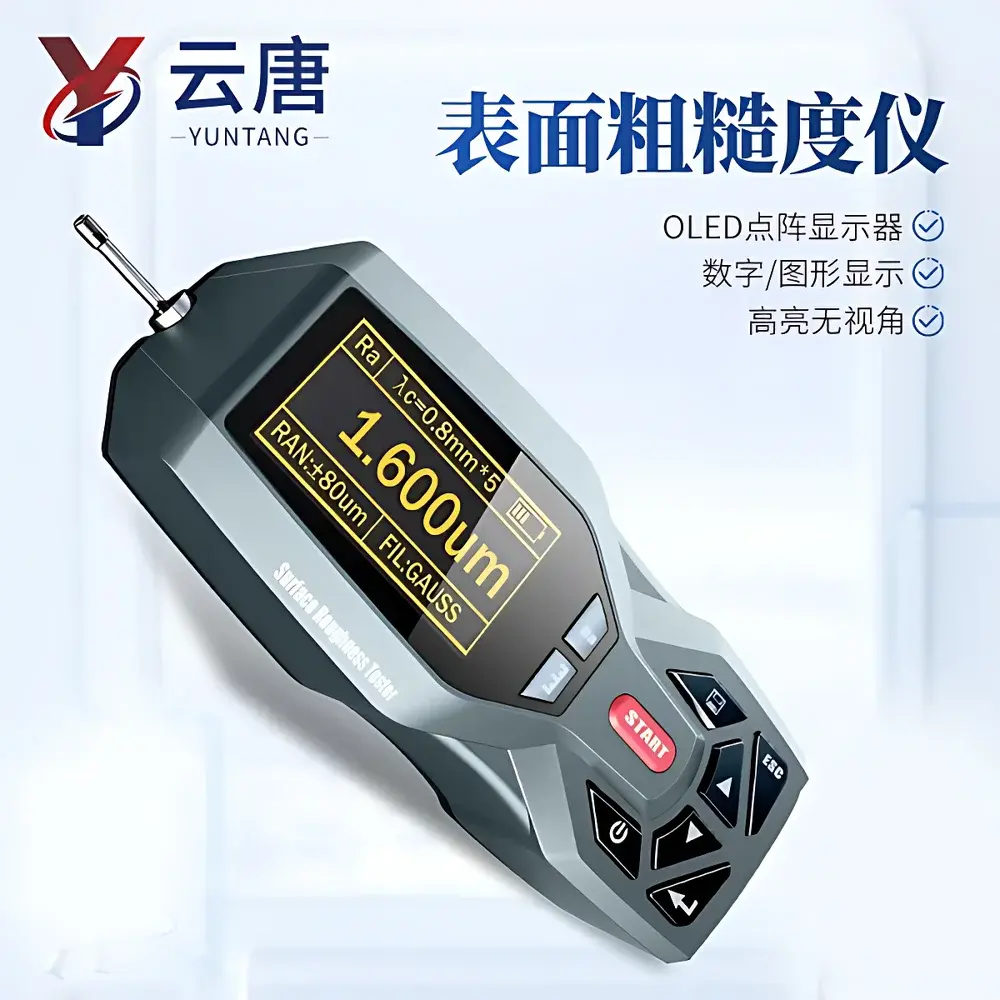
Yuntang RT-200 Portable High-Precision Surface Roughness Tester
| Brand | Yuntang |
|---|---|
| Origin | Shandong, China |
| Manufacturer Type | OEM/ODM Manufacturer |
| Country of Origin | China |
| Model | RT-200 |
| Price Range | USD 560 – 920 |
| Measurement Principle | Inductive Contact Profilometry (Stylus-Based) |
| Display | 128×64 OLED Dot-Matrix |
| Battery | Rechargeable Li-ion, >20 h Continuous Operation |
| Data Storage | 100 Sets (Raw Profile + Parameters) |
| Compliance | ISO 4287, ISO 4288, DIN EN ISO 3274, ANSI B46.1, JIS B 0601, JIS B 0611 |
| Measured Parameters | Ra, Rz, Rq, Rt, Rp, Rv, R3z, R3y, RzJIS, Rsk, Rku, Rsm, Rmr |
| Sampling Length | 0.25 mm / 0.8 mm / 2.5 mm (Auto-selectable per standard) |
| Cutoff Wavelength | λc = 0.25 / 0.8 / 2.5 mm |
| Vertical Resolution | 0.01 µm |
| Traverse Speed | 0.5 mm/s (standard), 0.1–1.0 mm/s adjustable |
| Stylus Tip Radius | 5 µm (diamond, 90° included angle) |
| Force | 4 mN (standard), 0.75–15 mN programmable |
| Interface | USB 2.0 (for PC communication & firmware update) |
| Optional Accessory | Thermal Printer Module |
Overview
The Yuntang RT-200 is a portable, microprocessor-controlled surface roughness tester engineered for high-reproducibility contact profilometry in industrial metrology environments. It operates on the principle of inductive stylus-based measurement: a diamond-tipped probe (5 µm radius, 90° included angle) traverses the surface at a precisely controlled speed (0.5 mm/s nominal), converting mechanical displacement into an analog inductance signal via a differential coil system. This analog output undergoes phase-sensitive demodulation, amplification, and digitization before being processed by a dedicated DSP engine. The instrument implements digital Gaussian filtering per ISO 16610-21 to separate roughness, waviness, and form components, ensuring traceable compliance with international surface texture standards.
Key Features
- Compact, ergonomic handheld design (185 × 72 × 42 mm; 320 g) optimized for field use in production lines, inspection booths, and mobile calibration services;
- Dual-mode display: 128×64 monochrome OLED screen supporting simultaneous numeric parameter readout and real-time profile waveform visualization — viewable under direct sunlight with zero viewing-angle dependency;
- Full-parameter computation per ISO 4287 and ANSI B46.1, including amplitude (Ra, Rq, Rz, Rt, Rp, Rv), spacing (Rsm), hybrid (Rmr), and statistical descriptors (Rsk, Rku);
- Programmable measurement force (0.75–15 mN) and traverse speed (0.1–1.0 mm/s) to accommodate soft polymers, hardened steels, and coated substrates without surface damage or probe skip;
- Onboard real-time clock (RTC) with timestamped data logging; automatic file naming and sequential group indexing for audit-ready recordkeeping;
- Rechargeable lithium-ion battery with state-of-charge indicator, intelligent charging circuitry, and >20 hours of continuous operation on a single charge;
- Robust mechanical architecture: IP53-rated enclosure, anti-stall motor control logic, and error-resilient firmware with self-diagnostic boot sequence;
- USB 2.0 interface compliant with CDC ACM class for seamless integration with Windows/Linux PCs; supports raw profile export (.txt, .csv) and proprietary binary format for advanced analysis;
- Configurable auto-power management: programmable idle timeout, sleep mode activation, and graceful shutdown to preserve battery life and measurement integrity.
Sample Compatibility & Compliance
The RT-200 is validated for quantitative assessment of machined, ground, polished, EDM-finished, and additive-manufactured surfaces across metallic (aluminum alloys, stainless steel, titanium), polymeric (ABS, PEEK, PC), and ceramic substrates. Its modular stylus assembly enables rapid tip replacement and calibration verification using certified step-height artifacts traceable to NIST or PTB reference standards. The device meets essential requirements of ISO/IEC 17025:2017 for in-house calibration laboratories and supports GLP/GMP documentation workflows through time-stamped, non-editable data records. All filter algorithms, cutoff selection logic, and parameter definitions conform strictly to ISO 16610 series (Gaussian robust filters), ISO 4287 (roughness parameters), and ISO 4288 (lay and sampling length rules). Export configurations include full ANSI B46.1 and JIS B 0601 parameter mapping for multinational manufacturing sites.
Software & Data Management
Bundled Yuntang SurfaceLab PC software (v3.2+) provides post-processing capabilities including spectral analysis, bearing ratio curve (Abbott-Firestone), material ratio curve fitting, and multi-trace comparative overlay. Raw profile data is stored in IEEE 754-compliant 32-bit floating-point format, enabling third-party interoperability with Metrology Software Suite (MSS), MountainsMap®, and MATLAB®. The software enforces 21 CFR Part 11-compliant user authentication, electronic signatures, and immutable audit trails for regulated industries. Data export options include PDF reports with embedded calibration certificates, CSV for SPC charting, and XML for MES/ERP integration. Firmware updates are delivered via signed binary packages with SHA-256 hash verification to ensure device integrity.
Applications
- Automotive powertrain component verification (crankshaft journals, cylinder bores, cam lobes);
- Aerospace turbine blade root fillet and leading-edge finish evaluation;
- Medical device surface characterization (orthopedic implant articulating surfaces, dental abutment threads);
- Electronics heat sink fin roughness validation for thermal interface material (TIM) bonding efficacy;
- Quality gate inspection in metal injection molding (MIM) and selective laser melting (SLM) production lines;
- Supplier qualification audits requiring on-site, ISO-compliant surface texture evidence;
- Educational labs for hands-on teaching of surface metrology fundamentals and GD&T symbology interpretation.
FAQ
What surface finish standards does the RT-200 support natively?
The instrument implements ISO 4287, ISO 4288, DIN EN ISO 3274, ANSI B46.1, and JIS B 0601 parameter definitions and filtering protocols without external software dependency.
Can the RT-200 measure curved or inclined surfaces?
Yes — its articulated probe arm and low-profile base allow stable placement on convex radii down to 5 mm and inclinations up to ±15°; optional V-block and spherical adapters extend capability to cylindrical parts.
Is calibration traceability provided with the unit?
Each shipment includes a factory calibration certificate referencing NIST-traceable step-height standards (1 µm and 5 µm), with uncertainty budgets stated per ISO/IEC 17025 Annex A.
How is data integrity ensured during field use?
All measurements are tagged with UTC timestamp, operator ID (via PIN), probe serial number, and environmental metadata (battery level, ambient temperature range); no parameter can be edited post-acquisition.
Does the RT-200 support automated reporting for ISO 9001 documentation?
Yes — SurfaceLab software generates customizable PDF reports with company header, revision control, signature fields, and embedded calibration status indicators compliant with ISO 9001:2015 Clause 7.1.5.