
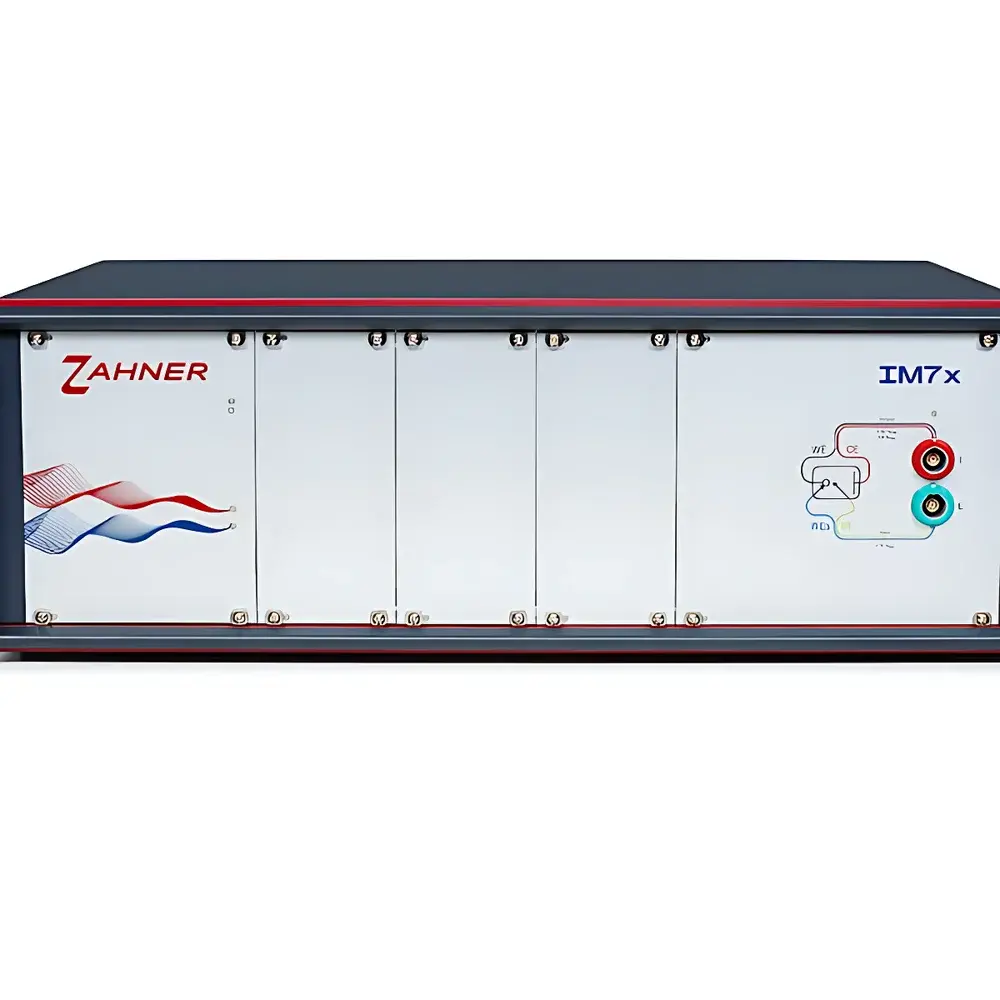
Zahner IM7x Electrochemical Workstation
| Brand | Zahner |
|---|---|
| Origin | Germany |
| Model | IM7x |
| Instrument Type | Electrochemical Workstation |
| Channel Count | Single-Channel |
| Current Range | ±4 A |
| EIS Frequency Range | 10 µHz – 12 MHz |
| Potentiostat Bandwidth | DC – 15 MHz |
| ADC Resolution | 32 bit |
| Input Impedance | >10 TΩ |
| Applied Potential Range | ±15 V |
| Cell Voltage Range | ±32 V |
| Voltage Resolution | 2.5 nV / 7.5 nV |
| Current Resolution | ±2 aA (±2 × 10⁻¹⁸ A) |
| Output Current Accuracy | ±0.025% of reading ± 0.01% of FS (≥3 µA to 300 mA) |
| Rise Time (Small Signal) | 150 ns – 200 µs (5 auto-ranging steps) |
| IR Compensation | Real-time, adaptive EIS-based |
| Grounding Mode | Switchable floating/grounded |
| Communication Interface | Gigabit Ethernet |
| Internal Storage | 40 GB SSD |
| Software Platform | Zahner Lab (Windows 11, Linux, macOS compatible) |
| API Support | Python/C++ SDK included |
| Compliance | Designed for GLP/GMP-aligned workflows |
Overview
The Zahner IM7x Electrochemical Workstation is a high-performance, research-grade potentiostat/galvanostat engineered for precision electrochemical characterization across demanding academic, industrial, and regulatory environments. Built upon a modular hardware architecture and driven by the next-generation Zahner Lab software platform, the IM7x implements true dual-channel analog signal processing with 32-bit high-dynamic-range (HDP) analog-to-digital conversion and real-time digital signal synthesis. Its core measurement principle relies on four-terminal (Kelvin) sensing, low-noise current-to-voltage conversion, and digitally synchronized waveform generation—enabling accurate control and acquisition under conditions ranging from ultra-low-current nanoelectrode studies to high-power battery stack impedance profiling. With a DC–15 MHz potentiostat bandwidth and an EIS frequency range spanning 10 µHz to 12 MHz, the IM7x supports both steady-state kinetic analysis and time-resolved interfacial phenomena—including dielectric relaxation, charge-transfer resistance evolution, and solid-electrolyte interphase (SEI) dynamics.
Key Features
- Single-channel workstation with optional expansion to multi-channel EIS or external potentiostat modules
- Ultra-low current resolution of ±2 aA (2 × 10⁻¹⁸ A) enabled by 32-bit ADC and optimized front-end filtering
- Maximum output current of ±4 A and cell voltage compliance up to ±32 V for high-power electrochemical systems
- 10 µHz–12 MHz electrochemical impedance spectroscopy with <0.0025% frequency accuracy and 10,000 points/decade resolution
- Switchable floating/grounded operation mode for compatibility with grounded reference electrodes, fuel cell test stations, or battery cycler integration
- Gigabit Ethernet interface enabling deterministic latency, remote lab access, and synchronized multi-instrument control
- Onboard 40 GB SSD for local data buffering, ensuring uninterrupted acquisition during network interruptions or high-throughput sequences
- Real-time, adaptive IR compensation using EIS-derived system identification—no manual L/R parameter estimation required
- Sub-200 ns small-signal rise time across 5 auto-ranging current ranges, preserving transient fidelity in pulse and step experiments
Sample Compatibility & Compliance
The IM7x accommodates diverse electrochemical configurations including three-electrode cells, rotating disk electrodes (RDE), rotating ring-disk electrodes (RRDE), microelectrodes, battery coin cells, pouch cells, flow cells, and full-stack fuel cell test rigs. Its input impedance (>10 TΩ) minimizes loading errors on high-impedance samples such as insulating coatings, polymer electrolytes, and corrosion-inhibiting films. The instrument is designed to support analytical workflows compliant with ISO 17025, ASTM G102 (corrosion rate calculation), ASTM E2918 (EIS for organic coatings), and IEC 62660-2 (lithium-ion battery impedance validation). When deployed with configured user access controls, electronic signatures, and audit-trail logging via Zahner Lab, the system meets foundational requirements for FDA 21 CFR Part 11 adherence in regulated R&D and quality control laboratories.
Software & Data Management
Zahner Lab is a cross-platform (Windows 11, Linux, macOS), modular electrochemical software suite built around a structured experiment workflow paradigm. It features a Blockly-based visual sequencer that allows users to construct repeatable, parameterized test protocols—such as GITT/PITT for lithium-ion diffusion analysis, multi-step polarization curves with in-situ EIS, or corrosion potential monitoring with periodic impedance snapshots—without coding. All experiments are stored in HDF5 format with embedded metadata (timestamp, instrument ID, calibration state, environmental conditions), ensuring FAIR (Findable, Accessible, Interoperable, Reusable) data principles. Remote access is supported via authenticated Ethernet connections; multiple clients may monitor a single IM7x simultaneously, while exclusive control is granted to one active session to prevent conflicting commands. The software includes native EIS equivalent-circuit fitting (Z-HIT validation, Kramers–Kronig consistency checks), Mott–Schottky analysis, NFRA (nonlinear frequency response analysis), and time-domain techniques including chronoamperometry, chronopotentiometry, and differential pulse voltammetry. A documented Python/C++ API enables integration with LabVIEW, MATLAB, or custom MES/QMS platforms.
Applications
- Electrocatalysis and fuel cell catalyst layer characterization (ORR, OER, HOR kinetics)
- Lithium-ion and solid-state battery development: SEI growth monitoring, Li⁺ diffusion coefficient mapping, degradation pathway identification
- Photoelectrochemical systems: IPCE, incident photon-to-current efficiency, and transient photocurrent decay analysis
- Corrosion science: electrochemical noise analysis (ENA), localized corrosion mapping, inhibitor performance quantification
- Supercapacitor electrode material evaluation: capacitance retention, ESR tracking, aging under galvanostatic cycling
- Sensor development: amperometric detection limits, selectivity screening, fouling resistance assessment
- Coating integrity testing: pore resistance, water uptake modeling, delamination onset detection via low-frequency EIS
- Fundamental physical electrochemistry: double-layer capacitance, uncompensated resistance correction, electron transfer rate constant extraction
FAQ
What is the maximum number of cells that can be measured simultaneously for EIS using the IM7x?
The base IM7x supports parallel EIS on up to 33 individual cells within a single stack when equipped with the optional Multi-Cell EIS module and appropriate multiplexing hardware.
Does the IM7x support true bipotentiostat operation for RRDE measurements?
Yes—the IM7x can be expanded with an external bipotentiostat module or integrated with a dedicated RRDE controller to enable independent potential control of ring and disk electrodes.
Can Zahner Lab export raw data in ASCII or CSV format for third-party analysis?
Yes—Zahner Lab provides configurable export options including tab-delimited ASCII, CSV, and MATLAB (.mat) formats, preserving all metadata and scaling information.
Is firmware update capability available over Ethernet without requiring physical access?
Yes—firmware updates, calibration file uploads, and configuration backups can be performed remotely via the web-based device manager embedded in the IM7x’s Ethernet interface.
How does the IM7x handle grounding conflicts in setups involving grounded power supplies or battery cyclers?
The switchable floating/grounded mode allows seamless integration with externally grounded equipment while maintaining measurement integrity through isolated signal paths and differential sensing.
Related Products






