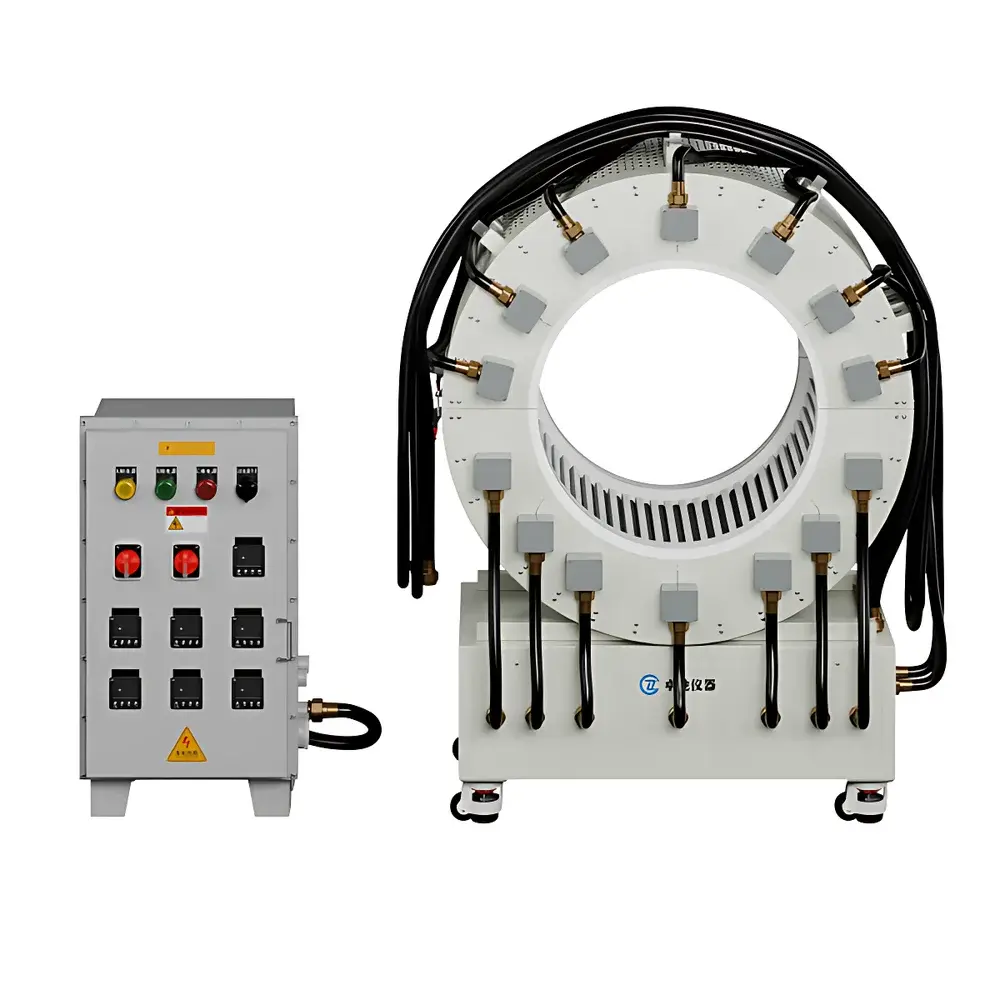
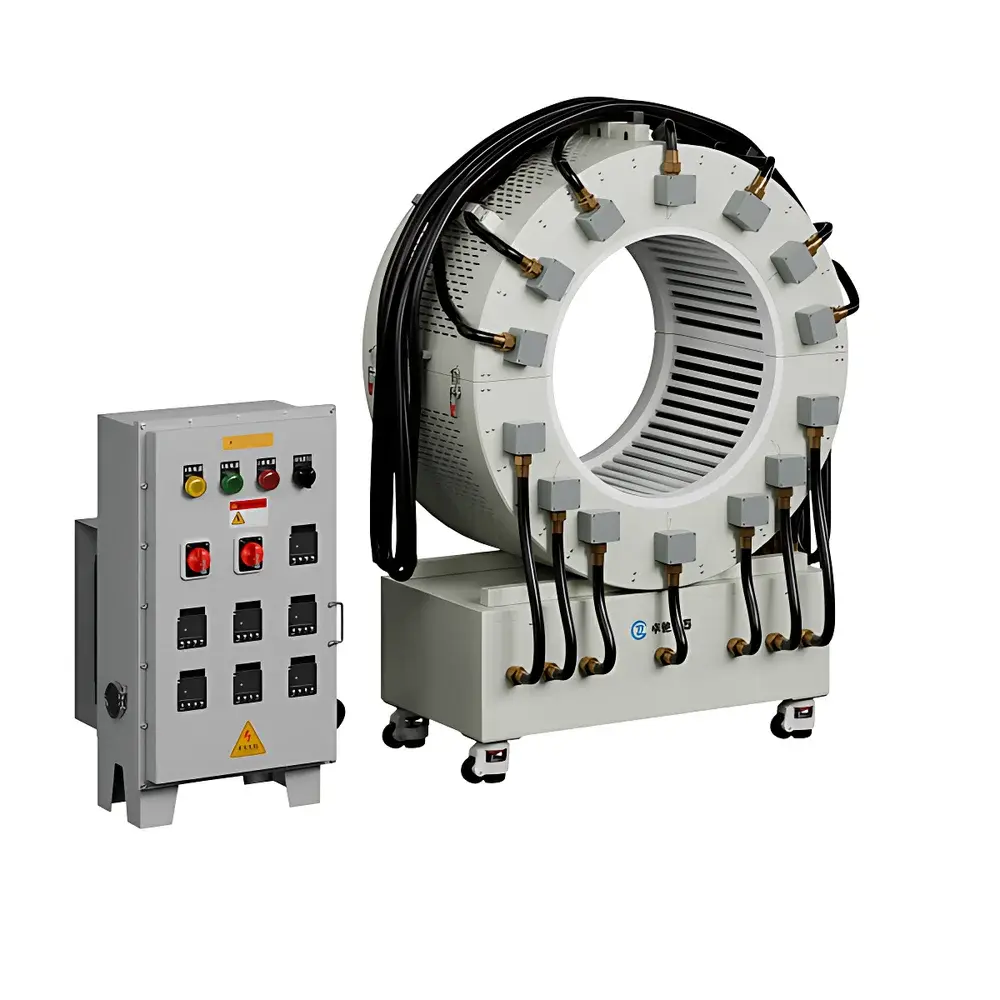
ZC-K740 Open-Type Horizontal Large-Diameter Rapid Thermal Annealing Furnace
| Brand | ZOCHI |
|---|---|
| Origin | Zhejiang, China |
| Model | ZC-K740 |
| Instrument Type | Non-Vacuum Rapid Thermal Annealing Furnace |
| Sample Dimensions | 1.2 m × 1.5 m (max. loading footprint) |
| Temperature Range | 300–1000 °C |
| Max. Heating Rate | 30 °C/min |
| Cooling Rate | 20 °C/s |
| Temperature Uniformity | ±1 °C across heated zone |
| Heating Configuration | 6 independently controlled zones |
| Heated Zone Diameter | 740 mm |
| Chamber Inlet/Outlet Diameter | 630 mm |
| Heated Zone Length | 450 mm |
| Internal Cavity Dimensions | Ø630 mm × 550 mm |
| Heating Element | Insulated quartz tube heaters |
| Display Resolution | 1 °C |
| Safety Certification | Explosion-proof control cabinet (IEC 60079-compliant enclosure design) |
Overview
The ZC-K740 Open-Type Horizontal Large-Diameter Rapid Thermal Annealing Furnace is engineered for high-precision thermal processing of large-format semiconductor wafers, photovoltaic substrates, and advanced ceramic or metal thin-film samples. It operates on rapid thermal processing (RTP) principles—utilizing localized, high-intensity radiant heating from quartz-encapsulated heating elements to achieve precise, repeatable thermal profiles without vacuum requirements. Unlike conventional batch furnaces, the ZC-K740 delivers fast thermal ramping (up to 30 °C/min) and rapid cooling (20 °C/s), minimizing thermal budget while maintaining strict uniformity (±1 °C across the 740 mm-diameter heated zone). Its open horizontal configuration supports seamless integration into inline fabrication workflows and enables straightforward manual or robotic loading of substrates up to 1.2 m × 1.5 m—ideal for flat-panel display TFT annealing, SiC epitaxy pre-treatment, and large-area transparent conductive oxide (TCO) activation.
Key Features
- Open horizontal architecture with front-access loading—designed for easy maintenance, visual inspection, and compatibility with automated material handling systems.
- Six independently controlled heating zones ensure axial and radial temperature homogeneity; each zone features PID-based closed-loop regulation with real-time thermocouple feedback (type K, embedded in furnace wall).
- 740 mm-diameter heated zone with tapered 630 mm inlet/outlet ports—optimized geometry enhances thermal retention and reduces edge cooling effects during transient heating cycles.
- Quartz-insulated tubular heating elements mounted circumferentially along the furnace wall—eliminates metallic contamination risks associated with embedded resistance wire, improves dielectric stability at high temperatures, and extends service life under repeated thermal cycling.
- Explosion-proof control cabinet compliant with IEC 60079-1 (flameproof enclosure) and IEC 60079-7 (increased safety)—featuring aluminum heat-sink panels, external finned radiators, and intrinsically safe forced-air cooling fans.
- Integrated safety interlocks including overtemperature cutoff, door-open shutdown, gas purge monitoring (optional N₂ or forming gas), and emergency power-off circuitry meeting SEMI S2-0215 requirements.
Sample Compatibility & Compliance
The ZC-K740 accommodates rigid and semi-rigid planar substrates including silicon wafers (up to 200 mm equivalent area coverage), glass panels (Gen 2–Gen 4), ceramic tiles, and metal foils. Its non-vacuum operation eliminates outgassing concerns and simplifies process qualification under ambient or controlled-atmosphere conditions (N₂, Ar, or forming gas via optional mass flow controller). The system conforms to key industry standards: ASTM F1528 (RTP equipment qualification), SEMI E10 (definition of equipment reliability metrics), and ISO 9001:2015 manufacturing controls. Full traceability logs—including temperature setpoints, actual profiles, alarm events, and operator IDs—are retained for GLP/GMP-aligned audit readiness.
Software & Data Management
Equipped with a Windows-based HMI running proprietary ZOCHI RTP Control Suite, the furnace supports recipe-driven operation with up to 99 programmable thermal cycles. Each recipe stores ramp rates, soak durations, atmosphere parameters, and zone-specific setpoints. Real-time graphing displays all six zone temperatures versus time with 1-second logging resolution. Data export is available in CSV and XML formats compatible with MES platforms (e.g., Siemens Opcenter, Camstar). Optional 21 CFR Part 11 compliance package includes electronic signatures, role-based access control, and immutable audit trails for regulated semiconductor manufacturing environments.
Applications
- Activation annealing of ion-implanted dopants in Si, Ge, and compound semiconductors (e.g., GaAs, InP)
- Crystallization of amorphous silicon (a-Si) and metal oxide TFT backplanes for OLED and LCD production
- Stress relief and grain growth optimization in sputtered ITO, AZO, and IGZO films
- Pre-epitaxy surface cleaning and desorption for SiC and GaN heterostructures
- Thermal stabilization of piezoelectric thin films (e.g., AlN, PZT) on MEMS substrates
- Low-thermal-budget metallization annealing for Cu/low-k interconnect integration
FAQ
What atmosphere options are supported?
Standard operation is in ambient air or inert nitrogen; optional gas delivery modules support argon, forming gas (95% N₂/5% H₂), or vacuum purging (down to 10⁻² mbar) with leak-checked seals.
Is the furnace compatible with automated wafer handling?
Yes—the open horizontal design and standardized 300 mm mounting interface enable integration with SECS/GEM-compliant robotic loaders and aligners.
How is temperature uniformity validated?
Uniformity is verified per ASTM F1528 using a 9-point thermocouple mapping grid across the heated zone at 600 °C and 900 °C; calibration certificates include full uncertainty budgets (k=2).
Can the system be upgraded for vacuum operation?
No—the ZC-K740 is structurally optimized for atmospheric RTP; vacuum-capable variants (e.g., ZC-K740-V) are available as separate models with reinforced flanges and differential pumping stages.
What maintenance intervals are recommended?
Quartz heater inspection every 500 operating hours; thermocouple recalibration annually or after 1000 thermal cycles; fan filter replacement quarterly under continuous use.