
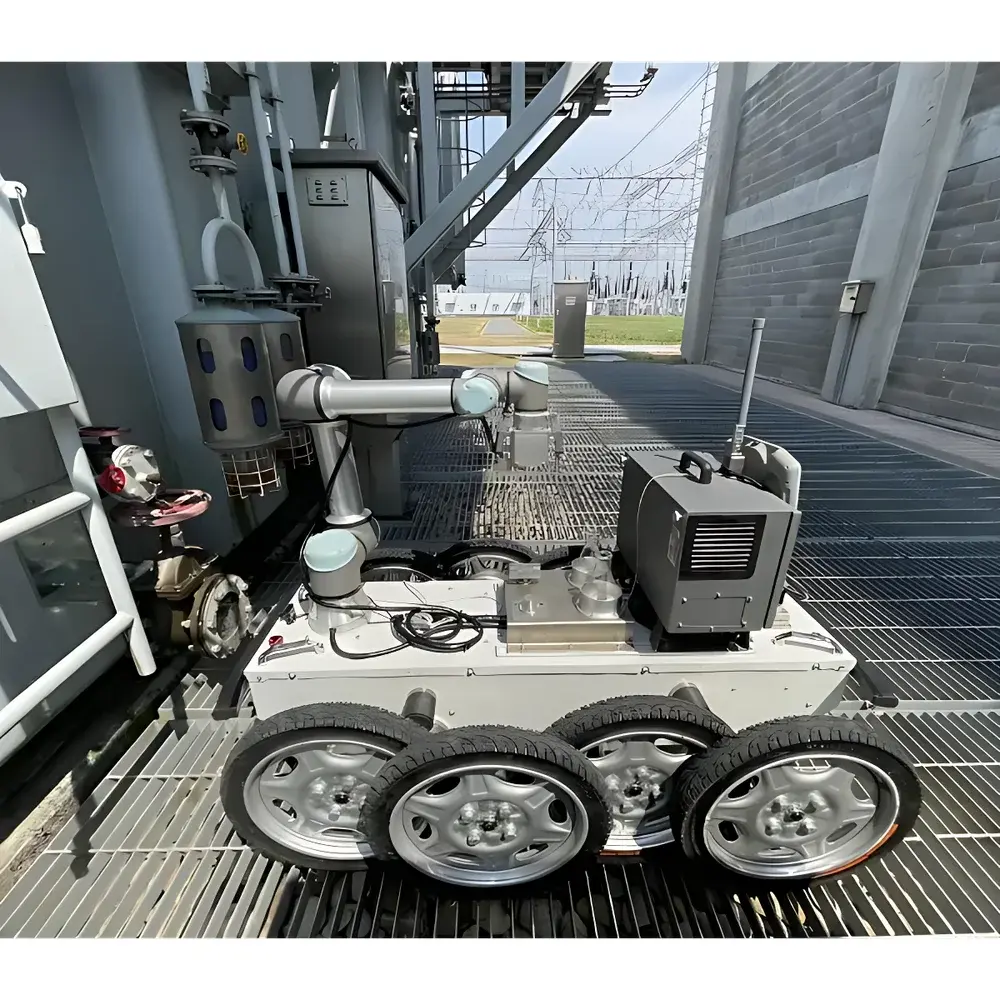
Zealquest AI SMR-COM Collaborative Operation & Maintenance Robot for Power Substations
| Brand | Zealquest AI Netherlands |
|---|---|
| Origin | Shanghai, China |
| Manufacturer Type | Authorized Distributor |
| Country of Origin | China |
| Model | Zealquest-AI SMR-COM |
| Pricing | Available Upon Request |
| Dimensions (L×W×H) | <1400×800×1500 mm |
| Curb Weight | 300 kg |
| Mobility System | All-terrain chassis with planetary swing-wheel suspension, 8-wheel 4-wheel-drive |
| Max Speed | 5 km/h |
| Obstacle Clearance | 350 mm |
| Trench Crossing Width | 500 mm |
| Climbing Angle | 35° |
| Turning Diameter Under Load | ≤2.2 m |
| Control Modes | Wireless remote control + autonomous navigation |
| Battery Endurance | ≥8 h (typical operational cycle) |
| Video & Data Transmission Range | 500 m (line-of-sight, 2.4/5.8 GHz dual-band RF) |
| Water Immersion Depth | 300 mm |
| Payload Capacity | 100 kg |
| IP Rating | IP65 |
| Robotic Arm Reach | 850 mm (33.5 in) |
| Robotic Arm Payload | 5 kg (11 lbs) |
| Pan-Tilt Unit | 360° continuous pan, -90° to +90° tilt |
| Visible Light Camera | 2560 × 1440 resolution, 5–160 mm motorized zoom lens |
| Thermal Imaging Camera | 384 × 288 resolution, 7–25 mm fixed-focus lens (optional calibrated variant available) |
| Optional Modules | Acoustic monitoring, handheld intelligent remote terminal, AI-powered obstacle avoidance, multi-gas detection (CH₄, SF₆, CO, O₂), bidirectional VoIP intercom, warning beacon, mesh networking bridge, auto-docking charging station, embedded AI vision inference engine (ONNX/TensorRT support), custom ROS2 middleware integration |
Overview
The Zealquest AI SMR-COM Collaborative Operation & Maintenance Robot is an industrial-grade mobile robotic platform engineered specifically for high-voltage and ultra-high-voltage (UHV) substation environments. Designed to operate within the stringent safety, electromagnetic compatibility (EMC), and environmental constraints of live power infrastructure, the SMR-COM integrates a rugged all-terrain mobility base, a dexterous 6-DOF robotic arm, and a dual-spectrum perception suite—comprising high-resolution visible-light and uncooled microbolometer thermal imaging—to enable supervised autonomy and human-in-the-loop teleoperation. Its core operational paradigm follows ISO/IEC 23053-compliant robotic system architecture for critical infrastructure monitoring, supporting both scheduled patrol routines and on-demand intervention tasks under IEC 61850-9-3 time-synchronized operation. Unlike generic service robots, the SMR-COM adheres to IEEE 1622.1 guidelines for substation robotics interoperability and features EMI-hardened power electronics rated for Class III substation electromagnetic environments per IEC 61000-4-3 and IEC 61000-4-6.
Key Features
- Planetary swing-wheel suspension with eight independently articulated wheels provides exceptional terrain adaptability—enabling stable traversal across gravel beds, grassy embankments, uneven concrete slabs, and steep inclines up to 35° without loss of traction or sensor alignment.
- AI-augmented robotic arm (850 mm reach, 5 kg payload) supports precise teleoperated manipulation—including valve actuation, enclosure door opening, and sample container handling—via low-latency haptic feedback enabled by sub-100 ms end-to-end control loop latency.
- Dual-modal optical payload delivers synchronized visible-light and thermal imagery with georeferenced metadata; visible camera supports OCR-based meter reading compliant with ANSI C12.20 and IEC 62056 standards, while thermal imaging enables predictive thermographic inspection per ASTM E1934 and IEC 60270.
- Embedded AI vision stack performs real-time personnel identification (ISO/IEC 19794-5), PPE compliance verification, abnormal behavior detection (e.g., unauthorized access, ladder misuse), and leak localization via pixel-level thermal gradient analysis.
- IP65-rated enclosure and flame-retardant, heat-resistant rubber track material ensure reliable operation in ambient temperatures from −20 °C to +50 °C—validated per IEC 60068-2-1, IEC 60068-2-2, and IEC 60068-2-14.
- Autonomous docking capability integrates with IEEE 802.11ac/ax Wi-Fi 6 and optional 5G NR-U modules for seamless handover between local APs and wide-area telemetry networks during extended patrols.
Sample Compatibility & Compliance
The SMR-COM is certified for deployment in AC/DC converter stations, GIS substations, and open-air switchyards operating at nominal voltages up to 1100 kV. It complies with EN 50121-3-2 (railway EMC adaptation for industrial zones), GB/T 17626 series (Chinese national EMC standard aligned with IEC 61000-4), and DL/T 1533–2016 (China’s technical specification for intelligent patrol robots in substations). All onboard sensors meet SIL2 functional safety requirements per IEC 61508 when configured with redundant obstacle detection pathways. The platform supports audit-ready data logging aligned with GLP principles, including immutable timestamps, operator ID binding, and cryptographic signature of inspection reports per NIST SP 800-90B entropy standards.
Software & Data Management
The robot operates on a ROS2 Foxy-based middleware framework with deterministic real-time scheduling (PREEMPT_RT kernel patch). Its mission planning interface—accessible via web browser or dedicated handheld terminal—supports waypoint-based patrol scripting, dynamic route optimization using D* Lite algorithm, and over-the-air firmware updates signed with X.509 v3 certificates. Inspection data is structured in OPC UA PubSub format (IEC 62541 Part 14) and ingested into vendor-agnostic time-series databases (InfluxDB or TimescaleDB). Full audit trails—including command history, sensor calibration logs, and AI inference confidence scores—are retained for ≥36 months and exportable in CSV/JSON-LD for regulatory submission under China’s Cybersecurity Law Article 21 and EU NIS2 Directive Annex I reporting obligations.
Applications
- Automated infrared thermography of bushings, disconnect switches, and transformer cooling fins during peak-load conditions.
- Remote verification of relay protection panel status lights and analog meter readings with ±0.5% digitization accuracy.
- Post-fault visual documentation of arcing damage, insulator contamination, or oil leakage using geo-tagged HD video sequences.
- Continuous environmental monitoring via modular gas sensors—supporting SF₆ leak detection down to 1 ppmv and combustible gas screening per IEC 60079-29-1.
- Human-robot collaborative maintenance: technician guides arm motion via augmented reality overlay on tablet display while robot maintains stable platform posture on sloped terrain.
- Regulatory compliance reporting: automated generation of DL/T 741–2019-mandated patrol summary reports with digital signature and timestamped evidence attachments.
FAQ
Does the SMR-COM support integration with existing SCADA or EMS systems?
Yes—the platform provides native OPC UA server functionality and supports Modbus TCP gateway mode for legacy protocol bridging. Integration kits include pre-certified drivers for Siemens Desigo CC, GE Digital Predix, and Nari D5000 environments.
What is the calibration interval for thermal imaging and visible-light cameras?
Thermal modules require annual NIST-traceable calibration; visible-light cameras are factory-calibrated for geometric distortion and color fidelity per ISO 12233, with field recalibration supported via QR-coded test charts.
Can the robot operate autonomously in GPS-denied indoor switch rooms?
Yes—using SLAM-based localization (Cartographer ROS2 port) fused with UWB anchor beacons (IEEE 802.15.4a) and inertial odometry, achieving ≤15 cm positional uncertainty over 8-hour missions without external positioning aids.
Is source code access available for custom AI model deployment?
Qualified partners receive Dockerized inference runtime containers and ONNX model import toolchain under a commercial license agreement; full ROS2 source code is available under a separate OEM development agreement.
How is cybersecurity ensured during remote operation?
All wireless links enforce TLS 1.3 encryption; remote sessions require hardware-bound MFA tokens compliant with FIDO2 WebAuthn; firmware signing uses RSA-3072 keys managed in HSM-backed PKI infrastructure.
Related Products





