
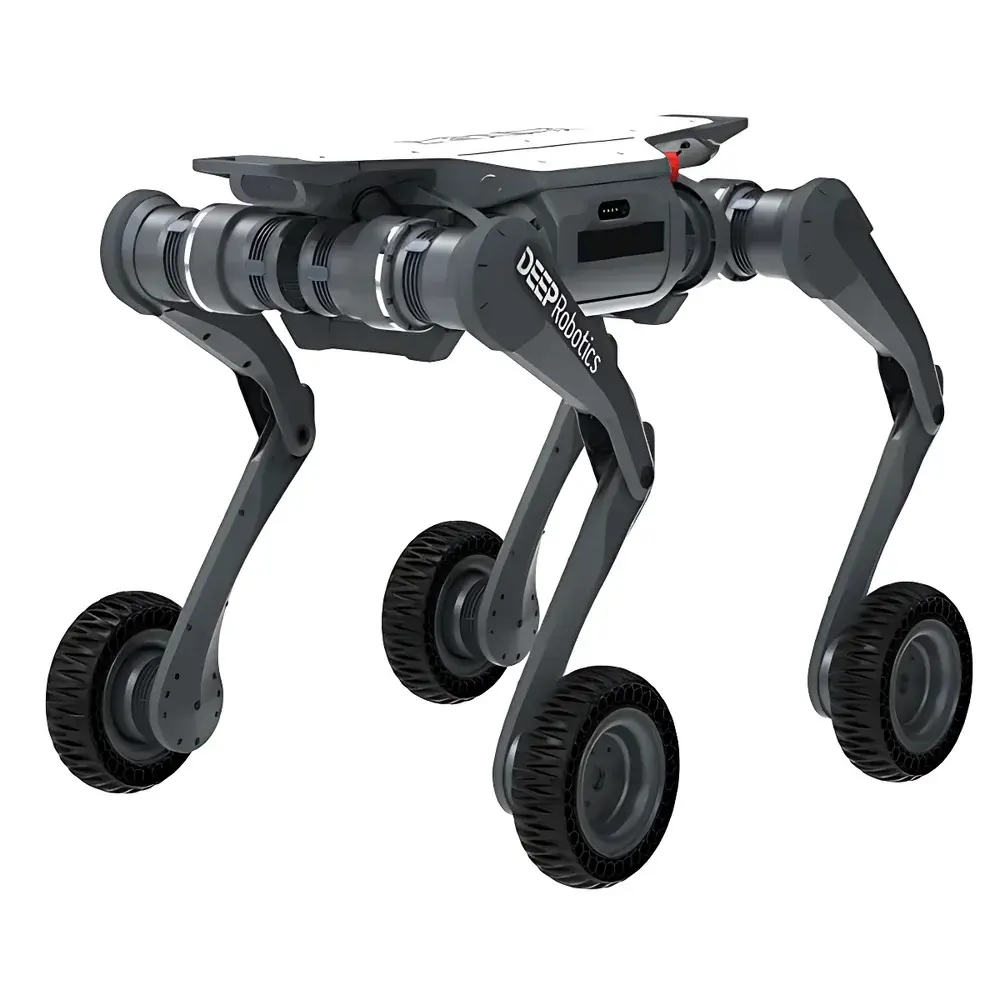
Zealquest AI SpecBotics-20 Lynx All-Terrain Mobile Robot Platform
| Brand | Zealquest AI Netherlands |
|---|---|
| Origin | Shanghai, China |
| Manufacturer Type | Authorized Distributor |
| Country of Origin | China |
| Model | SpecBotics-20 |
| Pricing | Available Upon Request |
| Dimensions (Standing) | 0.8 m × 0.5 m × 0.6 m |
| Weight | 30 kg |
| Payload Capacity | 12 kg |
| Max Speed | 5 m/s |
| Stair Climbing Capability | 22 cm continuous steps |
| Vertical Obstacle Clearance | 80 cm |
| Battery Runtime | 1.5–3 h (dual hot-swap Li-ion) |
| Range | 15 km |
| IP Rating | IP54 |
| Operating Temperature | 0–40 °C |
| Camera | 1080p Wide-Angle Visual Sensor |
| Connectivity | Wi-Fi, GNSS (GPS/BeiDou), OTA Firmware Updates |
| Control Interface | Handheld Remote, Mobile App, Real-Time Video Telemetry |
Overview
The Zealquest AI SpecBotics-20 Lynx is a purpose-built all-terrain mobile robot platform engineered for demanding field operations in power infrastructure inspection, substation monitoring, and utility corridor reconnaissance. Unlike conventional wheeled or tracked platforms, the Lynx integrates a hybrid wheel-leg locomotion architecture—enabling dynamic gait adaptation across unstructured environments including gravel, rubble, grass, stairs, and uneven concrete surfaces. Its operational principle relies on real-time terrain perception fused with model-predictive motion control, allowing stable traversal of 22 cm continuous vertical steps and static vertical obstacles up to 80 cm. Designed for integration into industrial IoT ecosystems, the platform serves as a modular carrier for thermal imaging, partial discharge detection, LiDAR mapping, and acoustic emission sensors—making it suitable for compliance-driven workflows aligned with IEC 61850, IEEE 1626, and China’s DL/T 1579–2016 standards for intelligent power equipment inspection.
Key Features
- Hybrid wheel-leg mobility system delivering optimal trade-off between speed (up to 5 m/s on flat terrain) and agility on discontinuous terrain
- Hot-swappable dual lithium-ion battery architecture supporting uninterrupted operation and rapid field recharging via integrated fast-charge battery management unit
- IP54-rated enclosure ensuring protection against dust ingress and water splashing—validated for outdoor deployment under rain, fog, and high-humidity conditions typical of transmission line corridors
- Onboard 1080p wide-angle visual sensor with low-latency H.265 video streaming over encrypted Wi-Fi (IEEE 802.11ac) and real-time telemetry overlay (battery status, GNSS position, IMU orientation)
- Firmware-upgradable control stack compliant with ISO/IEC 15408 (Common Criteria) functional requirements for secure remote operation and audit-ready firmware versioning
- ROS 2 Foxy-compatible middleware layer enabling seamless integration with SLAM, path planning, and edge AI inference modules for autonomous patrol scripting
Sample Compatibility & Compliance
The SpecBotics-20 Lynx is not a measurement instrument per se but a certified robotic carrier platform meeting mechanical and electromagnetic compatibility requirements for use in Class I, Division 2 hazardous locations (per ANSI/ISA-12.12.01). It complies with GB/T 18655–2018 (EMI emissions), GB/T 17626.2–2018 (ESD immunity), and EN 61000-6-2/6-4 for industrial environments. Its structural load capacity (12 kg payload) supports standardized mounting interfaces for third-party certified sensors—including FLIR Axxx-series thermal imagers, UltraTEV Plus® partial discharge detectors, and Leica BLK2GO LiDAR units—ensuring traceable calibration chains per ISO/IEC 17025 when deployed in accredited laboratory or field QA/QC programs.
Software & Data Management
The Lynx platform operates under Zealquest AI’s proprietary SpecOS—a deterministic real-time OS built on Zephyr RTOS with POSIX-compliant application layer. The SpecControl Suite provides web-based dashboard access (HTTPS/TLS 1.3), role-based user permissions, and full audit trail logging in accordance with FDA 21 CFR Part 11 and GLP Annex 11 requirements. All mission data—including video streams, GNSS trajectories, and sensor timestamps—is stored in vendor-agnostic .bag (ROS2) or ASAM ODS-compliant formats. Over-the-air (OTA) updates are cryptographically signed and verified using ECDSA-P256, with rollback capability and versioned firmware manifest storage.
Applications
- Autonomous infrared thermography patrols of transformer banks, GIS enclosures, and overhead line terminations
- Visual and acoustic inspection of insulators, bushings, and grounding grids in substations with limited human access
- Pre-commissioning verification of cable trench alignment and conduit integrity along right-of-way corridors
- Post-storm damage assessment in mountainous or flood-affected distribution networks where UAVs face GPS-denied or no-fly constraints
- Integration into digital twin pipelines via OPC UA server interface for synchronized asset health modeling in Siemens Desigo CC or GE Digital APM environments
FAQ
Is the SpecBotics-20 Lynx certified for operation inside live substations?
Yes—it meets IEC 61000-6-4 emission limits and carries CE marking for industrial electromagnetic environments; site-specific RF hazard assessment is recommended prior to deployment near ultra-high-voltage equipment.
Can third-party sensors be mounted without mechanical or electrical modification?
All standard payloads interface via M3/M4 threaded mounting points and 24 V DC / CAN FD / RS-485 / GigE Vision ports—no custom brackets or firmware patches required.
What level of cybersecurity assurance does the platform provide?
It implements TLS 1.3 for all remote communications, secure boot with hardware-rooted trust anchor (ARM TrustZone), and quarterly penetration test reports available under NDA for enterprise customers.
Does the platform support autonomous navigation in GPS-denied indoor switchgear rooms?
Yes—via optional SLAM-enabled lidar module (Velodyne VLP-16 compatible) and pre-mapped waypoint navigation with ±5 cm positional repeatability.
What documentation is supplied for regulatory validation in utility QA processes?
Each unit ships with Factory Acceptance Test (FAT) report, EMC test certificate, IP54 validation log, and traceable component BOM aligned with RoHS 3 and REACH Annex XIV requirements.
Related Products






