
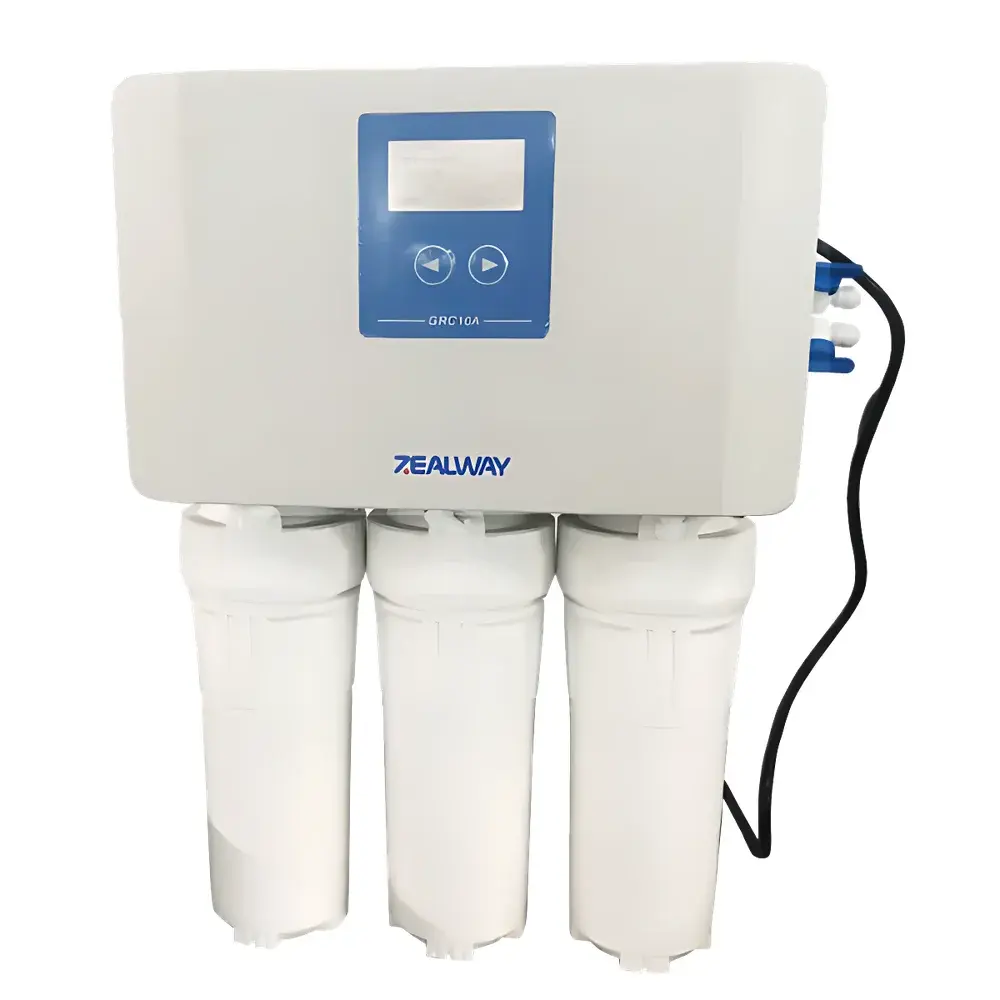
Zealway CL30WA Dedicated Ultra-Pure Water System for Vertical Autoclaves
| Brand | Zealway |
|---|---|
| Origin | Fujian, China |
| Manufacturer Type | Direct Manufacturer |
| Regional Classification | Domestic (China) |
| Model | CL30WA |
| Pricing | Available Upon Request |
Overview
The Zealway CL30WA Dedicated Ultra-Pure Water System is an engineered water purification solution specifically designed to support vertical high-pressure steam sterilizers (autoclaves) in regulated laboratory, pharmaceutical, and healthcare environments. Unlike general-purpose ultrapure water systems, the CL30WA integrates process-critical design features—including adjustable conductivity control, fully automated feedwater management, and seamless integration with autoclave water inlet protocols—to ensure consistent compliance with steam purity requirements defined in ISO 17665-1, EN 285, and USP . It operates on a multi-stage purification architecture: municipal tap water first passes through a sediment-grade polypropylene (PP) cartridge to remove particulates ≥5 µm, followed by catalytic granular activated carbon (GAC) for chlorine, organic adsorption, and chloramine reduction, then undergoes reverse osmosis (RO) using a high-rejection thin-film composite (TFC) membrane (typical NaCl rejection >98%). The resulting purified water is stored in an integrated stainless-steel or food-grade polymer reservoir with level-sensing feedback, enabling on-demand delivery without manual refilling—functioning analogously to a “wash-and-fill” cycle in modern laundry equipment.
Key Features
- Adjustable conductivity setpoint (0.1–1.0 µS/cm range) via digital front-panel interface, enabling precise tailoring of resistivity to match autoclave chamber material compatibility and steam dryness specifications.
- Auto-fill and auto-shutoff logic synchronized with connected autoclave’s water demand cycle—eliminates operator intervention and reduces risk of dry-run or overflow incidents.
- Integrated pre-treatment stage with dual-layer PP + GAC filtration certified to NSF/ANSI Standard 42 and 53 for aesthetic and health-related contaminant reduction.
- RO system equipped with real-time TDS monitoring, automatic membrane flush cycle, and low-pressure protection to extend membrane service life and maintain consistent rejection performance.
- Reservoir-level sensors with audible/visual alerts and optional dry-run interlock output compatible with autoclave PLC inputs per IEC 61508 functional safety guidelines.
- Compact vertical footprint optimized for placement beneath or adjacent to Zealway and third-party vertical autoclaves (e.g., models with ≤60 cm width and ≤180 cm height).
Sample Compatibility & Compliance
The CL30WA delivers water meeting ASTM D1193 Type II specifications and exceeds the minimum purity thresholds required for autoclave feedwater per ISO 17665-1 Annex A (conductivity ≤1.0 µS/cm at 25°C; total oxidizable carbon [TOC] < 500 ppb; silica < 0.1 mg/L). Its output is validated for use with stainless-steel sterilization chambers, avoiding scaling, pitting, or biofilm initiation caused by hardness ions (Ca²⁺, Mg²⁺), chloride, or residual chlorine. All wetted materials—including housing, tubing, and reservoir—are compliant with USP Class VI biocompatibility testing and FDA 21 CFR 177.2440 for repeated contact with purified water. System documentation supports GLP/GMP audit readiness, including calibration records for conductivity sensor (traceable to NIST standards) and maintenance logs for consumables (PP, GAC, RO membrane).
Software & Data Management
The CL30WA includes embedded firmware with non-volatile event logging (last 500 operational cycles), timestamped conductivity readings, filter replacement reminders, and RO membrane performance metrics (flux decline rate, pressure differential). Optional RS-485 Modbus RTU or Ethernet TCP/IP interface enables integration into facility-wide Building Management Systems (BMS) or Laboratory Information Management Systems (LIMS). Audit trail functionality complies with FDA 21 CFR Part 11 requirements when paired with validated third-party software platforms—supporting electronic signatures, user access levels (admin/operator), and immutable record retention for ≥12 months.
Applications
- Feedwater supply for vertical benchtop and floor-standing autoclaves used in microbiology labs, hospital central sterile supply departments (CSSD), and contract manufacturing organizations (CMOs).
- Preparation of Water for Injection (WFI)-adjacent applications where ultra-low endotoxin and ion content are critical but full WFI validation is not mandated.
- Supporting validation protocols (IQ/OQ/PQ) for sterilization processes under ISO 13485 and EU MDR Annex I essential requirements.
- Continuous operation in cleanroom environments (ISO Class 7–8) due to low particulate generation and absence of volatile organic compound (VOC) off-gassing from internal components.
FAQ
Does the CL30WA meet regulatory requirements for pharmaceutical sterilization?
Yes—the system is engineered to consistently produce water within the conductivity, TOC, and microbial limits specified in ISO 17665-1 and aligned with Annex A of EN 285 for steam sterilization processes.
Can it be integrated with non-Zealway autoclaves?
Yes—its universal 1/4″ push-to-connect outlet, programmable conductivity setpoint, and dry-contact interlock signals are compatible with major vertical autoclave brands including Tuttnauer, Priorclave, and Getinge.
What is the recommended maintenance schedule?
PP and GAC cartridges require replacement every 6 months or after 2,000 L of throughput; RO membrane replacement is advised every 18–24 months depending on feedwater quality and usage frequency.
Is remote monitoring supported out of the box?
Basic local display and logging are standard; remote monitoring requires optional communication module installation and configuration with site-specific network infrastructure.
How does the adjustable conductivity feature improve autoclave performance?
Precise conductivity control prevents excessive mineral carryover into steam, minimizing chamber corrosion, load discoloration, and potential interference with biological indicator (BI) performance during sterility assurance testing.



