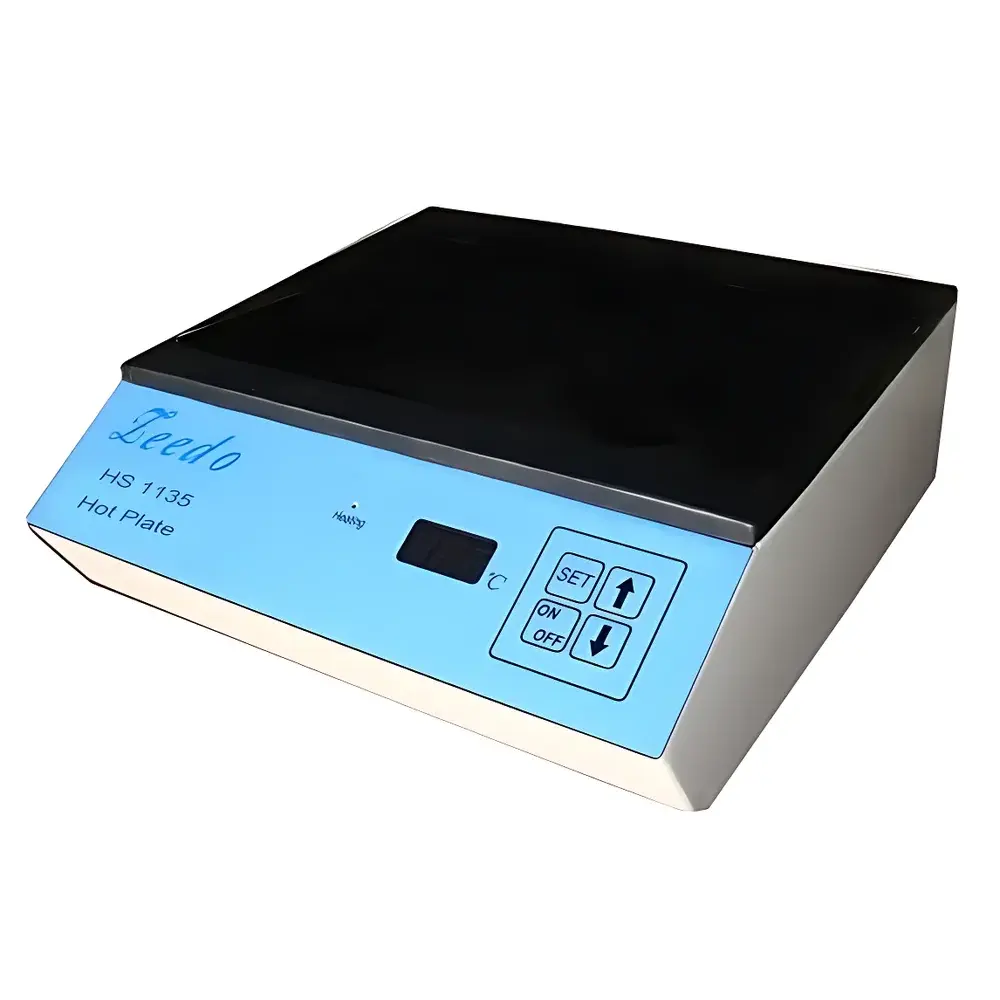
ZEEDO HS-1135 Tissue Flattening and Baking Station
| Brand | ZEEDO |
|---|---|
| Model | HS-1135 |
| Temperature Range | Ambient to 90°C (adjustable) |
| Temperature Control Accuracy | ±1°C |
| Power Supply | AC 220V/50Hz or AC 110V/60Hz |
| Power Consumption | 200 VA |
| Dimensions (W×D×H) | 340 × 340 × 120 mm |
| Weight | 6 kg |
| Operating Environment | 0–40°C |
Overview
The ZEEDO HS-1135 Tissue Flattening and Baking Station is a dedicated benchtop instrument engineered for standardized histopathological slide preparation in clinical pathology laboratories, academic research facilities, and diagnostic centers. It integrates three critical pre-staining steps—tissue section flotation (water bath leveling), flattening (surface tension-mediated tissue adhesion), and controlled thermal baking—into a single, compact platform. The device operates on the principle of precise conductive heating combined with passive capillary-driven tissue adherence, ensuring uniform thermal transfer across glass microscope slides while minimizing curling, folding, or detachment of paraffin-embedded tissue sections. Its design conforms to routine histology workflow requirements outlined in CAP (College of American Pathologists) and ISO 15189-accredited laboratory protocols, supporting reproducible slide quality essential for downstream H&E staining, immunohistochemistry (IHC), and in situ hybridization (ISH).
Key Features
- Independent dual digital display showing real-time measured temperature and user-set target temperature for immediate verification and process traceability.
- High-stability heating element with rapid thermal response (<60 s to reach setpoint from ambient) and extended service life (>10,000 operational hours under standard use conditions).
- Non-volatile memory function retains the last configured temperature setting after power cycling, reducing setup time between batches.
- Corrosion-resistant black anodized aluminum housing provides mechanical durability and chemical resistance against common histology reagents including xylene, ethanol, and aqueous buffer solutions.
- Thermostatically regulated heating surface maintains ±1°C stability over full operating range (ambient to 90°C), validated per ASTM E74-22 calibration procedures for laboratory thermal equipment.
- Compact footprint (340 × 340 × 120 mm) enables integration into space-constrained tissue processing workstations without compromising accessibility or ergonomics.
Sample Compatibility & Compliance
The HS-1135 accommodates standard 1″ × 3″ (25 × 75 mm) and 2″ × 3″ (50 × 75 mm) microscope slides, including charged, silanized, and poly-L-lysine-coated variants. It supports both paraffin-embedded and frozen-sectioned tissues, with optimal performance observed at 60–75°C for routine H&E workflows and up to 90°C for high-adhesion applications such as decalcified bone or fatty tissue specimens. The unit complies with IEC 61010-1:2010 safety standards for electrical equipment used in laboratory environments and meets electromagnetic compatibility (EMC) requirements per EN 61326-1:2013. While not FDA-cleared as a medical device, its operational parameters align with CLIA-waived and CAP-mandated pre-analytical controls for slide integrity prior to staining.
Software & Data Management
The HS-1135 operates as a standalone analog-digital hybrid instrument with no embedded software or network interface. All temperature settings and status indicators are managed via front-panel push-button controls and LED displays. No data logging, USB export, or remote monitoring capabilities are included; however, the ±1°C control accuracy and memory retention function support GLP-compliant manual recordkeeping when integrated into laboratory notebooks or LIMS entries. For facilities requiring electronic audit trails, external digital thermometers with timestamped output (e.g., Fluke 1524 or Omega HH309A) may be deployed alongside the unit to satisfy 21 CFR Part 11 documentation expectations where applicable.
Applications
- Routine histology labs performing high-volume slide baking prior to hematoxylin and eosin (H&E) staining.
- Research cores preparing tissue microarrays (TMAs) requiring consistent section adhesion across hundreds of slides.
- Teaching laboratories in university pathology or biomedical science programs demonstrating standardized slide preparation techniques.
- Reference labs validating new antibody clones in IHC, where uncontrolled slide drying can introduce false-negative artifacts due to antigen denaturation or poor epitope exposure.
- Forensic pathology units processing delicate post-mortem specimens prone to shrinkage or edge lifting during ambient-air drying.
FAQ
What is the maximum number of slides the HS-1135 can process simultaneously?
The unit accommodates up to 30 standard 1″ × 3″ glass slides in a single batch, arranged in two parallel rows on the heated plate surface.
Does the HS-1135 include a water bath for floating sections?
No—the HS-1135 is a dry-heating baking station only. Tissue flotation must be performed separately using a dedicated digital floatation bath (e.g., ZEEDO FS-200 or equivalent) prior to transfer onto the HS-1135 surface.
Can the HS-1135 be used for baking immunofluorescence (IF) slides?
Yes, provided baking temperature is maintained ≤60°C to preserve fluorophore integrity; extended exposure above this threshold may accelerate photobleaching in subsequent imaging.
Is calibration documentation provided with the instrument?
A factory-verified temperature calibration certificate (traceable to NIST standards) is available upon request at time of order, though not included by default.
What maintenance is required for long-term reliability?
Monthly visual inspection of heating surface for residue buildup and gentle cleaning with lint-free cloth dampened with 70% isopropyl alcohol; no lubrication or internal servicing is necessary under normal operating conditions.