
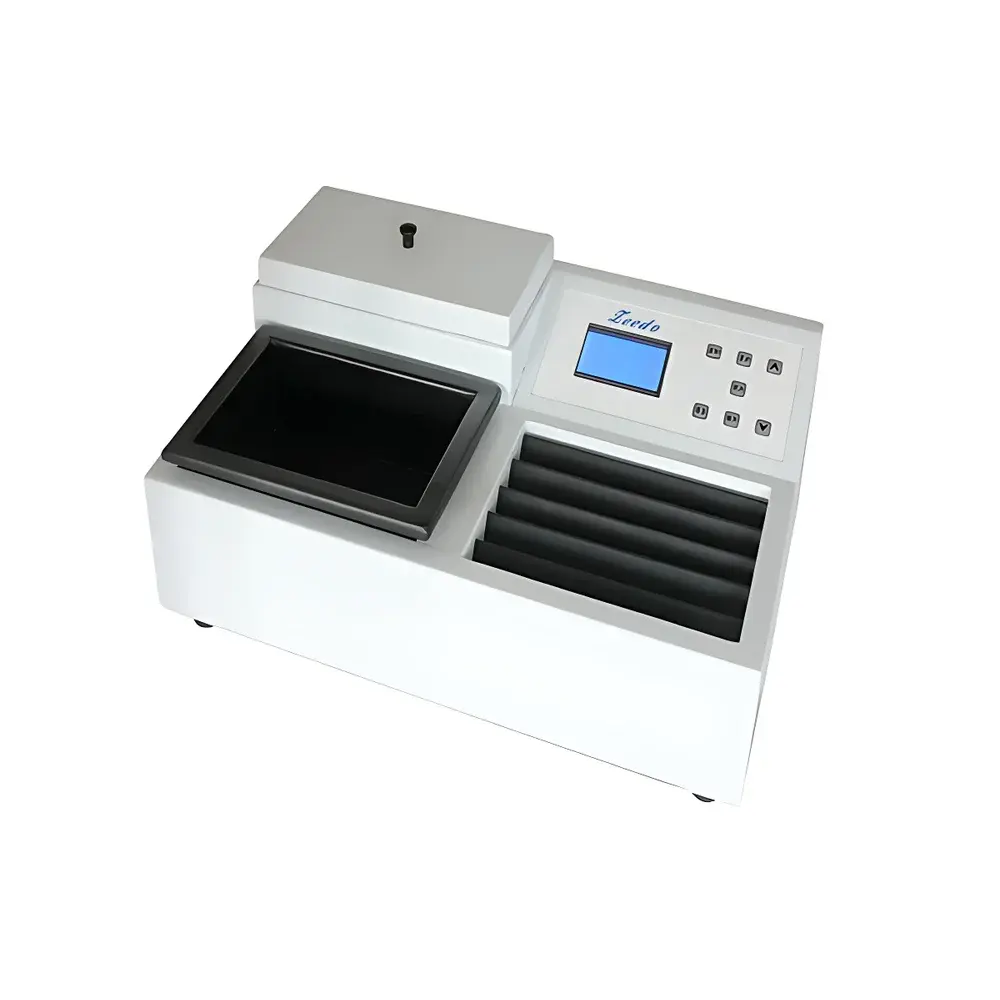
ZEEDO HS-1145 Combined Floating, Drying & Baking Slide Processor
| Brand | ZEEDO |
|---|---|
| Origin | Zhejiang, China |
| Model | HS-1145 |
| Automation Level | Semi-Automatic |
| Instrument Type | Non-Rotary |
| Temperature Range | Ambient to 90 °C (independently adjustable for floating, drying, and baking zones) |
| Floating Bath Volume | 135 × 185 × 80 mm |
| Dimensions (W×D×H) | 510 × 340 × 220 mm |
| Weight | 16 kg |
| Voltage | 220 V, 50 Hz |
| Power Consumption | 1000 W |
| Drying Rack Capacity | 70 glass slides (60° angled insertion) |
| Baking Chamber Capacity | 3 standard staining racks (30–40 slides each) or two 250 mL beakers for paraffin melting |
Overview
The ZEEDO HS-1145 Combined Floating, Drying & Baking Slide Processor is a semi-automatic, non-rotary pathology workstation engineered for precise, reproducible preparation of histological tissue sections on glass microscope slides. It integrates three critical pre-staining steps—tissue section floating (water bath spreading), slide drying (controlled ambient-air dehydration), and paraffin baking (adhesion fixation)—into a single compact platform. Each functional zone operates with independent PID temperature control, enabling simultaneous yet thermally isolated processing across the floating bath, drying rack, and baking chamber. Designed in accordance with routine histopathology workflow requirements, the HS-1145 supports standardized tissue adhesion protocols used in clinical diagnostics, academic research, and GLP-compliant laboratory environments. Its architecture adheres to fundamental principles of thermal stability and mechanical repeatability, ensuring consistent section flattening, minimal curling, and optimal wax-to-glass bonding prior to hematoxylin-eosin (H&E) or immunohistochemical (IHC) staining.
Key Features
- Triple-zone independent temperature control (ambient to 90 °C) with digital display and ±0.5 °C thermal stability per zone
- Enameled polymer floating bath with matte black interior surface—enhances visual contrast during section retrieval and improves operator ergonomics
- Corrugated drying rack configured at a fixed 60° inclination—accommodates up to 70 standard 25 × 75 mm glass slides with gravity-assisted drainage and uniform airflow exposure
- Expandable baking chamber with configurable internal layout—supports either three standard slide staining racks (30–40 slides per rack) or dual 250 mL beakers for paraffin phase transition monitoring
- Programmable baking timer with audible end-of-cycle alert—enables unattended operation while maintaining traceable process parameters
- Robust stainless-steel chassis and heat-resistant polymer housing—designed for continuous duty in high-throughput pathology labs with daily batch processing demands
Sample Compatibility & Compliance
The HS-1145 is validated for use with formalin-fixed, paraffin-embedded (FFPE) tissue sections cut at thicknesses ranging from 3 µm to 10 µm using rotary or cryostat microtomes. It accommodates standard microscope slides (75 × 25 mm, 1.0–1.2 mm thickness) and is compatible with charged, APES-coated, or poly-L-lysine-treated substrates. The instrument meets CE marking requirements for low-voltage equipment (2014/35/EU) and electromagnetic compatibility (2014/30/EU). While not certified under FDA 21 CFR Part 11, its operational parameters—including time-stamped temperature logs (when integrated with external data acquisition systems) and user-accessible calibration offsets—support audit readiness for ISO 15189-accredited medical laboratories and CAP-inspected facilities. All thermal profiles align with recommended practices outlined in CAP Checklist ANP.40320 (Slide Adhesion Validation) and CLSI document H25-A3 (Preparation of Tissue Sections for Microscopic Examination).
Software & Data Management
The HS-1145 operates via an embedded microcontroller interface with tactile push-button controls and LED status indicators—no onboard software or network connectivity is included. Temperature setpoints, timer values, and alarm activation are manually entered and retained across power cycles. For laboratories requiring electronic recordkeeping, the unit features analog voltage outputs (0–5 V DC) corresponding to real-time zone temperatures, allowing integration with third-party data loggers compliant with ASTM E2500-13 (Standard Guide for Specification, Design, and Verification of Pharmaceutical and Biopharmaceutical Manufacturing Systems). When deployed alongside LIMS or ELN platforms, operators may manually enter processing metadata—including start/end times, operator ID, and batch identifiers—ensuring full traceability per ISO/IEC 17025 clause 7.5.2 (Technical Records).
Applications
- Routine H&E staining workflows in hospital pathology departments and reference laboratories
- Immunohistochemistry (IHC) slide preparation where uniform antigen preservation and section adherence are critical
- Research-grade tissue microarray (TMA) construction requiring high positional fidelity across hundreds of serial sections
- Teaching laboratories in biomedical science programs—providing students hands-on experience with standardized slide preparation protocols
- Quality assurance testing of new slide coatings or adhesive formulations under controlled thermal conditions
FAQ
Is the HS-1145 suitable for frozen section processing?
No—the instrument is designed exclusively for paraffin-embedded tissue sections. It does not support cryogenic temperatures or rapid freeze-thaw cycling required for frozen section workflows.
Can the floating bath temperature be set below ambient?
No—temperature control is limited to ambient to 90 °C; active cooling is not implemented.
Does the unit include calibration documentation?
Yes—each unit ships with a factory calibration certificate referencing NIST-traceable reference thermometers used during final verification.
What maintenance is required for long-term reliability?
Monthly cleaning of the enameled bath with mild detergent and deionized water; annual inspection of heating element continuity and thermostat response lag using calibrated thermal probes.
Is the baking chamber accessible during operation?
Yes—the front-loading door features a safety interlock that pauses heating when opened, resuming automatically upon closure.
Related Products




