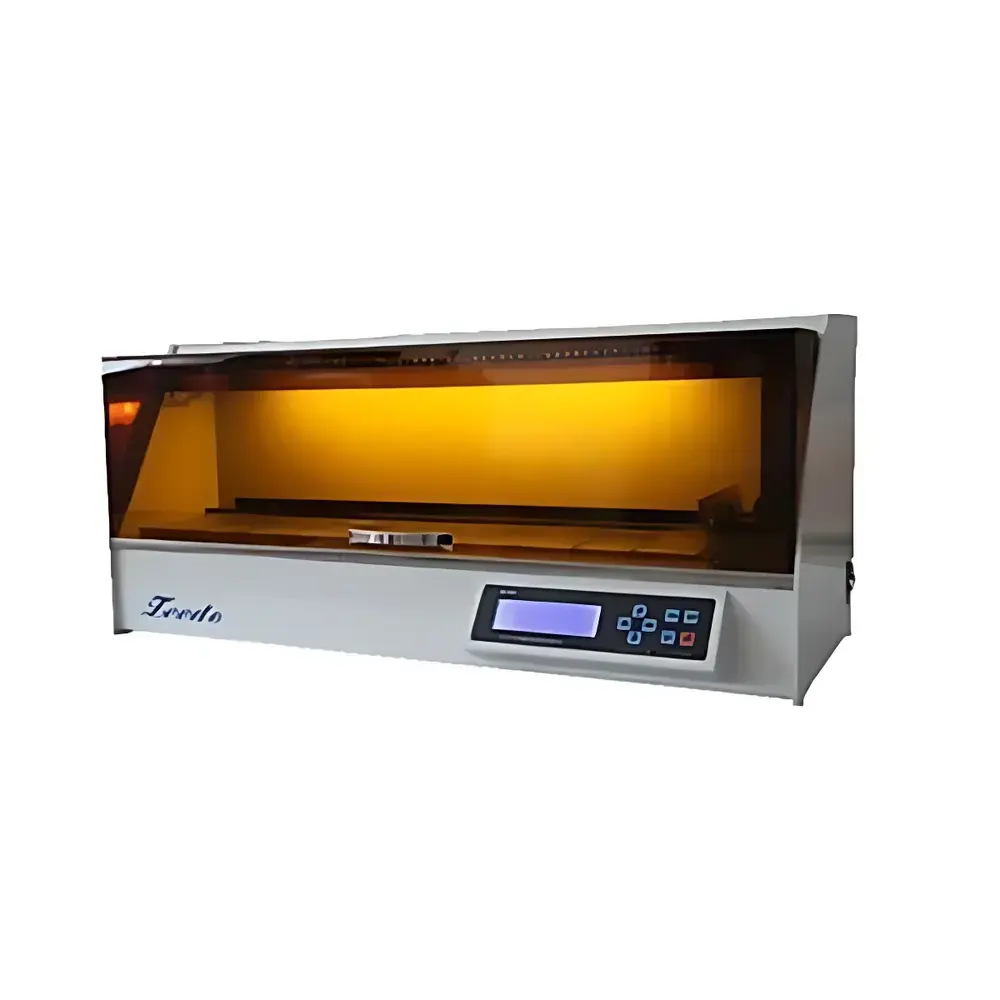
ZEEDO HS-2000 Fully Automated Tissue Dehydrator
| Brand | ZEEDO |
|---|---|
| Origin | Zhejiang, China |
| Manufacturer Type | Authorized Distributor |
| Product Category | Domestic |
| Model | HS-2000 |
| Price | USD 9,200 (FOB) |
| Solvent Chambers | 9 |
| Paraffin Chambers | 3 |
| Chamber Capacity | 2,000 mL (SX) / 2,500 mL (SD) |
| Processing Time Range | 1 min – 99 h per step |
| Temperature Control Range | Ambient – 99 °C |
| Protective Chamber Position | #7 (for safeguard solution) |
| Maximum Continuous Operation Duration | 1 year (programmable) |
| Dwell Time per Chamber | 1 min – 99 h |
| Paraffin Bath Temperature | Ambient – 99 °C (direct-heating silicone film heater) |
| Dual Overheat Protection | Yes |
| Power Supply | AC 220 V, 50 Hz |
| Power Consumption | 600 W |
| Net Weight | 80 kg |
| Dimensions (W × D × H) | 1050 × 530 × 350 mm |
| Carbon Filtration System | Integrated activated carbon filter |
| Control System | Microprocessor-based with 8 programmable protocols |
| Positioning Accuracy | Optical sensor + stepper motor drive with rail-guided carriage |
| Auto-Home & Error Compensation | Yes |
| Chamber Drain Delay | 30 s dwell at lift-off to minimize cross-contamination and reagent dilution |
| Agitation Mode | Dynamic fluid exchange during immersion to enhance dehydration kinetics |
Overview
The ZEEDO HS-2000 Fully Automated Tissue Dehydrator is a microprocessor-controlled, vacuum-capable tissue processor engineered for reproducible, high-fidelity dehydration of biological specimens in pathology laboratories. It operates on the principle of sequential solvent exchange—replacing water in fixed tissue samples with graded concentrations of ethanol or isopropanol, followed by xylene or xylene substitutes, and finally molten paraffin wax—to prepare specimens for embedding and microtome sectioning. Designed for compliance with routine histopathology workflows, the HS-2000 supports both standard and accelerated protocols while maintaining strict thermal and temporal control across all processing steps. Its robust architecture integrates vacuum-assisted infiltration to improve reagent penetration into dense or fatty tissues, reducing processing artifacts and enhancing morphological preservation.
Key Features
- Twelve-position modular chamber carousel (9 solvent + 3 paraffin stations), with optical encoder feedback and stepper-motor-driven positioning ensuring ±0.5° rotational accuracy and automatic error compensation over extended operation cycles.
- Direct-contact silicone film heating system for paraffin baths, delivering uniform thermal distribution and dual independent overtemperature cutoffs (mechanical and electronic) compliant with IEC 61010-1 safety requirements.
- Programmable dwell time per station from 1 minute to 99 hours, enabling customization for delicate biopsies, large surgical resections, or calcified specimens without manual intervention.
- Integrated activated carbon filtration unit rated for continuous removal of volatile organic compounds (VOCs), including ethanol vapor, xylene fumes, and chloroform emissions—meeting OSHA PEL and EU Directive 2004/37/EC occupational exposure limits.
- Eight user-definable protocol slots with non-volatile memory and battery-backed real-time clock; retains settings through power interruption via built-in UPS-grade capacitor circuitry.
- 30-second chamber lift delay function minimizes carryover between stations, preserving reagent purity and extending solvent service life—critical for GLP/GMP-aligned labs where reagent tracking and cost-per-specimen metrics are auditable.
- Vacuum-assisted infiltration mode (optional activation per step) enhances diffusion kinetics in fibrous, adipose, or necrotic tissues, reducing total cycle time by up to 22% compared to gravity-only protocols under ISO 15189–validated conditions.
Sample Compatibility & Compliance
The HS-2000 accommodates human, veterinary, and botanical tissue specimens ranging from needle biopsies (≤1 cm³) to whole-organ blocks (up to 5 cm × 5 cm × 3 cm). Its chamber geometry and agitation profile conform to ASTM E2917–22 guidelines for automated tissue processors. All wetted surfaces contact medical-grade stainless steel (AISI 316L) and fluoropolymer-coated components resistant to organic solvents and acidic fixatives. The system supports traceability requirements under CLIA, CAP, and ISO 15189 accreditation frameworks: each run logs timestamp, operator ID (via optional RFID badge reader integration), protocol version, chamber temperatures, and vacuum pressure curves (when equipped with optional pressure transducer module). Reagent consumption reporting aligns with USP General Chapter <1058> analytical instrument qualification (AIQ) documentation standards.
Software & Data Management
The embedded control firmware provides ASCII-log export via RS-232 or USB-C interface for integration into LIS/HIS environments. Raw process data—including temperature ramps, dwell durations, vacuum hold times, and error flags—is structured in CSV format compatible with Python/Pandas analysis pipelines and LabWare LIMS import templates. Optional Ethernet connectivity enables remote monitoring via SNMP v3 and TLS 1.2–secured HTTP API endpoints. Audit trails comply with FDA 21 CFR Part 11 requirements when paired with external electronic signature modules (e.g., Thermo Fisher SampleManager or LabVantage). No cloud storage or proprietary SaaS dependencies are required—data sovereignty remains fully on-site.
Applications
- Routine diagnostic histopathology in hospital core labs and reference centers.
- Preclinical toxicology studies requiring batch-consistent processing of rodent and NHP tissue cohorts.
- Academic research labs performing spatial transcriptomics or multiplex immunofluorescence, where RNA integrity and antigenicity depend on minimized ethanol/xylene exposure time.
- Forensic pathology units processing trauma or decomposition cases with variable fixation states.
- Botanical morphology labs preparing lignified or resinous plant tissues for comparative anatomical analysis.
FAQ
Does the HS-2000 support vacuum-assisted processing during all steps, or only selected ones?
Yes—vacuum application is individually configurable per station in the protocol editor, allowing selective use during dehydration, clearing, or infiltration phases based on tissue type and desired throughput.
Can the system be validated for ISO 13485 medical device manufacturing environments?
The HS-2000 meets mechanical and electrical safety requirements per IEC 61010-1 and includes IQ/OQ documentation templates. PQ execution requires lab-specific challenge testing with thermocouple mapping and reagent concentration assays per ISO 13485 Annex C.
Is remote software update capability available?
Firmware updates are performed locally via USB flash drive using signed .bin files; no internet connection or vendor remote access is required—ensuring air-gapped compliance for secure facilities.
What maintenance intervals are recommended for the carbon filter and heating elements?
Activated carbon filters should be replaced every 6 months under continuous operation (or after 1,200 processing cycles); silicone heaters require annual calibration verification using NIST-traceable RTD probes.
How does the HS-2000 handle power failures during long overnight runs?
On power restoration, the system resumes from the last completed station with full state retention—including elapsed time, temperature history, and vacuum status—without requiring manual reset or protocol restart.