
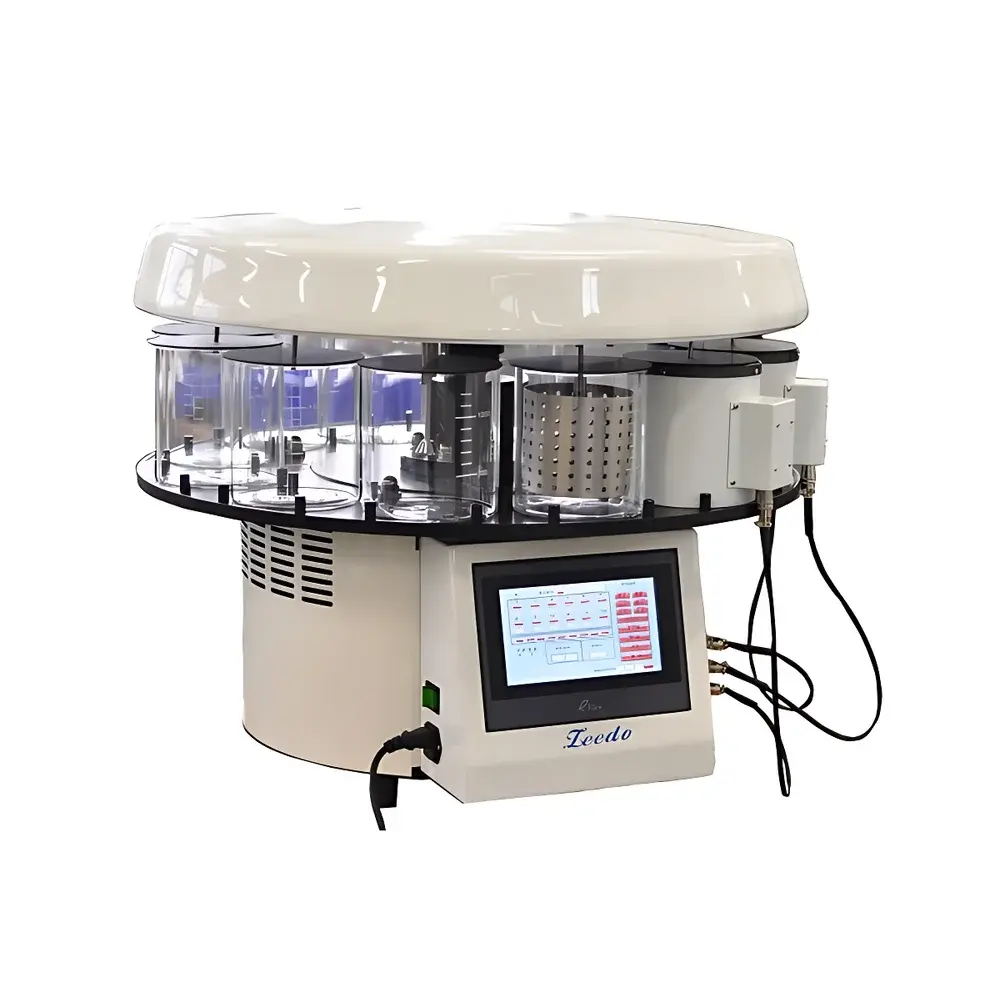
ZEEDO HS-366 Circular Vacuum Tissue Dehydrator
| Brand | ZEEDO |
|---|---|
| Origin | Zhejiang, China |
| Manufacturer Type | Authorized Distributor |
| Country of Origin | China |
| Model | HS-366 |
| Price | USD 9,200 (FOB) |
| Tissue Processing Stages | 12 |
| Solvent Stations | 9 × 1.2 L glass cylinders |
| Paraffin Stations | 3 × 1.0 L heated wax baths |
| Temperature Control Range | 45–85 °C (±3 °C) |
| Stage Time Setting | 0–59 h 59 min per station |
| Delay Start | 0–59 h 59 min |
| Basket Agitation Frequency | 3 cycles/min |
| Basket Dimensions | Φ95 × 80 mm (single-tier) or 5-layer stackable |
| Net Weight | ~60 kg |
| External Dimensions | 660 × 550 × 680 mm |
| Power Supply | AC 220 V, 50 Hz |
| Rated Power | 500 W |
| Operating Environment | +5 to +40 °C ambient temperature |
| Display Language | Switchable Chinese/English LCD interface |
| Pre-stored Protocols | 10 user-programmable methods |
| Minimum Time Resolution | 1 minute |
| Wax Bath Temperature Stability | ±0.5 °C under load |
| Interior Surface Coating | PTFE (Teflon®) anti-adhesive and corrosion-resistant finish |
| Safety Features | Power-failure alarm with auto-suspension to designated solvent station, mechanical obstruction detection, emergency stop, over-temperature cutoff |
Overview
The ZEEDO HS-366 Circular Vacuum Tissue Dehydrator is an automated, microprocessor-controlled instrument engineered for precise, reproducible dehydration of biological specimens in histopathology and plant science laboratories. It operates on the principle of sequential solvent exchange under controlled vacuum and elevated temperature conditions—facilitating rapid water removal from fixed tissue samples while minimizing structural distortion and lipid loss. The circular carousel architecture enables simultaneous handling of multiple reagent stations (9 solvent + 3 paraffin baths), supporting standardized protocols aligned with ASTM E2217, ISO 15189, and CAP-accredited pathology workflows. Designed for high-throughput environments—including hospital pathology departments, university research cores, and contract histology labs—the HS-366 delivers consistent tissue processing performance across human, animal, and botanical specimens without requiring continuous operator supervision.
Key Features
- 12-stage programmable dehydration cycle with independent time and temperature control per station
- 9 transparent 1.2 L borosilicate glass solvent cylinders enabling real-time visual monitoring of tissue progression
- 3 independently heated 1.0 L paraffin baths with high-stability PID temperature regulation (±0.5 °C)
- PTFE-coated internal chamber surfaces resist chemical adhesion and simplify cleaning between runs
- Motor-driven basket agitation at 3 cycles per minute ensures uniform reagent penetration and prevents tissue settling
- Fail-safe power-loss protocol automatically relocates baskets to a preselected protective solvent station
- Integrated obstruction sensor halts rotation if mechanical resistance exceeds threshold, preventing motor strain or basket damage
- Backlit bilingual LCD interface supports seamless operation in multilingual lab environments
- 10 non-volatile memory slots for protocol storage with timestamped audit trail capability
Sample Compatibility & Compliance
The HS-366 accommodates standard histological cassettes (e.g., Leica, Sakura, Thermo Fisher formats) within its Φ95 × 80 mm single-tier or 5-layer stackable baskets. It supports routine fixation media (10% neutral buffered formalin), graded ethanol series (70–100%), xylene substitutes (e.g., Histo-Clear®, CitriSolv®), and molten paraffin (melting point 56–60 °C). All materials contacting reagents comply with USP Class VI biocompatibility standards. The system meets IEC 61010-1 safety requirements for laboratory equipment and conforms to CE marking directives for electromagnetic compatibility (EMC) and low-voltage operation. Optional battery backup module (4–16 hr runtime) satisfies GLP/GMP continuity-of-process expectations during utility interruptions.
Software & Data Management
While the HS-366 operates via embedded firmware without external PC dependency, its control logic supports full traceability: each run logs start time, stage transitions, temperature deviations >±2 °C, agitation anomalies, and fault codes to internal memory. Exportable CSV reports (via optional USB interface) include operator ID, protocol version, tissue batch number, and QC pass/fail flags—enabling integration into LIMS platforms compliant with FDA 21 CFR Part 11 when paired with validated electronic signature modules. Firmware updates are performed via secure USB key, with version history retained for audit readiness.
Applications
- Routine diagnostic histology: Hematoxylin-eosin (H&E) staining preparation for surgical pathology
- Research-grade tissue banking: Preservation integrity assessment for biobank repositories
- Botanical morphology studies: Woody stem, leaf, and root tissue dehydration without shrinkage artifacts
- Toxicologic pathology: Multi-dose rodent tissue processing with strict inter-batch consistency
- Veterinary diagnostics: Equine, bovine, and avian specimen throughput optimization
- Teaching laboratories: Demonstrating solvent kinetics and phase transition behavior in undergraduate histotechnology courses
FAQ
What vacuum level does the HS-366 achieve during dehydration stages?
The unit maintains a stable vacuum range of –0.08 to –0.095 MPa (–80 to –95 kPa) during active solvent exchange phases, adjustable via front-panel calibration.
Can the HS-366 be integrated into a fully automated tissue processor line?
Yes—its RS-485 serial interface supports Modbus RTU communication for synchronization with downstream embedding or sectioning stations.
Is validation documentation available for IQ/OQ/PQ protocols?
ZEEDO provides a comprehensive Validation Support Package including DQ templates, factory-tested OQ checklists, and PQ test procedures aligned with ISO/IEC 17025 guidelines.
How often does the PTFE coating require reapplication?
The electrostatically bonded PTFE layer is rated for ≥5 years of continuous use under standard laboratory conditions and requires no maintenance or recoating.
Does the system support xylene-free processing protocols?
Yes—programmable solvent dwell times and temperature profiles accommodate alcohol-based clearing agents (e.g., 1-propanol, limonene derivatives) per CLSI H25-A3 recommendations.
Related Products






