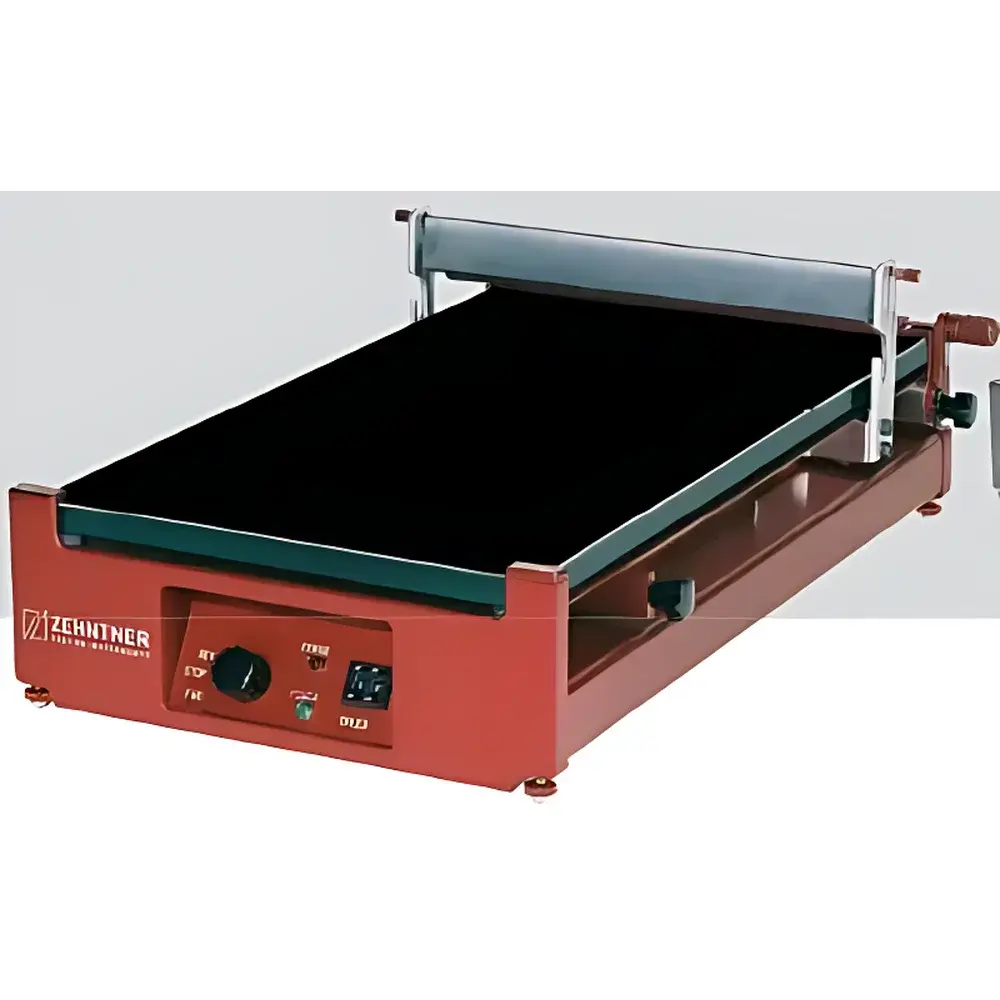
Zehntner ZAA2300 Automatic Coater
| Brand | Zehntner |
|---|---|
| Origin | Switzerland |
| Model | ZAA2300 |
| Dimensions (L×W×H) | 565 × 382 × 190 mm |
| Glass Plate Dimensions | 553 × 300 × 15 mm |
| Weight | 20 kg (glass plate: 6.4 kg) |
| Coating Speed | 1–99 mm/s |
| Application Length | 1–400 mm |
| Application Width | 1–300 mm |
| Power Supply | 100–230 V, 50–60 Hz |
| Compliance | ASTM D823-95 |
| Coating Head Options | Metal doctor blade, rubber-coated blanket surface, vacuum-assisted substrate holder |
| Included Accessories | Reversible dual-surface glass plate (glass side + rubber-coated printing blanket side), precision leveling device, manufacturer’s certificate of conformance and operation manual, RDS drawdown bars (7 pcs, wet film thicknesses: 4, 6, 12, 24, 40, 50, 60 µm) |
Overview
The Zehntner ZAA2300 Automatic Coater is a precision-engineered laboratory instrument designed for repeatable, controllable thin-film deposition in textile dyeing, printing, and functional coating development. It operates on the principle of controlled linear drawdown—where a calibrated coating head traverses a stationary substrate at a defined speed and gap height—to produce uniform wet films with predictable thickness profiles. Engineered for metrological rigor in R&D and quality control environments, the ZAA2300 supports method-standardized applications per ASTM D823-95, which governs procedures for preparing coated test specimens using drawdown bars and mechanical coaters. Its modular architecture accommodates multiple coating modalities—including metal rod (RDS), wire-wound bar, and doctor-blade configurations—enabling cross-method correlation studies and process validation across textile finishing, pigment dispersion evaluation, and functional chemical application.
Key Features
- Dual-surface reversible glass plate (553 × 300 × 15 mm): one side features optical-grade float glass for high-resolution coating with non-contact heads; the opposite side is fitted with a rubber-coated printing blanket (textile-grade elastomer) optimized for metal rod and blade-based deposition.
- Motorized traverse system with digitally adjustable speed (1–99 mm/s) and programmable start/stop positions—manually set via micrometer-adjustable end stops with center-clamping fixture to ensure positional repeatability within ±0.2 mm.
- Tool-free glass plate exchange and 180° flip mechanism—enabling rapid reconfiguration between coating modes without recalibration or hardware disassembly.
- Optional vacuum substrate holder (available as accessory): provides uniform clamping force across porous or low-stiffness textiles (e.g., nonwovens, knits), minimizing edge lift and improving coating homogeneity over irregular surfaces.
- Integrated precision leveling device ensures consistent horizontal alignment across the entire 400 mm application length—critical for maintaining constant gap geometry and eliminating gravitational film thickness gradients.
Sample Compatibility & Compliance
The ZAA2300 accepts rigid and semi-rigid substrates up to 300 mm wide and 400 mm long, including glass slides, polyester films, paper, woven cotton, and technical textiles. Its dual-surface plate design allows direct comparison of coating behavior on smooth versus compliant backing materials—essential for simulating real-world printing conditions on fabric vs. calibration standards. The system complies with ASTM D823-95 for specimen preparation in colorant and finish evaluation, and its mechanical stability meets GLP-aligned operational requirements for traceable, auditable test execution. All included RDS drawdown bars are manufactured to ISO 2834-1 tolerances for wet film thickness accuracy, with nominal values traceable to NIST-certified reference standards.
Software & Data Management
The ZAA2300 operates as a stand-alone electromechanical platform with no embedded firmware or proprietary software. Speed, travel distance, and start/stop positions are set manually via front-panel dials and mechanical stops—ensuring deterministic, non-volatile operation without dependency on digital interfaces. This analog-digital hybrid design eliminates cybersecurity risks, avoids software validation burdens under FDA 21 CFR Part 11, and simplifies IQ/OQ documentation for regulated textile testing labs. All operational parameters are recorded manually in lab notebooks or integrated into LIMS via external timestamped log entries. The absence of firmware also guarantees long-term serviceability independent of vendor software lifecycle support.
Applications
- Development and validation of dye formulations, pigment pastes, and functional finishes (e.g., flame retardants, water repellents, antimicrobials) on textile substrates.
- Inter-laboratory round-robin testing per ISO 105-X12 and AATCC Test Method 16 for colorfastness and finish durability assessment.
- Quantitative evaluation of rheological influence on coating uniformity—correlating viscosity (measured via rotational rheometer) with wet film thickness variability across shear rates.
- Calibration and verification of spectrophotometric color measurement systems using standardized coated panels with known optical density gradients.
- Preparation of reference samples for FTIR, XRF, or SEM-EDS analysis of finish distribution and penetration depth in multi-layer textile structures.
FAQ
What coating methods does the ZAA2300 support?
It supports drawdown bar (RDS), doctor blade, and roller-based coating via interchangeable heads and the dual-surface glass plate—enabling method flexibility without hardware modification.
Is the ZAA2300 suitable for porous or stretchable textiles?
Yes—when equipped with the optional vacuum substrate holder, it maintains dimensional stability during coating of knits, nonwovens, and low-modulus fabrics.
How is traceability ensured for regulatory submissions?
All mechanical settings (speed, position, bar type) are manually recorded and linked to physical reference standards (e.g., NIST-traceable RDS bars); no electronic audit trail is required due to the absence of digital control logic.
Can the glass plate be replaced with custom substrates?
Yes—the mounting interface accommodates user-supplied plates up to 565 × 382 mm and 20 mm thickness, provided flatness deviation remains ≤0.05 mm over the active area.
Does Zehntner provide calibration services for the ZAA2300?
Zehntner certifies mechanical repeatability at time of shipment; end-user calibration of speed and position is performed using certified calipers and stopwatch per ISO/IEC 17025 guidelines.