
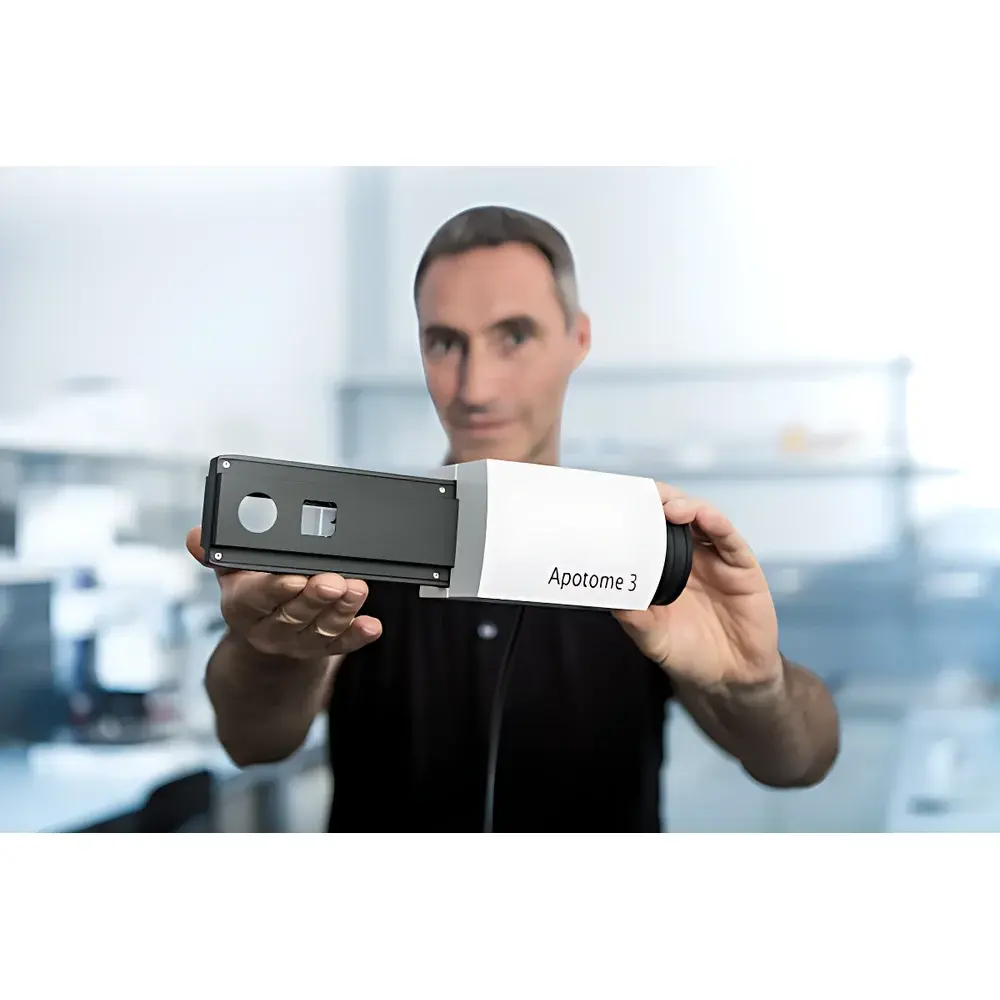
ZEISS Apotome 3 Structured Illumination Optical Sectioning Module for Widefield Fluorescence Microscopy
| Brand | ZEISS |
|---|---|
| Origin | Germany |
| Model | Apotome 3 |
| Type | Structured illumination-based optical sectioning module |
| Compatibility | Integrates with ZEISS Axio inverted and upright widefield fluorescence microscopes (e.g., Axio Observer, Axio Imager), as well as macro zoom systems |
| Optical Principle | Grid-projected structured illumination with computational reconstruction |
| Axial Resolution Enhancement | ~1.5–2× improvement over conventional widefield fluorescence |
| Software Integration | Fully embedded in ZEN imaging platform (ZEN Blue/Black) |
| Compliance | Designed for GLP/GMP-adjacent research environments |
| Licensing | Requires active ZEN software license (v3.4 or later) |
Overview
The ZEISS Apotome 3 is a high-precision structured illumination module engineered for optical sectioning in widefield fluorescence microscopy. Unlike confocal or spinning-disk systems that rely on physical pinholes or rotating disks to reject out-of-focus light, the Apotome 3 employs a motorized, multi-grid pattern projector positioned in the excitation light path. As the grid moves across the field of view in precise phase steps—typically three positions per focal plane—the system captures multiple raw images per Z-plane. These are computationally reconstructed using ZEISS’s proprietary deconvolution algorithm to suppress haze from non-focal planes, thereby generating optically sectioned images with enhanced axial contrast and effective resolution. The module operates natively within the ZEN imaging environment and requires no additional hardware synchronization beyond standard microscope control interfaces. Its design targets laboratories performing routine and advanced 3D fluorescence imaging on thick biological specimens—including whole-mount embryos, organotypic slices, and live-cell monolayers—where speed, phototoxicity minimization, and compatibility with standard fluorophores are critical constraints.
Key Features
- Triple-grid optical architecture: Three mechanically distinct diffraction gratings (optimized for low-, medium-, and high-magnification objectives) ensure optimal modulation frequency alignment across 5× to 100× magnifications, maintaining consistent optical sectioning performance without manual recalibration.
- Automatic objective recognition: Integrated communication with ZEISS microscope encoders enables real-time detection of objective magnification and correction collar position, automatically selecting the appropriate grid and adjusting exposure timing and step size.
- Full spectral flexibility: Compatible with standard fluorescence light sources (Xenon or LED-based), and supports all common fluorophores—from DAPI and FITC to far-red dyes such as Cy5 and Alexa Fluor 647—without requiring spectral reconfiguration of the module.
- Integrated computational pipeline: Raw image acquisition, grid-phase alignment, and optical section reconstruction occur in real time within ZEN software; reconstructed slices retain full bit-depth (16-bit) and metadata integrity for downstream quantitative analysis.
- Modular deployment: Mounts directly into the ZEISS fluorescence illumination path (via beam splitter port) and is compatible with both transmitted-light and epi-fluorescence configurations, including DIC and phase contrast overlays.
Sample Compatibility & Compliance
The Apotome 3 is validated for use with fixed and live biological samples mounted in standard aqueous or refractive-index-matched media (e.g., Vectashield, ProLong Diamond, or custom glycerol-based solutions). It supports coverslip thicknesses from No. 0 to No. 2 and accommodates chambered coverslips, glass-bottom dishes, and multi-well plates (96- and 384-well formats with appropriate stage adapters). From a regulatory standpoint, when deployed with ZEN Connect and configured under documented SOPs, the system supports traceable image acquisition workflows compliant with ISO/IEC 17025 for testing laboratories and aligns with data integrity expectations outlined in FDA 21 CFR Part 11—particularly when audit trail, electronic signature, and version-controlled protocol storage features are enabled.
Software & Data Management
Acquisition, reconstruction, and visualization are fully managed through ZEISS ZEN software (Blue or Black edition, v3.4+). The Apotome 3 module appears as a native acquisition mode alongside conventional widefield and tile-scan options. All reconstructed optical sections preserve EXIF-compatible metadata—including objective ID, exposure time, grid phase settings, Z-step interval, and environmental timestamps. Batch processing of Z-stacks is supported via ZEN’s scripting interface (Python-based ZEN Scripting API), enabling integration into automated image analysis pipelines (e.g., Fiji/ImageJ macros, ilastik, or MATLAB-based quantification workflows). Export formats include CZI (native), TIFF (OME-TIFF compliant), and HDF5, ensuring interoperability with open-source platforms and institutional data repositories.
Applications
- Three-dimensional histological reconstruction: Enables high-fidelity rendering of immunolabeled tissue sections (e.g., brain cortex, kidney glomeruli) up to 100 µm thick, preserving spatial relationships between nuclear (DAPI), cytoskeletal (anti-tubulin), and membrane markers.
- Live-cell dynamics in thick monolayers: Captures time-lapse optical sections of migrating fibroblasts or polarized epithelial cells without confocal photobleaching penalties, supporting kinetic analysis of organelle trafficking and calcium signaling.
- Whole-embryo imaging: Delivers subcellular resolution across millimeter-scale cleared or lightly mounted vertebrate embryos (e.g., zebrafish, mouse E12.5), facilitating segmentation and morphometric analysis in developmental biology studies.
- Neuronal network mapping: Resolves dense dendritic arbors and synaptic puncta in primary cortical neuron cultures co-stained with MAP2 and synaptophysin, where conventional widefield imaging fails due to signal saturation from overlapping focal planes.
FAQ
Can the Apotome 3 be used with non-ZEISS microscopes?
No—the Apotome 3 requires bidirectional hardware-level communication with ZEISS microscope control units (e.g., HAL 100, Colibri LED controller, or Axiocam cameras) for synchronized grid movement, focus tracking, and objective encoding. Third-party integration is not supported.
Does Apotome 3 require special sample preparation?
No—standard fluorescence mounting media and fixation protocols apply. However, optimal results are achieved with homogeneous refractive index matching between immersion medium and mounting medium to minimize spherical aberration-induced grid distortion.
How does Apotome 3 compare to confocal microscopy in terms of resolution and speed?
Axial resolution is improved ~1.5–2× over widefield but remains lower than point-scanning confocal systems (~0.7–1.0 µm vs. ~0.5–0.7 µm). However, Apotome 3 achieves full-frame optical sectioning at speeds comparable to single-frame widefield acquisition—making it significantly faster than sequential line-scanning confocal modalities.
Is deconvolution mandatory for Apotome 3 image reconstruction?
Yes—optical sectioning relies entirely on the structured illumination acquisition sequence and subsequent algorithmic reconstruction. Raw grid-shifted images are not interpretable without ZEN-based processing.
Can Apotome 3 data be exported for third-party deconvolution?
Raw phase-shifted image stacks (unreconstructed) can be exported in TIFF format, but ZEISS does not provide the grid geometry or phase calibration parameters required for external implementation of its proprietary reconstruction algorithm.




