
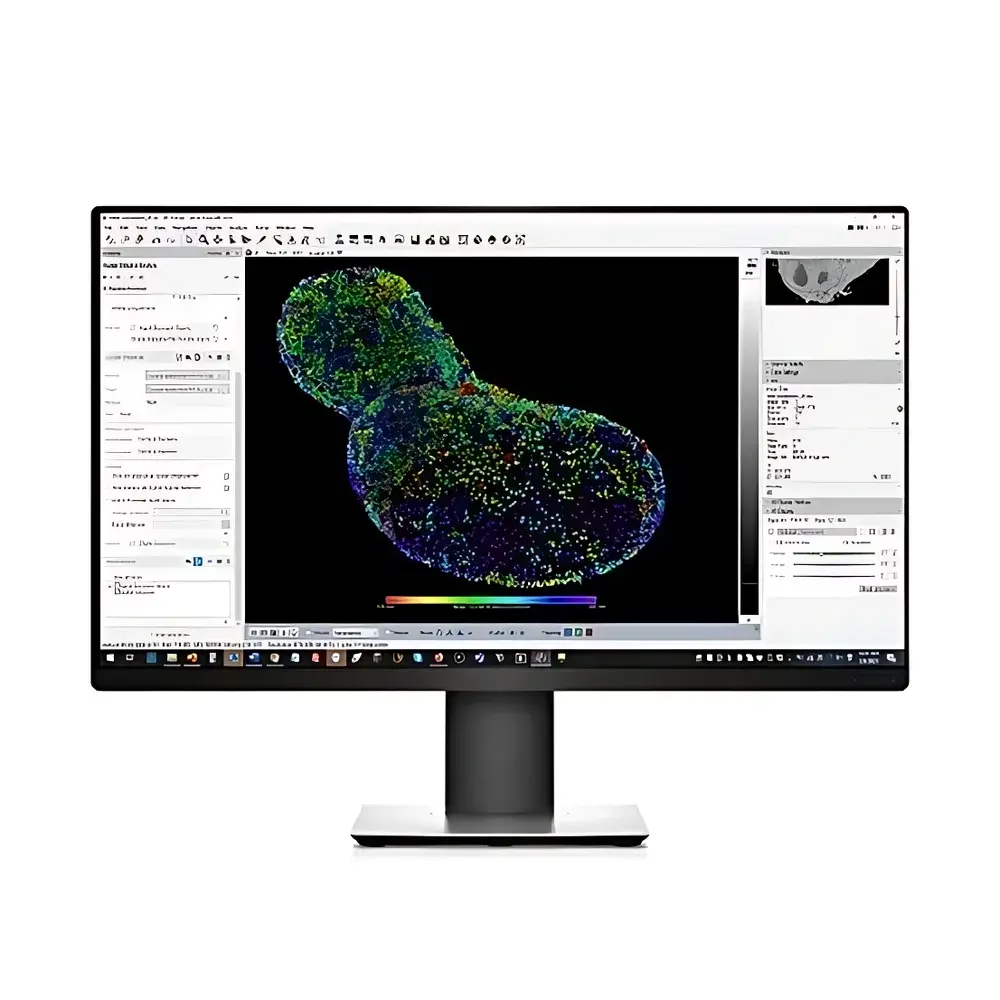
ZEISS arivis Pro Advanced Microscopic Image Analysis Software
| Brand | ZEISS |
|---|---|
| Origin | Germany |
| Model | arivis Pro |
| Compatibility | Native support for >60 image formats including CZI, TIFF, LSM, ND2, OME-TIFF, STK, etc. |
| Deployment | Local workstation (Windows 10/11 64-bit), GPU-accelerated processing (NVIDIA CUDA-compatible GPUs recommended) |
| Data Scale Handling | Optimized for terabyte-scale 2D–5D volumetric datasets (up to 100+ TB via virtual tiling) |
| AI Framework Integration | Built-in inference and training pipelines for Cellpose, Semantic Segmentation, Instance Segmentation, and custom PyTorch/TensorFlow models |
| Compliance | Supports audit trails, user role management, and export logs compliant with GLP/GMP documentation requirements |
Overview
ZEISS arivis Pro is a high-performance, modular image analysis platform engineered for quantitative microscopy in life sciences, materials research, and industrial quality control. It implements a hybrid computational architecture—combining optimized CPU-based algorithms with GPU-accelerated deep learning inference—to deliver deterministic, reproducible analysis across multi-dimensional (2D–5D) image data. Unlike legacy tools constrained by memory-mapped file handling or proprietary format lock-in, arivis Pro employs a virtual tiling engine that streams petabyte-scale datasets directly from network-attached storage (NAS) or local SSDs without full-load buffering. Its core design principle centers on workflow continuity: analysis logic defined in Pro propagates seamlessly to arivis Hub (server-based batch execution), arivis Cloud (cloud-hosted AI model training and validation), and arivis Pro VR (immersive 3D annotation and morphometric validation). This architecture ensures traceability from raw acquisition through quantification to regulatory reporting—critical for labs operating under ISO 13485, FDA 21 CFR Part 11, or EU Annex 11 frameworks.
Key Features
- Pipeline-Based Workflow Engine: Drag-and-drop visual programming interface enabling non-programmers to construct repeatable, version-controlled analysis sequences—from preprocessing (deconvolution, denoising, flat-field correction) to segmentation, tracking, and statistical reporting.
- TB-Scale Volumetric Processing: Native CZI reader with zero-conversion latency; handles datasets exceeding 100 TB via on-the-fly tiling and out-of-core memory management—minimizing RAM footprint while maintaining sub-second slice navigation.
- Integrated AI Toolkit: Preconfigured inference modules for cell nuclei (Cellpose), organelle membranes (U-Net variants), and particle morphology (Mask R-CNN); supports fine-tuning of models using arivis Cloud’s federated training environment with encrypted dataset partitioning.
- Multi-Modal Fusion & Spatial Analytics: Volume Fusion module aligns and co-registers multi-channel, multi-modal datasets (e.g., FIB-SEM + fluorescence + X-ray CT) using rigid and deformable registration; enables compartmental quantification (nuclear/cytoplasmic ratio), distance mapping (ligand-receptor proximity), and colocalization metrics (Manders’ coefficients, Pearson correlation).
- High-Content Screening (HCS) Optimization: Plate-aware analysis engine with real-time progress visualization, plate-level QC flags, and re-analysis triggers for outlier wells—integrated with ZEISS Axio Scan.Z1 and LSM 900 acquisition metadata.
- Extensible Python Environment: Embedded Jupyter-compatible console with preloaded libraries (scikit-image, napari, SimpleITK); supports direct execution of custom scripts (e.g., Sholl analysis for neuronal arborization, microtubule orientation mapping, Allen Brain Atlas registration) without external IDE dependencies.
Sample Compatibility & Compliance
arivis Pro natively ingests over 60 microscopy file formats—including ZEISS CZI, Nikon ND2, Olympus OIR, Leica LIF, and open standards such as OME-TIFF and HDF5—eliminating format conversion bottlenecks. It fully preserves embedded metadata (acquisition parameters, stage coordinates, objective calibration, time stamps) required for ISO/IEC 17025 traceability. The software supports role-based access control (RBAC), electronic signatures, and immutable audit logs aligned with ALCOA+ principles (Attributable, Legible, Contemporaneous, Original, Accurate, Complete, Consistent, Enduring, Available). All exported results include embedded provenance tags linking measurements to source images, applied pipelines, and user credentials—facilitating FDA inspection readiness and internal GLP audits.
Software & Data Management
arivis Pro operates as the interactive front-end of a unified ecosystem: analysis protocols authored locally are deployable to arivis Hub for unattended server-side batch processing across Linux clusters or Windows Server farms. arivis Cloud provides a HIPAA-compliant, ISO 27001-certified infrastructure for collaborative AI model development—where users upload annotated ground-truth datasets, train models with adjustable hyperparameters, and validate performance via confusion matrices and precision-recall curves. All trained models synchronize bi-directionally with Pro for local inference. Data synchronization uses TLS 1.3 encryption; no raw image data resides permanently in the cloud unless explicitly staged for training. Export options include CSV, Excel, JSON-LD (for FAIR data compliance), and MIAME-compliant MAGE-TAB.
Applications
The platform serves diverse use cases requiring rigorous spatial quantification: developmental biology (e.g., automated cell lineage tracing in Drosophila embryogenesis using time-lapse light-sheet data), structural cell biology (3D reconstruction and organelle segmentation of HeLa cells imaged via ZEISS Crossbeam FIB-SEM), and advanced materials science (NCM cathode particle morphology analysis in lithium-ion batteries, including primary particle size distribution, crack propagation mapping, and intergranular phase quantification). Its high-content screening capabilities support phenotypic drug discovery workflows—measuring hundreds of morphometric and intensity-based features per well across 384-well plates—with built-in statistical outlier detection and dose-response curve fitting.
FAQ
Does arivis Pro require dedicated GPU hardware?
Yes—NVIDIA GPUs with compute capability ≥6.0 (e.g., GTX 10-series or newer) are required for AI inference and real-time 3D rendering; minimum 8 GB VRAM recommended for datasets >100 GB.
Can existing MATLAB or Python scripts be imported into arivis Pro?
Yes—via the integrated Python console; users may load .py files, execute them against loaded datasets, and return results to the pipeline for downstream quantification.
Is arivis Pro validated for regulated environments?
ZEISS provides IQ/OQ documentation packages and supports 21 CFR Part 11 compliance via optional Validation Support Services, including installation qualification, operational qualification, and performance qualification protocols.
How does arivis handle multi-user collaboration on shared datasets?
arivis Hub provides centralized project repositories with versioned pipeline histories, concurrent editing locks, and granular permission tiers (viewer, editor, administrator) synchronized across Pro, Hub, and Cloud instances.
What file formats are supported for AI model export?
Trained models from arivis Cloud export as ONNX or PyTorch (.pt) files, compatible with third-party inference engines and edge deployment platforms.



