
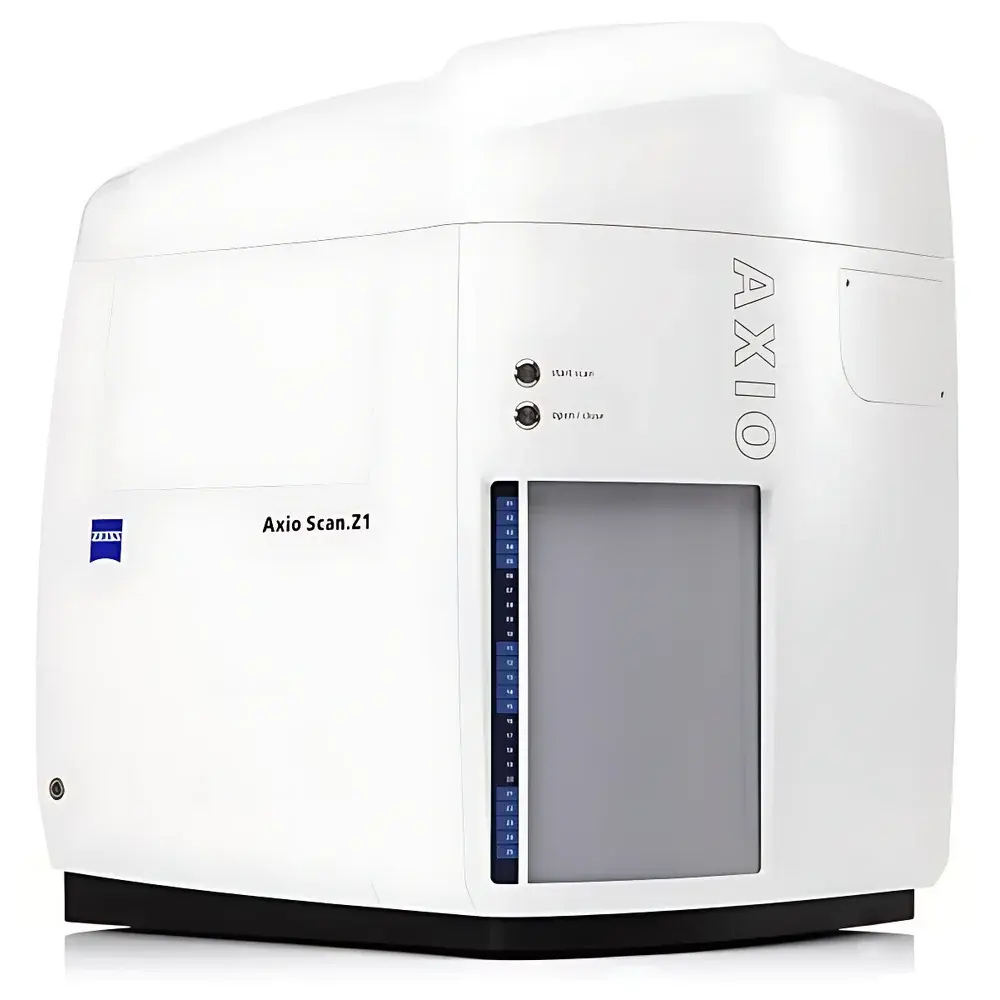
ZEISS Axio Scan.Z1 Fully Automated Digital Slide Scanning System
| [Brand | ZEISS |
|---|---|
| Origin | Germany |
| Model | Axio Scan.Z1 |
| Fluorescence Channels | Up to 9 |
| Filter Wheel Switching Time | <40 ms |
| Excitation Wavelength Switching | Millisecond-scale |
| LED Light Source | Colibri.2 (10 selectable wavelengths) |
| Supported Slide Formats | 26 × 76 mm, 52 × 76 mm, 102 × 76 mm (tray-based modular loading) |
| Maximum Capacity | 100 standard 1″ × 3″ slides per tray |
| Camera Options | Hamamatsu ORCA-Flash4.0 V2, AxioCam MRm, Hitachi HV-F202 |
| Software Platform | ZEN Blue with ZEN slidescan, ZEN Lite, ZEN Browser, and OAD (Open Application Development) |
| Calibration | Fully automated geometric, chromatic, and focus calibration |
| Compliance | Designed for GLP/GMP-aligned workflows |
Overview
The ZEISS Axio Scan.Z1 is a high-throughput, fully automated digital slide scanning system engineered for precision histopathology, translational research, and clinical trial support laboratories. It employs widefield brightfield, polarization, and multi-channel epifluorescence imaging based on Köhler illumination principles and calibrated optical path integrity. The system captures whole-slide images (WSI) at sub-micron pixel resolution—down to 0.22 µm/pixel at 20×—with rigorous geometric fidelity and photometric consistency across modalities. Its core architecture integrates a motorized XYZ stage, programmable LED excitation (Colibri.2), high-dynamic-range sCMOS or CCD cameras, and a modular tray-based sample handling platform compliant with ISO 8601 and ANSI/NIST standards for slide dimensions. Designed and manufactured in Oberkochen, Germany, the Axio Scan.Z1 delivers reproducible, traceable digitization essential for longitudinal studies, remote expert consultation, AI training pipelines, and regulatory submissions.
Key Features
- Modular slide tray system supporting three standardized formats: 26 × 76 mm, 52 × 76 mm, and 102 × 76 mm—enabling compatibility with both conventional glass slides and tissue microarrays (TMA)
- Up to nine fluorescence channels enabled by three synchronized high-speed filter wheels (excitation, dichroic, emission), each switching in under 40 ms without mechanical latency in multi-band configurations
- Colibri.2 LED light source with ten discrete excitation wavelengths (365–625 nm), delivering stable, low-phototoxicity illumination ideal for live-tissue proxies and archival FFPE sections
- Fully automated calibration suite—including geometric alignment, chromatic aberration correction, and z-axis focus homogeneity—ensuring pixel-accurate registration across objectives and sessions
- Dual-camera imaging architecture: one dedicated macro overview camera for rapid navigation and region-of-interest (ROI) selection; second high-sensitivity camera optimized for quantitative fluorescence, brightfield, or polarized light acquisition
- Integrated barcode recognition (1D/2D) for unambiguous slide identification, metadata association, and LIMS interoperability during batch scanning
- Robust mechanical design tolerates dimensional variance in commercial slide stock—compatible with Giessener, US 1″ × 3″, and ISO 80601-2-57-compliant substrates
Sample Compatibility & Compliance
The Axio Scan.Z1 accommodates unstained, H&E-, IHC-, IF-, FISH-, and multiplex-immunofluorescence-stained sections ranging from 3–10 µm thickness on standard glass or charged slides. It supports coverslip-present or coverslip-absent preparations without performance degradation, thanks to its non-contact tray advancement mechanism. The system complies with foundational requirements of ISO/IEC 17025 for testing laboratories and aligns with documentation expectations under CAP Checklist GEN.41730 (digital pathology validation), FDA Guidance for Industry on Clinical Evaluation of Digital Pathology Devices (2023), and EU IVDR Annex II technical documentation structure. All acquired images embed EXIF- and DICOM-SR-compatible metadata—including objective magnification, exposure time, gain, illumination intensity, and calibration timestamps—facilitating 21 CFR Part 11–compliant audit trails when deployed with ZEN Blue’s optional secure user authentication and electronic signature modules.
Software & Data Management
ZEN software forms the unified control, acquisition, and analysis layer. ZEN slidescan orchestrates automated scanning protocols—including Z-stack acquisition, multi-region stitching, and dynamic exposure optimization per field. ZEN Lite provides browser-based annotation, measurement (length, area, angle, intensity profiling), and side-by-side comparison of up to 16 registered images. ZEN Browser enables secure web-based access to archived CZI files—ZEISS’s native multi-dimensional container format—with lossless compression, pyramidal tiling, and ROI-level streaming. The platform supports TIFF, JPEG2000, PNG, and OME-TIFF export for integration into PACS, LIS, or AI model training environments. Open Application Development (OAD) APIs allow custom algorithm integration (e.g., nuclei segmentation, mitotic count, spectral unmixing) while maintaining full provenance tracking. All processing steps are logged with operator ID, timestamp, and parameter set—critical for GLP audits and method validation reports.
Applications
The Axio Scan.Z1 serves as a reference-grade digitization platform across academic, pharmaceutical, and diagnostic settings. In neurodegenerative disease research, it enables quantitative amyloid plaque mapping in transgenic mouse brain sections using PAS and Thioflavin-S staining. For oncology, its high-fidelity multichannel fluorescence supports spatial phenotyping of tumor-infiltrating lymphocytes (CD3/CD8/FOXP3) and stromal interactions in TMA cohorts. In toxicologic pathology, automated batch scanning combined with ZEN’s batch analysis macros accelerates hepatocyte vacuolization scoring or renal tubular injury quantification. FISH applications benefit from extended depth-of-field reconstruction and precise spectral separation across ≥5 probes—validated for HER2, EGFR, and ALK copy number assessment. Additionally, the system supports correlative light-electron microscopy (CLEM) workflows via coordinate-mapped ROI export and is routinely deployed in international multicenter trials requiring centralized, harmonized WSI acquisition.
FAQ
What slide formats does the Axio Scan.Z1 support?
Standard 26 × 76 mm and 52 × 76 mm trays are included; custom trays for 102 × 76 mm or other dimensions are available upon request.
Can the system perform Z-stack acquisition for thick sections?
Yes—it supports automated Z-series capture with user-defined step size, number of planes, and focus algorithm (contrast-based or hardware encoder-driven).
Is DICOM WSI export supported?
Native DICOM-SR structured reporting and DICOM WSI (Supplement 145) export are enabled via ZEN Blue with appropriate licensing.
How is color consistency maintained across instruments and time?
Through factory-calibrated white reference tiles and optional in-situ color calibration using ZEISS-certified color targets, ensuring CIELAB ΔE < 2.0 repeatability.
Does the system integrate with laboratory information systems (LIS)?
Yes—via HL7 v2.x and RESTful API interfaces embedded in ZEN Browser; barcode-triggered auto-import and bidirectional status updates are configurable.





