
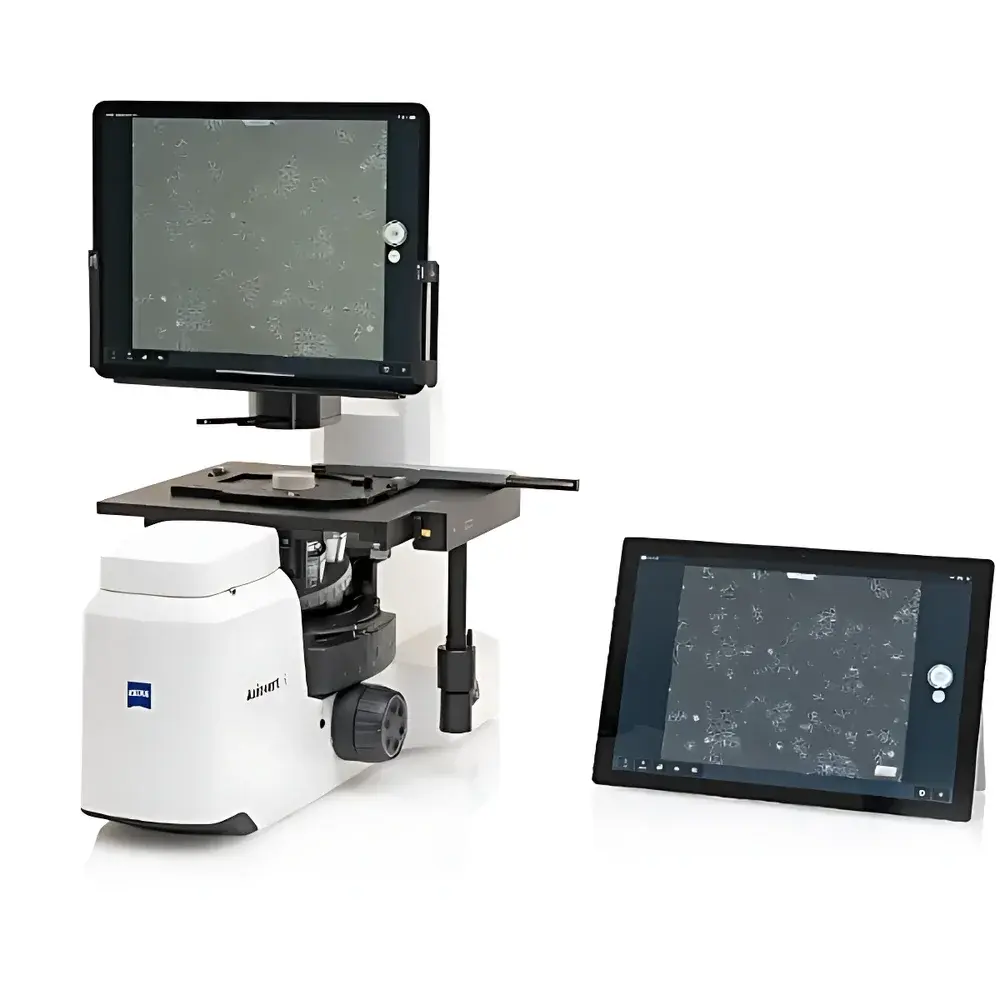
Zeiss Axiovert 5 Digital Inverted Smart Microscope
| Brand | Zeiss |
|---|---|
| Origin | Germany |
| Model | Axiovert 5 Digital |
| Configuration | Integrated digital imaging system with built-in camera and touchscreen interface |
| Optical System | IC2S-corrected optics (achromatic and contrast-optimized) |
| Objective Turret | Encoded 6-position |
| Filter Turret | Encoded 6-position |
| Illumination | Encoded transmitted-light and fluorescence illumination with intensity management |
| Imaging Mode | OSD (On-Screen Display) — direct monitor output without PC |
| AI Module | LabScope AI for automated confluence analysis and cell counting |
| Sample Clearance | Up to 220 mm height |
| Eco Mode | Power-saving operational profile |
| Compliance | Designed for GLP-compliant workflows |
Overview
The Zeiss Axiovert 5 Digital is a purpose-engineered inverted smart microscope optimized for routine live-cell imaging, quality-controlled cell culture monitoring, and standardized histological assessment in regulated laboratory environments. Unlike traditional inverted microscopes requiring external computers and complex peripheral integration, the Axiovert 5 Digital embeds core imaging functionality—including a high-sensitivity CMOS sensor, real-time image processing unit, and intuitive touch-enabled OSD interface—within its compact, ergonomic chassis. Its optical architecture is based on Zeiss’ IC2S (Improved Contrast & Chromatic Correction System), delivering consistent resolution and minimal chromatic aberration across both brightfield and multi-channel fluorescence modalities. The system operates on a Couette-flow-compatible stage design, enabling stable observation of adherent cultures under physiological conditions, while its encoded hardware components—objectives, filters, and illumination paths—ensure traceable, repeatable configuration states essential for audit-ready documentation.
Key Features
- IC2S-corrected optical pathway: Combines achromatic correction with enhanced phase and contrast fidelity for reliable visualization of unstained or lightly stained specimens—including phase contrast, DIC-compatible setups, and multi-label fluorescence.
- Encoded 6-position objective turret and 6-position filter cube turret: Enables automatic recognition and recall of magnification, NA, and spectral bandpass parameters during session logging and report generation.
- Smart illumination management: Transmitted-light LED source and fluorescence excitation LEDs are digitally encoded and intensity-regulated, supporting quantitative brightness normalization across time-lapse experiments.
- OSD (On-Screen Display) mode: Bypasses PC dependency—images and video streams render directly to HDMI/DisplayPort monitors, reducing latency and simplifying GxP-aligned documentation workflows.
- LabScope AI module: A validated, embedded AI engine performing pixel-based confluence quantification and nuclear segmentation using DAPI/TxRed dual-channel input; outputs CSV- and PDF-formatted reports compliant with internal SOPs.
- Extended working distance architecture: Accommodates vessels up to 220 mm in height—including triple-layered cell factories, bioreactor flasks, and custom macro-culture platforms—without mechanical interference or focus drift.
- Eco Mode firmware: Dynamically throttles LED drive current and sensor readout frequency during idle periods, reducing power draw by ≥40% versus continuous operation—certified per ISO 14001 energy efficiency benchmarks.
Sample Compatibility & Compliance
The Axiovert 5 Digital supports standard tissue culture formats (e.g., 6–96-well plates, Petri dishes, chamber slides) as well as non-standard geometries including microfluidic chips and organ-on-chip devices with transparent substrates (glass, cyclic olefin copolymer). Its open-stage design permits integration of environmental control units (temperature, CO₂, humidity) via third-party adapters conforming to ANSI/SLAS footprint standards. From a regulatory perspective, the system’s encoded hardware states, timestamped image metadata (EXIF + custom Zeiss ZEN metadata schema), and LabScope AI audit trail meet foundational requirements for GLP, ISO 13485, and FDA 21 CFR Part 11 compliance when deployed with validated network storage and user access controls.
Software & Data Management
Imaging acquisition, annotation, and export are handled natively through the embedded LabScope OS—no external host PC required. All captured data are stored in vendor-neutral TIFF and JPEG2000 formats with embedded calibration tags (pixel size, exposure time, objective ID). Metadata is structured according to MIAME and MIAPE guidelines, facilitating downstream integration with LIMS and ELN systems via RESTful API endpoints. For laboratories requiring electronic signature capability, optional Zeiss ZEN Blue Connect licensing enables role-based user authentication, electronic logbooks, and immutable change tracking aligned with ALCOA+ principles.
Applications
- Cell biology: Long-term confluence monitoring of primary fibroblasts, iPSC-derived lineages, and co-cultures using phase contrast and multi-channel fluorescence.
- Pharmaceutical QC: Routine verification of passage number, morphology consistency, and contamination screening in master cell banks per ICH Q5D.
- Histopathology support: Rapid evaluation of H&E-stained tissue sections and immunofluorescence-labeled biopsies at 20× and 40× magnification.
- Plant biology: Observation of root meristem dynamics and chloroplast distribution in intact seedlings mounted on agarose pads.
- Microbiology: Quantitative assessment of yeast budding index, bacterial filamentation, and biofilm thickness in static and flow-based assays.
FAQ
Does the Axiovert 5 Digital support motorized Z-focus or autofocus?
No—it features manual coarse/fine focusing only. Motorized focus is available in the Axiovert 7 series; this model prioritizes mechanical stability and reduced electromagnetic interference for sensitive long-term imaging.
Can LabScope AI be trained on custom cell types beyond HeLa and CHO-K1?
Yes—custom model training is supported via Zeiss ZEN Blue Connect with annotated ground-truth datasets provided by the user; validation protocols must follow ISO/IEC 17025 requirements for method verification.
Is the system compatible with third-party environmental chambers?
Yes—mechanical mounting interfaces comply with SLAS/ANSI standards, and thermal isolation design minimizes condensation risk when operating at 37°C/5% CO₂.
What file formats are generated during OSD recording?
H.264-encoded MP4 for video; 16-bit TIFF stacks for time-lapse image sequences; all include embedded EXIF and Zeiss-specific metadata fields.
How is calibration maintained across instrument deployments?
Each unit ships with NIST-traceable stage micrometer and fluorescence intensity reference slide; calibration logs are auto-generated and exportable as PDF or XML upon request.



