
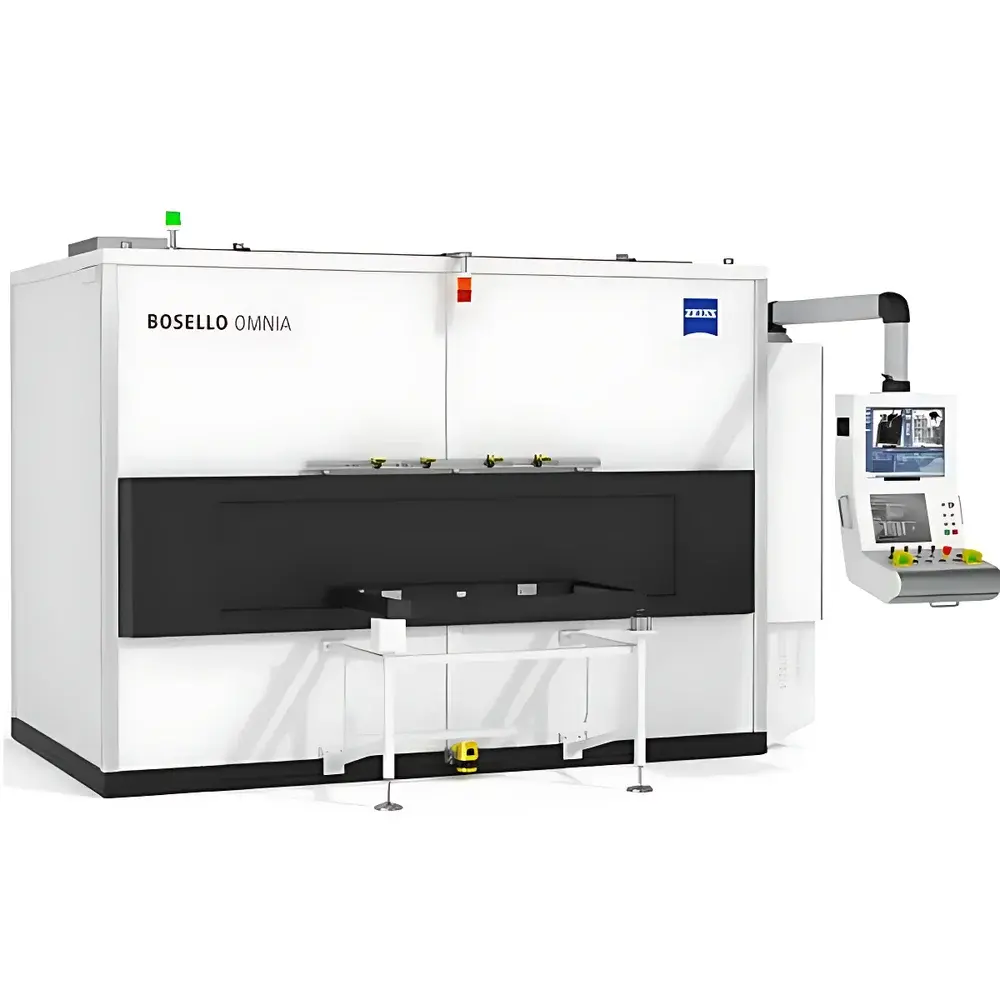
ZEISS BOSELLO OMNIA 2D X-ray Inspection System
| Brand | ZEISS |
|---|---|
| Origin | Shanghai, China |
| Manufacturer Type | Original Equipment Manufacturer (OEM) |
| Country of Origin | China |
| Model | ZEISS BOSELLO OMNIA |
| Quotation | Upon Request |
| Detector Type | Flat-Panel Digital Radiography (DR) Detector |
| Scanning Mode | Translation-Rotation (TR) |
| Maximum Inspection Volume | 1170 × 670 × 380 mm |
Overview
The ZEISS BOSELLO OMNIA 2D X-ray Inspection System is a high-throughput, production-integrated non-destructive testing (NDT) platform engineered for automated radiographic evaluation of cast components in industrial manufacturing environments. Unlike micro-CT or 3D volumetric systems, the OMNIA employs high-resolution digital radiography (DR) with fixed geometry and optimized TR (translation-rotation) motion control to deliver rapid, repeatable 2D projection imaging. Its design centers on inline process compatibility—enabling real-time defect detection without interrupting production flow. The system operates on the principle of differential X-ray attenuation, where internal discontinuities (e.g., porosity, inclusions, shrinkage cavities, misruns) manifest as localized contrast deviations in calibrated grayscale images. Engineered for robustness under continuous operation, it meets the mechanical, thermal, and electromagnetic stability requirements typical of foundry and automotive Tier-1 assembly lines.
Key Features
- High-throughput loading architecture: Dual-turntable and modular tray system enables sub-5-second part exchange—minimizing idle time between inspections.
- Production-hardened mechanical design: IP54-rated enclosure, vibration-damped base frame, and sealed X-ray tube housing ensure operational reliability in foundry environments with ambient temperatures up to 45 °C and dust exposure.
- TR-mode scanning optimization: Precise synchronization of linear translation and rotational axes ensures geometrically consistent projection angles across large-volume parts (up to 1170 mm × 670 mm × 380 mm), maintaining spatial resolution uniformity.
- Integrated flat-panel DR detector: High dynamic range (16-bit), low-noise amorphous silicon (a-Si) detector with pixel pitch ≤ 150 µm supports high-fidelity image acquisition at frame rates compatible with line-speed synchronization.
- Fixed-axis + rotating-stage hybrid configuration: Allows concurrent part unloading/loading and image acquisition—eliminating dead time and maximizing system duty cycle.
Sample Compatibility & Compliance
The ZEISS BOSELLO OMNIA accommodates a broad spectrum of metallic and near-metallic castings—including aluminum, magnesium, iron, and zinc alloys—within its maximum inspection envelope. It is validated for medium-to-low density materials (density range: 1.5–7.8 g/cm³) and thicknesses up to 120 mm Al-equivalent. The system complies with IEC 61331-1 (radiation protection), EN 1435 (weld radiography standards), and incorporates hardware-level interlocks aligned with ISO 15708-2 for industrial X-ray equipment safety. Software workflows support traceability per ISO 9001 and IATF 16949 quality management systems, including audit-ready log files with timestamped operator actions, system calibrations, and image metadata.
Software & Data Management
The proprietary ZEISS ADR (Automated Defect Recognition) software provides fully configurable, standards-based evaluation logic. It supports creation of application-specific acceptance libraries compliant with ASTM E186, E2868, and E2903 for castings; includes parametric search engines for sensitivity tuning (e.g., contrast threshold, minimum defect area, shape filters); and features synthetic defect simulation tools—allowing algorithm validation and training using virtual casting models prior to physical deployment. All image data, measurement logs, and pass/fail decisions are stored in a structured SQLite database with optional integration into MES/ERP via OPC UA or RESTful API. Audit trails adhere to FDA 21 CFR Part 11 requirements, including electronic signatures, immutable records, and user-role-based access control.
Applications
The OMNIA is deployed primarily in high-volume casting production for automotive powertrain components (cylinder heads, transmission housings, brake calipers), aerospace structural brackets, and rail vehicle suspension nodes. Its 2D DR architecture delivers optimal cost-per-part value when volumetric CT is unnecessary—particularly for planar defects oriented perpendicular to the beam path (e.g., hot tears, laminations, core shift). It serves as a deterministic go/no-go gate prior to machining or assembly, reducing downstream scrap and rework. In Tier-1 supplier networks, the system supports PPAP documentation by generating standardized defect reports aligned with OEM-specific AIAG CQI-11 guidelines.
FAQ
What types of defects can the ZEISS BOSELLO OMNIA reliably detect in aluminum die-castings?
Porosity clusters, oxide inclusions, cold shuts, core shifts, and wall thickness variations—provided they exceed the system’s practical contrast sensitivity limit (~2% Δμ/μ at 150 kV) and projected pixel size resolution.
Does the system support integration with robotic material handling?
Yes—the dual-turntable interface includes standardized pneumatic and electrical I/O ports (24 V DC, IO-Link compatible) and position feedback signals for seamless coordination with collaborative robots or gantry loaders.
Is ADR rule configuration transferable between different casting families?
Rule sets are project-specific but exportable/importable via XML schema; cross-application reuse requires recalibration of contrast thresholds and geometric filters due to differences in part geometry and alloy attenuation.
What radiation safety certifications does the OMNIA carry for installation in EU facilities?
It bears CE marking under the EU Electromagnetic Compatibility Directive 2014/30/EU and the Machinery Directive 2006/42/EC; local licensing per national radiation protection ordinances (e.g., German RöV) remains the responsibility of the end-user site.
Can the system operate unattended for extended shifts?
Yes—designed for 24/7 operation with predictive maintenance alerts, thermal monitoring of X-ray source and detector, and automatic daily calibration routines triggered during scheduled downtime windows.



