
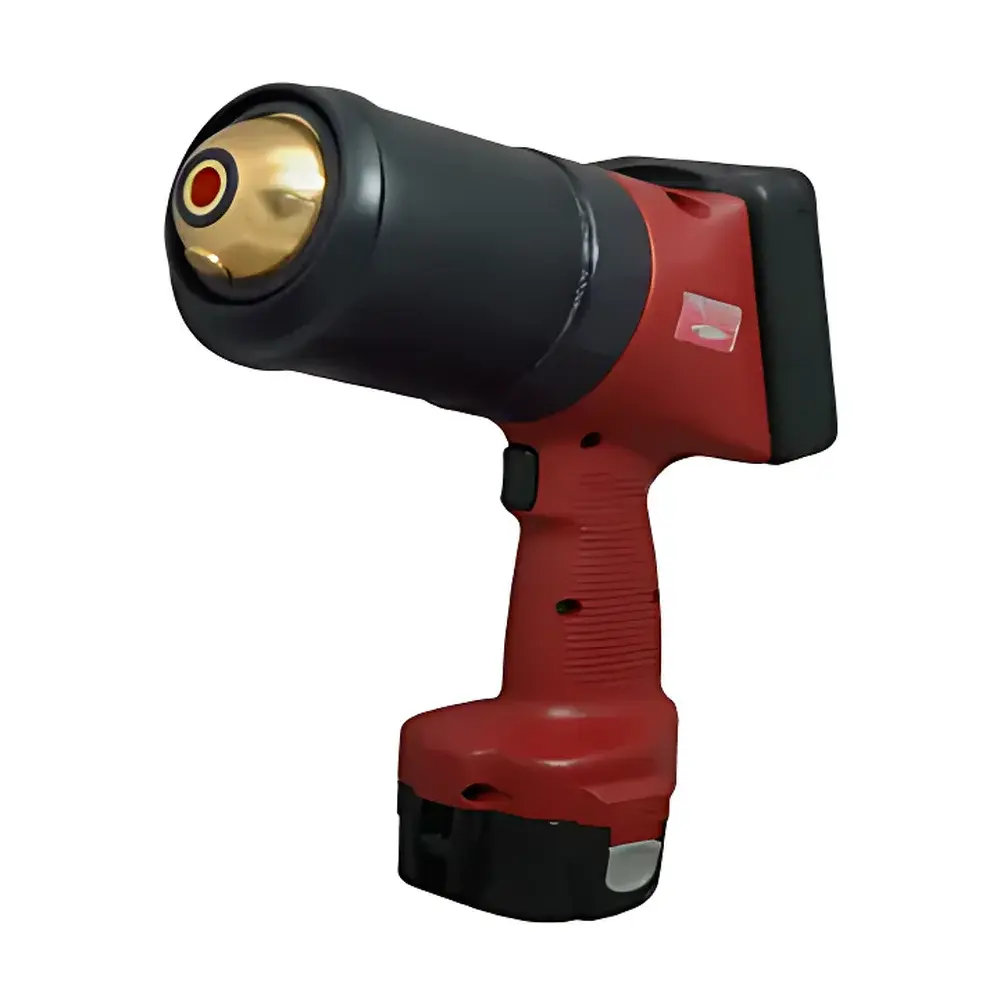
SurfaceOptics ET10 Portable Infrared Emissivity Meter
| Brand | SurfaceOptics |
|---|---|
| Origin | USA |
| Model | ET10 |
| Measurement Bands | 3–5 µm and 8–12 µm |
| Incident Angle | 20° from normal |
| Sample Compatibility | Opaque materials |
| Measurement Time | 7 s per acquisition (10 s typical system output) |
| Warm-up Time | 90 s |
| IR Source | FeCrAl alloy |
| Detector Configuration | Dual-band, simultaneous DHR measurement |
| Output Parameter | Spectral-directional emissivity (ε = 1 − ρ) |
| Display | Touch-enabled LCD PDA interface |
| Power | Rechargeable NiMH battery pack (2 units) |
| Weight | 2.1 kg (incl. batteries) |
| Operating Temperature | 0–40 °C (non-condensing) |
| Storage Temperature | −25–70 °C |
| Calibration | NIST-traceable gold mirror reference standard included |
| Compliance | ASTM E1933, ISO 18434-1, USP <1210>, GLP-compliant data audit trail support in software |
Overview
The SurfaceOptics ET10 Portable Infrared Emissivity Meter is an engineered field-deployable instrument designed for rapid, non-contact determination of directional-hemispherical reflectance (DHR) and derived spectral emissivity (ε) of opaque solid surfaces. It operates on the fundamental radiometric principle that, for thermally stable, non-transmissive materials, directional emissivity at a given wavelength and viewing geometry satisfies Kirchhoff’s law: ελ,θ = 1 − ρλ,θ, where ρλ,θ is the directional-hemispherical reflectance measured at the same wavelength and incident angle. The ET10 implements this relationship by integrating a stabilized broadband infrared source (FeCrAl alloy filament) with two synchronized, spectrally filtered photodetectors—each optimized for high signal-to-noise ratio within the 3–5 µm and 8–12 µm atmospheric transmission windows. With a fixed 20° off-normal incidence geometry, the system delivers repeatable, geometry-controlled reflectance data traceable to NIST-standard gold-coated reference mirrors. Its portability, battery-powered operation, and sub-10-second measurement cycle make it suitable for in-situ calibration of thermal imaging systems, validation of coating performance in aerospace thermal control, and emissivity input generation for industrial pyrometry correction protocols.
Key Features
- Dual-band simultaneous detection across 3–5 µm and 8–12 µm spectral ranges, enabling cross-band emissivity comparison and material classification
- Modular probe head architecture—field-replaceable optical modules ensure long-term serviceability and alignment stability
- Integrated NIST-traceable gold mirror standard supplied with each unit; supports on-site verification and recalibration without return-to-factory
- Touch-enabled PDA-based interface with real-time display of ten concurrent operational parameters—including source temperature drift, detector gain status, ambient humidity compensation flag, and measurement confidence index
- Robust mechanical design compliant with MIL-STD-810G for shock, vibration, and thermal cycling; IP54-rated enclosure for workshop and outdoor deployment
- Low-power NiMH battery system provides >4 hours continuous operation; hot-swappable battery modules eliminate downtime during extended field campaigns
Sample Compatibility & Compliance
The ET10 accepts any opaque, non-fluorescent surface with no requirement for surface preparation beyond routine cleaning. It accommodates moderate curvature: convex surfaces with radii ≥6 inches and concave surfaces with radii ≥12 inches maintain measurement fidelity due to its collimated illumination path and wide-field detector acceptance. The instrument complies with ASTM E1933 (Standard Test Methods for Measuring and Compensating for Emissivity Using Infrared Imaging Systems), ISO 18434-1 (Condition monitoring and diagnostics of machines — Thermography — Part 1: General procedures), and supports regulatory requirements under FDA 21 CFR Part 11 via optional software configuration (audit trail, electronic signatures, role-based access). All measurement data files include embedded metadata: timestamp, GPS coordinates (via optional Bluetooth module), operator ID, ambient conditions, and calibration certificate ID—ensuring full traceability for GLP/GMP environments.
Software & Data Management
The ET10 is operated through SurfaceOptics’ EmissivityStudio™ v4.x software suite, deployed on the integrated PDA or optionally on Windows-based host PCs. The software enforces structured data capture: each measurement session auto-generates .emx binary files containing raw detector voltages, normalized reflectance integrals, computed emissivity values, and uncertainty estimates based on detector noise floor and source stability metrics. Export formats include CSV (for Excel/Python analysis), XML (for LIMS integration), and PDF reports compliant with ISO/IEC 17025 documentation standards. Version-controlled firmware updates are delivered via encrypted USB key or secure HTTPS portal, with rollback capability and SHA-256 integrity verification. Audit logs record all user actions—including parameter changes, calibration events, and report generation—with immutable timestamps.
Applications
- Providing validated emissivity inputs for quantitative thermographic analysis in predictive maintenance programs
- Verifying thermal barrier coating (TBC) integrity on turbine blades and exhaust components
- Characterizing space-grade thermal control paints and second-surface mirrors used in satellite radiators
- Supporting ASTM C1371 and ISO 10292 compliance testing for building envelope materials
- Enabling emissivity-corrected temperature mapping in metallurgical process monitoring (e.g., annealing furnaces, hot rolling mills)
- Validating IR camera factory calibration against known reference surfaces prior to deployment in hazardous areas
FAQ
Can the ET10 measure transparent or semi-transparent materials?
No. The ET10 is explicitly designed for opaque solids only. Transmissive or scattering media violate the ε = 1 − ρ assumption and require alternative techniques such as FTIR with integrating sphere accessories.
Is the 20° incidence angle adjustable?
No. The optical path is fixed at 20° from normal to ensure consistent geometry across all measurements and alignment compatibility with NIST-traceable standards.
How often does the instrument require recalibration?
Annual recalibration is recommended under ISO/IEC 17025 guidelines; however, daily verification using the supplied gold mirror standard is required before critical measurements.
Does the system support external data logging or SCADA integration?
Yes. Via RS-232 and Ethernet interfaces, the ET10 can stream live reflectance values and status flags to PLCs or centralized monitoring systems using Modbus TCP or ASCII protocol.
What is the measurement uncertainty for emissivity at 8–12 µm on oxidized aluminum?
Typical expanded uncertainty (k=2) is ±0.015 ε units for polished metals and ±0.025 ε units for rough or oxidized surfaces, as documented in the Certificate of Calibration shipped with each unit.



