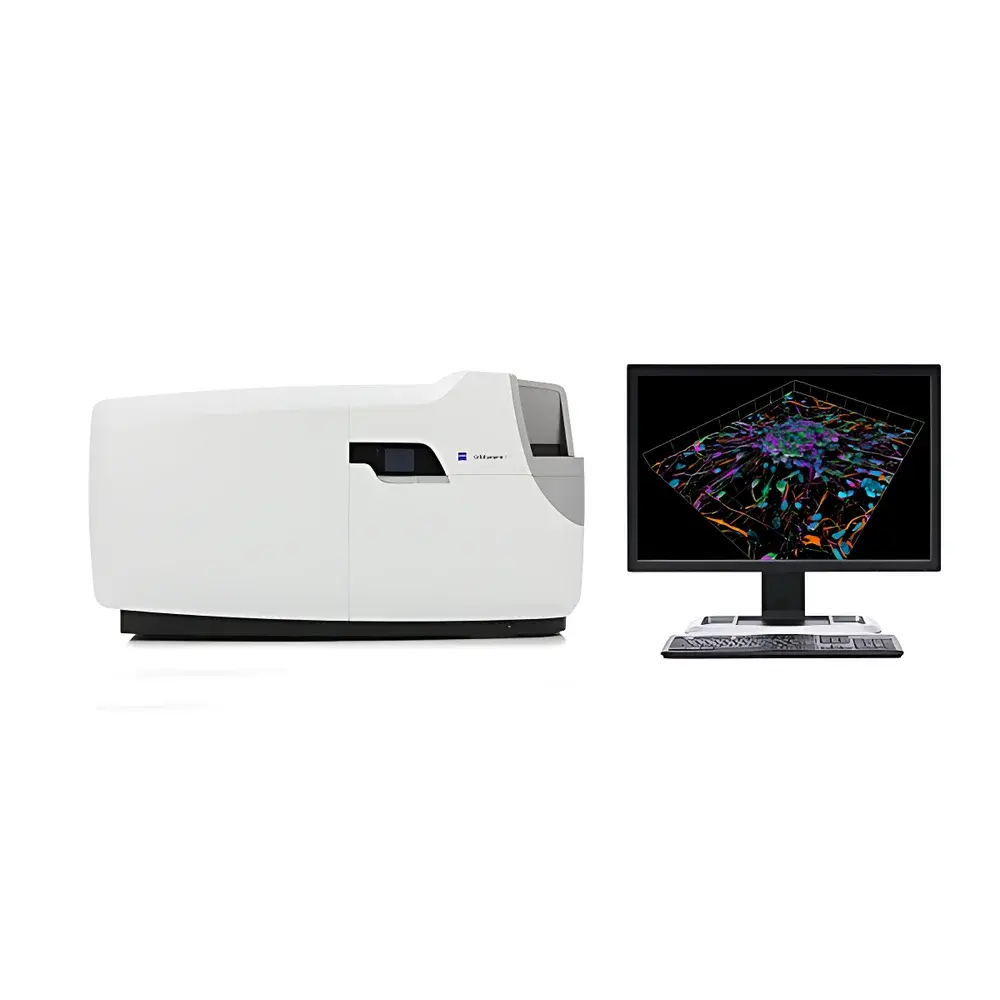
ZEISS Celldiscoverer 7 Automated Live-Cell Imaging Platform
| Brand | ZEISS |
|---|---|
| Origin | Germany |
| Model | Celldiscoverer 7 |
| Type | Integrated Inverted Microscope System with Environmental Control and Automated Imaging |
| Compliance | CE-marked, ISO 13485–compatible design, GLP/GMP-ready workflow architecture |
| Software Platform | ZEN Connect (v3.7+), supports FDA 21 CFR Part 11–compliant audit trails and electronic signatures |
Overview
The ZEISS Celldiscoverer 7 is an integrated, research-grade automated live-cell imaging platform engineered for high-content, long-term dynamic observation of biological specimens under physiologically relevant conditions. Built upon a precision inverted microscope architecture, it combines high-fidelity optical performance—including apochromatic correction, high numerical aperture optics, and multi-modal contrast capabilities—with fully automated environmental control (temperature, CO₂, humidity) and intelligent sample handling. Its core measurement principle relies on widefield fluorescence, phase gradient contrast (PGC), and optional confocal-capable detection paths—enabling quantitative spatiotemporal analysis of subcellular dynamics without compromising cell viability. Designed for reproducible time-lapse experiments ranging from minutes to >72 hours, the system integrates hardware-level autofocus (Definite Focus 2), motorized stage navigation, and adaptive immersion management (Autoimmersion™) to maintain optical stability across variable dish thicknesses and refractive indices. All optical calibration routines are software-driven and traceable, ensuring metrological consistency across users and laboratories.
Key Features
- Fully automated inverted microscope platform with motorized Z-drive, XY stage, filter turrets, and objective changers—enabling unattended multi-position, multi-channel acquisition
- Integrated environmental chamber with independent temperature control (20–40 °C ±0.2 °C), CO₂ regulation (0–20% ±0.1%), and active humidity management (up to 95% RH)
- Definite Focus 2 system: hardware-based, non-invasive focus stabilization that corrects for thermal drift and mechanical displacement in real time
- Autoimmersion™ technology: automatic top-up of immersion medium during extended acquisitions, preserving optical path integrity for high-NA objectives (e.g., Plan-Apochromat 20×/0.8 or 40×/1.3 Oil)
- Multi-contrast imaging engine supporting simultaneous acquisition of fluorescence (single- or multi-channel), phase gradient contrast (PGC), and brightfield—without mechanical reconfiguration
- Modular optical design compatible with sCMOS and EMCCD cameras, spectral unmixing modules, and optional point-scanning confocal units (e.g., LSM 800 integration)
Sample Compatibility & Compliance
The Celldiscoverer 7 accommodates standard and custom culture formats including 6–384-well plates, glass-bottom dishes (thickness 0.13–1.2 mm), organ-on-chip devices, and cleared tissue specimens (e.g., expansion microscopy samples). Its stage adapter system ensures mechanical repeatability across plate types while maintaining Z-axis alignment within ±0.3 µm. All environmental control parameters are logged with timestamped metadata and support ALCOA+ data integrity principles. The system’s firmware and ZEN Connect software comply with ISO/IEC 17025 documentation requirements for calibration traceability and are validated for use in GLP-regulated studies. Audit trail functionality meets FDA 21 CFR Part 11 criteria for electronic records and signatures, including user authentication, action logging, and immutable data archiving.
Software & Data Management
ZEN Connect serves as the unified acquisition, analysis, and data governance interface. It provides scriptable acquisition workflows (Python API), batch processing pipelines for Z-stack reconstruction and deconvolution, and integrated tools for object segmentation, intensity quantification, and kymograph generation. Raw data is stored in standardized OME-TIFF format with embedded MIAS-compliant metadata. The software supports DICOM export for cross-platform image sharing and includes built-in tools for FAIR (Findable, Accessible, Interoperable, Reusable) data packaging. Version-controlled experiment templates allow lab-wide protocol harmonization, while role-based access control ensures compliance with institutional data governance policies.
Applications
- Long-term mitotic tracking in HeLa Kyoto cells expressing H2B-mCherry and Tubulin-eGFP—72-hour time series at 15-min intervals with PGC + dual-fluorescence overlay
- High-throughput phenotypic screening in 348-well plates using 2.5× macro-objective imaging, eliminating tile stitching artifacts while resolving single-cell morphology
- Whole-brain expansion microscopy of YFP-labeled murine neurons—acquisition of >500 Z-slices per field with consistent SNR across depth, enabling axonal tract tracing and pyramidal neuron morphometry
- Co-localization dynamics of mitochondrial networks (MitoTracker Red) and nuclear DNA in primary human lung fibroblasts—quantified via Pearson’s coefficient and Manders’ overlap metrics over 48-hour time courses
- Embryonic development monitoring in zebrafish and C. elegans—multi-channel imaging of organogenesis under controlled hypoxia or pharmacological perturbation
FAQ
Does the Celldiscoverer 7 support true confocal imaging?
Yes—when equipped with the optional LSM 800 point-scanning module, the platform delivers diffraction-limited optical sectioning with spectral detection and resonant scanning up to 30 fps.
Can I use non-standard dish materials or custom microfluidic chips?
The system accepts substrates with refractive indices between 1.33–1.52 and thickness tolerances of ±0.1 mm; adapter kits are available for specialized carriers.
How is autofocus performance validated across different cell densities and media conditions?
Definite Focus 2 uses reflected infrared light from the coverslip interface—performance is invariant to fluorescence signal intensity, confluency, or phenol-red content in culture media.
Is remote operation supported for shared-core facilities?
ZEN Connect enables secure web-based monitoring and queue-based acquisition scheduling via ZEISS Lab Management Portal, with TLS 1.3 encryption and SSO integration.
What validation documentation is provided for regulatory submissions?
ZEISS supplies IQ/OQ protocols, calibration certificates for environmental sensors, and software validation packages aligned with ASTM E2500 and USP guidelines.