
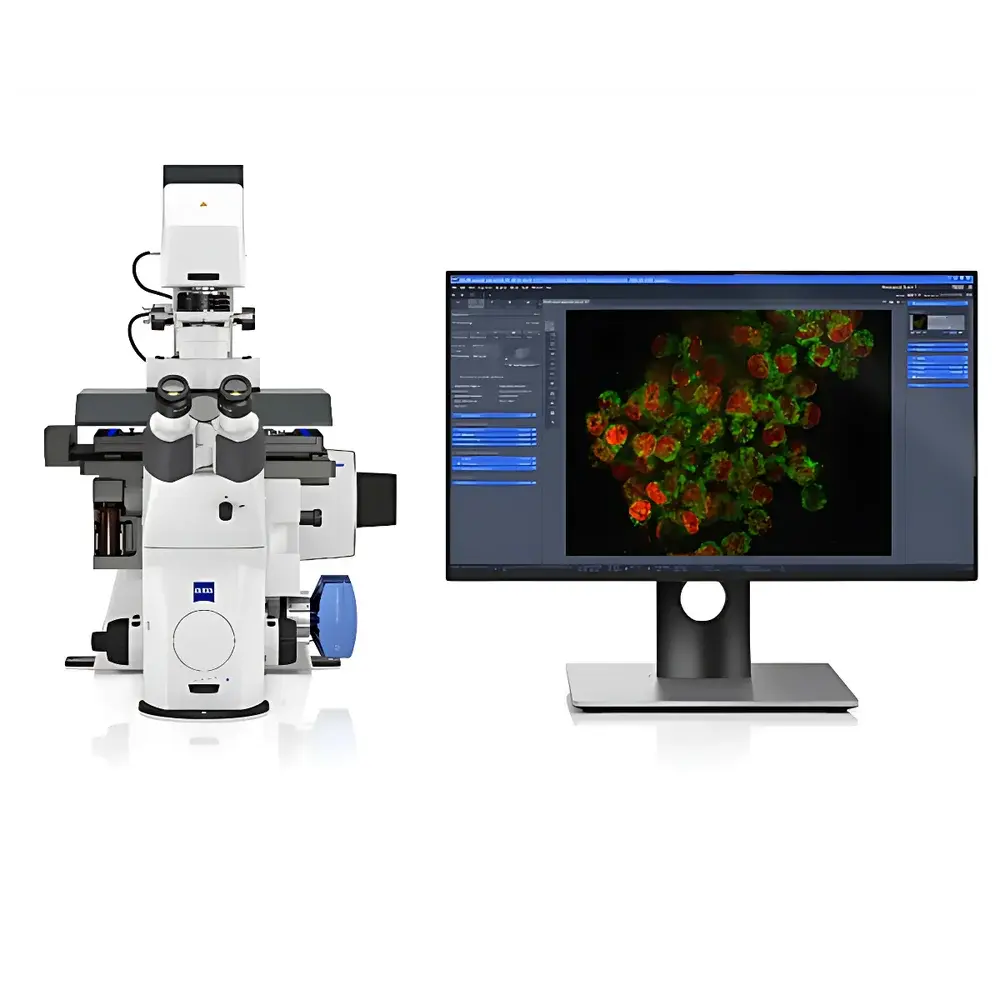
Zeiss Lattice SIM 3 Super-Resolution Microscope
| Brand | Zeiss |
|---|---|
| Origin | Germany |
| Model | Lattice SIM 3 |
| Type | Structured Illumination Microscopy (SIM) System |
| Optical Principle | Lattice Light-Sheet Illumination Combined with High-Frequency Patterned SIM |
| Max. Resolution (XY) | ~120 nm |
| Max. Resolution (Z) | ~300 nm |
| Imaging Speed | Up to 500 frames/sec (full-frame, region-of-interest dependent) |
| Penetration Depth | Up to 100–200 µm in cleared tissue |
| Objective Compatibility | 25×/1.0 NA water-dipping, 40×/1.1 NA water-immersion, 63×/1.2 NA water-immersion |
| Laser Lines | 405, 488, 561, 640 nm (standard) |
| Detection Channels | 4-channel simultaneous spectral detection with GaAsP PMTs or sCMOS cameras |
| Software Platform | ZEN Imaging (with Lattice SIM module), supports 3D deconvolution, drift correction, and multi-color registration |
| Compliance | CE-marked, compliant with ISO 13485 (for IVD-relevant configurations), supports FDA 21 CFR Part 11 audit trail (in validated ZEN Blue environment) |
Overview
The Zeiss Lattice SIM 3 is a next-generation super-resolution microscope engineered for quantitative, high-fidelity 3D imaging of thick biological specimens. It integrates lattice light-sheet illumination with advanced structured illumination microscopy (SIM), enabling simultaneous optimization of spatial resolution, temporal fidelity, optical sectioning quality, and phototoxicity management. Unlike conventional widefield or confocal systems, the Lattice SIM 3 employs a dynamically generated, high-contrast lattice pattern projected orthogonally to the detection axis—minimizing out-of-focus excitation while delivering uniform illumination across extended volumes. This dual-modality architecture achieves near-isotropic resolution (~120 nm lateral, ~300 nm axial) at speeds exceeding 500 frames per second for targeted regions, making it uniquely suited for live, long-term observation of dynamic subcellular processes in intact tissues and organoids.
Key Features
- Lattice Light-Sheet Illumination: Generates a thin, diffraction-limited sheet using spatially modulated laser interference patterns—reducing photobleaching and photodamage by >90% compared to point-scanning modalities.
- High-Frequency SIM Reconstruction: Acquires nine raw images per plane (three phase shifts × three rotation angles) with real-time GPU-accelerated processing, supporting live-cell compatible temporal resolution without compromising resolution fidelity.
- Multi-Scale Objective Support: Optimized for 25×/1.0 NA water-dipping objectives to enable large-field-of-view (up to 500 µm × 500 µm) super-resolution imaging of whole organoids or embryonic structures, while maintaining compatibility with higher-magnification water-immersion optics for subcellular detail.
- Simultaneous Multi-Channel Detection: Four independent detection paths with tunable spectral filters and high-quantum-efficiency GaAsP PMTs or back-illuminated sCMOS sensors ensure precise co-registration of spectrally distinct probes without sequential acquisition artifacts.
- Integrated Drift Correction & Adaptive Focus Lock: Uses fiducial-based stage feedback and infrared focus tracking to maintain sub-10 nm axial stability over multi-hour acquisitions—critical for developmental time-lapse studies.
Sample Compatibility & Compliance
The Lattice SIM 3 accommodates a broad range of optically accessible biospecimens, including intact cleared tissues (e.g., iDISCO+, CLARITY), live organoids embedded in Matrigel or collagen I, whole-mount Drosophila embryos, zebrafish larvae (≤7 dpf), and 3D neuronal cultures. Its low-phototoxicity design enables >12-hour continuous imaging of mitochondrial dynamics in human iPSC-derived cortical spheroids with minimal impact on viability or morphology. The system complies with CE marking requirements under Directive 2014/30/EU (EMC) and 2014/35/EU (LVD). When configured with ZEN Blue software and hardware-enforced user access controls, it meets audit-trail and electronic signature requirements per FDA 21 CFR Part 11 for regulated preclinical research environments. Optional IQ/OQ documentation packages support GLP-compliant installation and performance verification.
Software & Data Management
Imaging acquisition, reconstruction, and analysis are unified within Zeiss ZEN Imaging software (v3.6+), featuring dedicated modules for Lattice SIM alignment, blind-SIM deconvolution, chromatic aberration correction, and 4D (x,y,z,t) volume rendering. Raw data is stored in standardized OME-TIFF format with embedded metadata (acquisition parameters, calibration files, channel definitions) ensuring FAIR (Findable, Accessible, Interoperable, Reusable) compliance. Batch processing pipelines support automated stitching of tiled volumes, intensity normalization across time points, and export to Imaris, Fiji, or MATLAB for downstream segmentation and quantitative morphometrics. All reconstruction algorithms are fully documented and reproducible via scriptable Python API (ZEN Scripting Engine).
Applications
- Longitudinal tracking of organelle reorganization during organoid maturation and polarization.
- High-content mapping of synaptic protein distribution in 3D neuronal networks with nanoscale precision.
- Quantitative assessment of nuclear architecture remodeling in early mammalian embryogenesis.
- Multi-color structural phenotyping of vascular patterning in tumor spheroids under hypoxic gradients.
- Correlative imaging workflows integrating Lattice SIM with light-sheet fluorescence microscopy (LSFM) or expansion microscopy (ExM) for cross-scale validation.
FAQ
What sample mounting media are recommended for optimal Lattice SIM 3 performance?
We recommend refractive-index-matched aqueous media such as Fluoromount-G (RI = 1.45), RIMS (RI = 1.52), or custom sucrose/glycerol formulations calibrated to the objective’s immersion medium. Mounting in non-matching media induces spherical aberration that degrades axial resolution and pattern fidelity.
Can Lattice SIM 3 be integrated into existing Zeiss LSM platforms?
No—the Lattice SIM 3 is a standalone platform with proprietary beam path architecture, dedicated laser combiner, and synchronized galvo-scanning optics. It is not retrofittable onto LSM 900 or LSM 980 systems.
Is training provided for advanced reconstruction parameter tuning?
Yes—Zeiss offers on-site application specialist-led workshops covering SIM frequency selection, background subtraction strategies, noise modeling for low-SNR datasets, and validation protocols using NIST-traceable resolution test targets.
Does the system support two-photon excitation?
No—Lattice SIM 3 operates exclusively in linear excitation mode using visible-wavelength lasers. Two-photon capability is not supported due to fundamental incompatibility with lattice pattern generation and widefield detection geometry.
How is calibration maintained across multi-user laboratories?
Each instrument includes an automated daily calibration routine verifying grating alignment, laser power balance, and detector gain linearity. Calibration logs are timestamped, digitally signed, and archived within ZEN’s secure database with role-based access control.



