
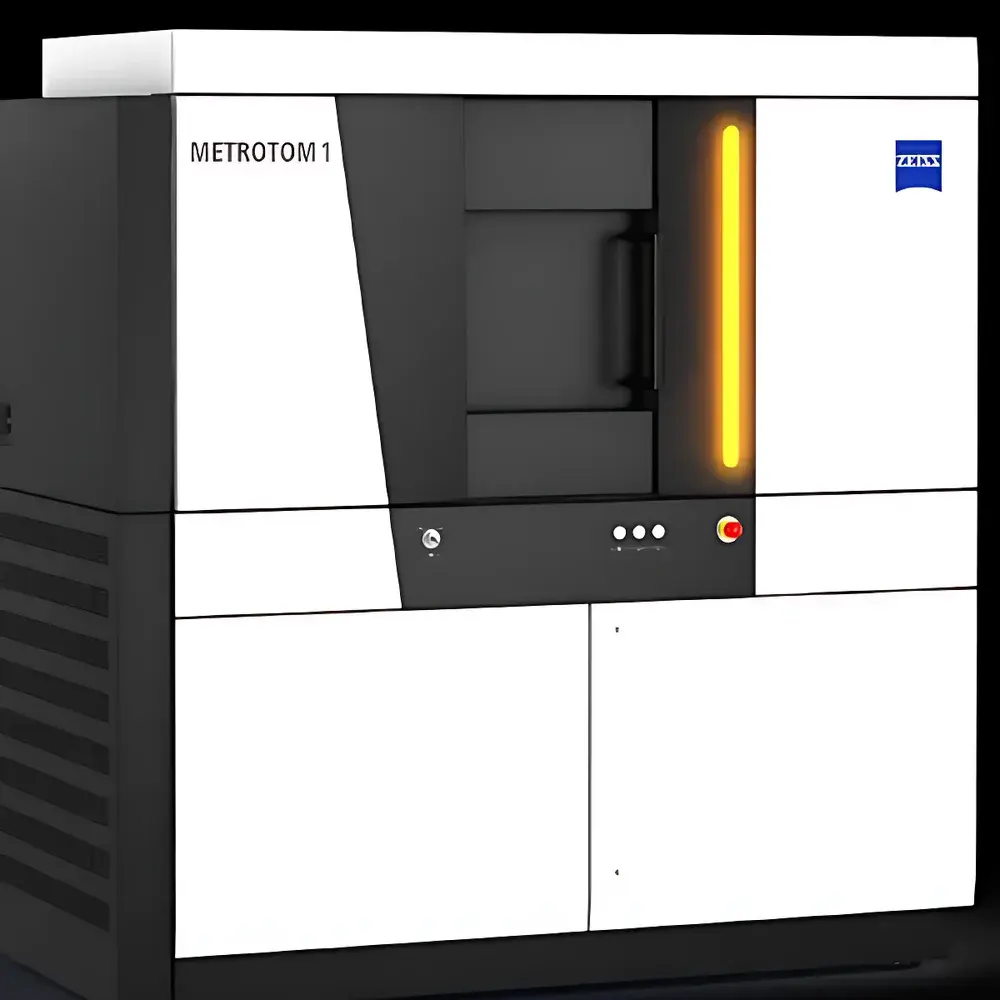
ZEISS METROTOM 1 Industrial Micro-CT System
| Brand | ZEISS |
|---|---|
| Origin | Shanghai, China |
| Manufacturer Type | Original Equipment Manufacturer (OEM) |
| Regional Classification | Domestic |
| Model | METROTOM 1 |
| Detector Type | Flat-Panel Detector |
| Scanning Mode | Translation-Rotation (TR) |
| Accuracy | Micron-Level |
| Measurement Volume | 165 × 140 mm |
| Dimensional Measurement Uncertainty (MPE SD) | 5 µm + L/100 |
| System Dimensions | 1750 mm (W) × 1820 mm (H) × 870 mm (D) |
| Weight | 2100 kg |
| X-ray Source | 160 kV |
| Detector Resolution | 2500 × 2500 pixels |
| Minimum Voxel Size | 32.6 µm |
| Software | ZEISS INSPECT |
Overview
The ZEISS METROTOM 1 Industrial Micro-CT System is a compact, benchtop-compliant X-ray computed tomography platform engineered for high-precision non-destructive 3D metrology and internal defect analysis of small-to-medium-sized industrial components. Operating on the principle of cone-beam micro-CT, it reconstructs volumetric density data from hundreds of angular projections acquired via a synchronized translation-rotation (TR) scanning motion. Unlike conventional coordinate measuring machines (CMMs), the METROTOM 1 captures both external geometry and internal features—including porosity, inclusions, wall thickness variations, and assembly integrity—without part disassembly or surface preparation. Its integrated 160 kV sealed-tube X-ray source eliminates the need for water cooling or high-maintenance filament replacement, supporting stable long-term operation in QC labs and production environments. Designed for ISO/IEC 17025-aligned metrology workflows, the system delivers traceable dimensional results compliant with VDI/VDE 2630 Part 1.3 and ASTM E1441 standards for industrial CT.
Key Features
- Compact footprint (1750 × 1820 × 870 mm) enables integration into standard laboratory spaces without structural reinforcement or radiation shielding retrofitting.
- Flat-panel detector with 2500 × 2500 pixel resolution ensures high signal-to-noise ratio and spatial fidelity across the full 165 × 140 mm measurement volume.
- Micron-level metrological performance: maximum permissible error (MPE SD) of 5 µm + L/100, validated per ISO 15530-3 using calibrated reference artifacts.
- Automated parameter optimization within ZEISS INSPECT software reduces setup time—exposure time, tube voltage, step count, and rotation increments are intelligently derived based on material density and part geometry.
- Multi-part scanning capability allows concurrent acquisition of up to eight geometrically compatible components, significantly improving throughput in batch inspection scenarios.
- Sealed X-ray tube architecture minimizes downtime and operational overhead, eliminating filament replacement cycles typical of open-tube systems.
Sample Compatibility & Compliance
The METROTOM 1 accommodates metallic, polymer, ceramic, and composite samples weighing up to 5 kg and fitting within its nominal measurement volume. It supports non-destructive evaluation of castings, injection-molded parts, additive-manufactured components, electronic assemblies, and medical device housings. All measurements adhere to GLP-compliant data handling protocols; ZEISS INSPECT maintains full audit trails—including user identity, timestamp, reconstruction parameters, and calibration history—as required under FDA 21 CFR Part 11 for regulated industries. The system meets IEC 61000-6-3 (EMC) and IEC 61000-6-4 emission standards, and its radiation safety design conforms to national regulations governing Class II X-ray equipment (e.g., NRC 10 CFR Part 35 in the US, or GBZ 130–2020 in China).
Software & Data Management
ZEISS INSPECT serves as the unified metrology and visualization environment for the METROTOM 1. It provides guided workflow navigation—from scan planning and acquisition to reconstruction, segmentation, GD&T evaluation, and CAD comparison. Volumetric datasets are stored in vendor-neutral formats (e.g., DICOM, TIFF stacks), enabling interoperability with third-party analysis tools such as Avizo, VGStudio MAX, or open-source platforms like 3D Slicer. Measurement reports include full uncertainty budgets, statistical process control (SPC) charts, and export-ready PDF/Excel outputs. Role-based access control, digital signature support, and encrypted database logging ensure data integrity throughout the product lifecycle—from R&D validation through final release testing.
Applications
- Dimensional verification of complex internal geometries against nominal CAD models (including GD&T compliance per ISO 1101).
- Porosity and inclusion quantification in aluminum die-castings and investment castings per ASTM E505 and ISO 10289.
- Wall thickness analysis of thin-walled plastic enclosures and fluidic manifolds.
- First-article inspection and FAI reporting for aerospace and automotive Tier-1 suppliers.
- Reverse engineering of legacy components lacking original drawings or CAD files.
- Fault root-cause analysis of field-failure parts, including crack propagation mapping and solder joint voiding assessment.
FAQ
What is the minimum resolvable feature size achievable with the METROTOM 1?
The system achieves a minimum voxel size of 32.6 µm under optimal magnification conditions; practical detectability of features depends on material contrast, signal-to-noise ratio, and reconstruction algorithm selection.
Does the METROTOM 1 require external radiation shielding?
No—its fully enclosed cabinet meets international regulatory requirements for self-shielded X-ray equipment, permitting installation in standard laboratory rooms without additional lead-lined walls or doors.
Can ZEISS INSPECT perform automated GD&T evaluation on reconstructed volumes?
Yes—it supports ISO 1101-compliant geometric tolerance evaluation (e.g., position, concentricity, profile) directly on 3D point clouds extracted from CT volumes, with statistical reporting per ASME Y14.5.
Is the system compatible with automated metrology cell integration?
Yes—via Ethernet/IP and OPC UA interfaces, the METROTOM 1 can be synchronized with robotic part loaders, barcode readers, and MES systems for unattended multi-shift operation.
How is measurement traceability maintained across system recalibrations?
Calibration is performed using ZEISS-certified reference artifacts traceable to PTB (Physikalisch-Technische Bundesanstalt); all calibration events are logged with metadata and linked to subsequent measurement records in INSPECT’s secure database.



