
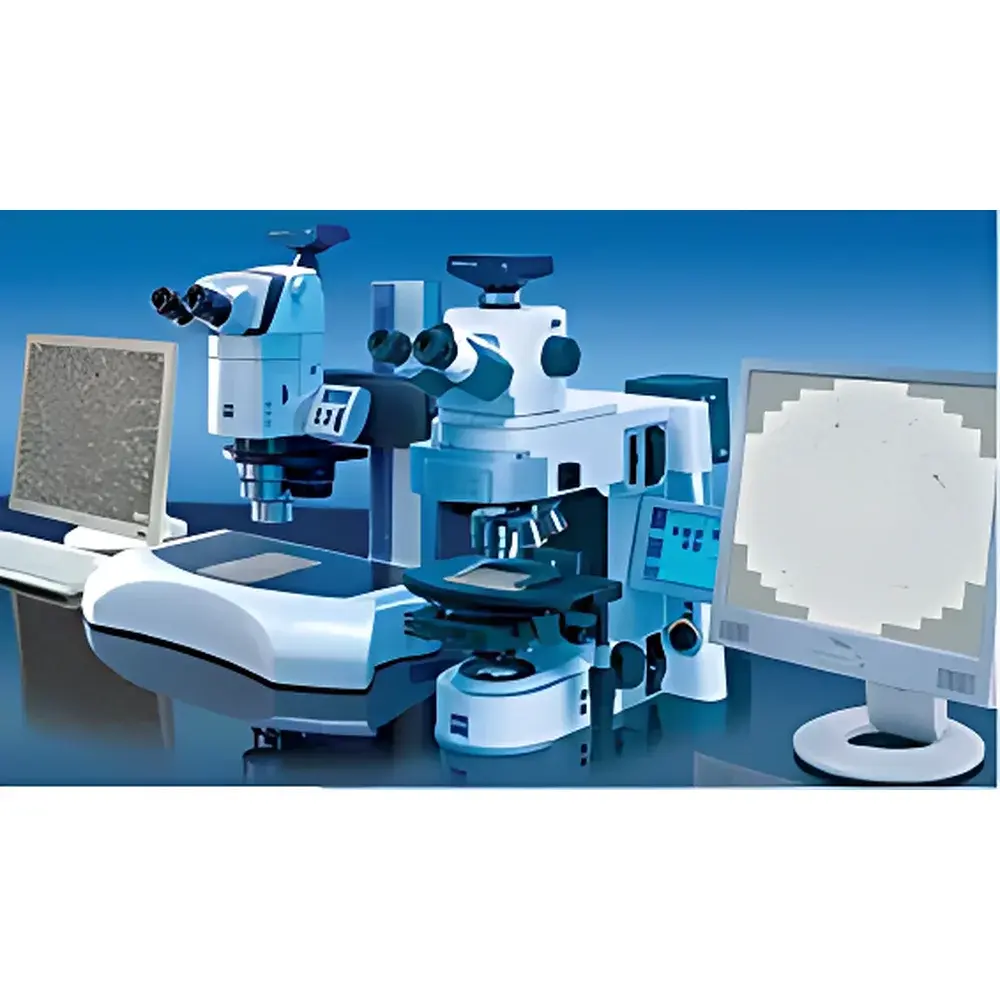
ZEISS Particle Analyzer Automated Cleanliness Analysis System
| Brand | ZEISS |
|---|---|
| Origin | Germany |
| Model | Particle Analyzer |
| Compliance Standards | ISO 4406, ISO 4407, ISO 16232, NAS 1638, ASTM D4378-03, VDA 19 |
| Automation Level | Fully Automated Imaging & Particle Classification |
| Sample Carrier | Filter Membrane (diameter 47 mm, pore sizes 0.45–8 µm) |
| Detection Principle | Brightfield/Darkfield Microscopy with Digital Image Acquisition & AI-Assisted Morphological Classification |
| Software Platform | ZEISS ZEN Core with Audit Trail & CFR 21 Part 11 Readiness |
Overview
The ZEISS Particle Analyzer Automated Cleanliness Analysis System is a high-precision, fully automated microscopic image analysis platform engineered for quantitative particulate contamination assessment on filter membranes. Built upon ZEISS’s century-long heritage in optical excellence and precision engineering, the system implements standardized light microscopy—combined with motorized stage scanning, multi-contrast illumination (brightfield/darkfield/phase contrast), and calibrated digital imaging—to deliver traceable, repeatable, and metrologically robust particle characterization. It measures particle count, size distribution (down to 5 µm per ISO 16232-C), shape descriptors (aspect ratio, circularity, convexity), and grayscale intensity—enabling not only compliance-driven cleanliness grading but also forensic source attribution (e.g., metallic wear debris vs. textile fiber vs. polishing residue). Designed for integration into quality control laboratories operating under ISO/IEC 17025, IATF 16949, or AS9100 frameworks, the Particle Analyzer eliminates manual counting bias and inter-operator variability while maintaining full traceability of every measurement step.
Key Features
- Fully automated membrane scanning: Motorized XYZ stage with sub-micron positioning repeatability ensures complete coverage of standard 47 mm filter membranes without stitching artifacts or field-of-view overlap gaps.
- Multi-contrast optical engine: Integrated brightfield, darkfield, and optional polarized illumination modes enhance contrast for low-refractive-index particles (e.g., silicone, plastic) and colored contaminants that are indistinguishable under single-mode lighting.
- Calibrated particle sizing: Optical magnification (10×–50× objectives) coupled with NIST-traceable pixel calibration delivers size measurement uncertainty < ±0.8 µm at 10 µm threshold—validated per ISO 21508 Annex B.
- Shape-based classification: Algorithmic morphological analysis distinguishes abrasive wear particles (elongated, sharp-edged), fatigue debris (rounded, laminar), corrosion products (irregular, porous), and environmental contaminants (fibrous, amorphous) using >12 geometric parameters.
- Regulatory-ready software architecture: ZEISS ZEN Core includes electronic signatures, configurable user roles, immutable audit trails, and optional 21 CFR Part 11 compliance modules for GxP environments.
- Standard-compliant reporting: Preconfigured templates for ISO 4406 (fluid cleanliness codes), ISO 16232 (automotive component classes), VDA 19 (German automotive), and NAS 1638 (aerospace hydraulics) ensure direct alignment with OEM specifications.
Sample Compatibility & Compliance
The Particle Analyzer accepts standard polycarbonate, mixed cellulose ester (MCE), or polyvinylidene fluoride (PVDF) filter membranes (47 mm diameter, pore sizes 0.45 µm to 8 µm), compatible with extraction solvents including isopropanol, n-hexane, and aqueous surfactant solutions. Sample preparation—whether performed manually via vacuum filtration or automatically using integrated fluid-handling modules—follows ISO 16232-2 and VDA 19 Part 1 protocols. All hardware components comply with CE marking requirements, electromagnetic compatibility (EMC) Directive 2014/30/EU, and Low Voltage Directive 2014/35/EU. The system supports GLP/GMP-aligned workflows through time-stamped metadata logging, instrument calibration certificate management, and raw image archiving in TIFF 6.0 format with embedded EXIF and custom metadata fields.
Software & Data Management
ZEN Core software provides a unified interface for acquisition, analysis, validation, and reporting. Acquired images are stored with embedded calibration data, illumination settings, and stage coordinates. Batch processing enables concurrent analysis of up to 96 membranes with auto-generated summary reports in PDF/XLSX formats—including histograms of particle size distribution, scatter plots of aspect ratio vs. equivalent circular diameter, and pass/fail status against user-defined limits. Data export supports LIMS integration via ASTM E1384-compliant XML schemas. Audit trail records include operator ID, timestamp, parameter changes, and result modifications—with write-once-read-many (WORM) archive options for long-term regulatory retention.
Applications
The Particle Analyzer serves as the reference method for cleanliness verification across high-reliability manufacturing sectors. In automotive powertrain production, it validates machining coolant filtration efficiency and verifies post-assembly cleaning of fuel injectors, ABS valves, and transmission clutches. Aerospace MRO facilities deploy it for hydraulic system component certification prior to reinstallation. Medical device manufacturers use it to verify particulate limits on stainless-steel surgical instruments and implant-grade titanium housings per ISO 10993-12. Semiconductor equipment suppliers apply it to quantify metallic contamination on wafer handling chucks and vacuum chamber liners. Additional applications include wear debris analysis in lubricating oils (per ASTM D7690), validation of cleanroom garment shedding, and qualification of filter integrity in pharmaceutical final-fill lines.
FAQ
Does the Particle Analyzer require external sample preparation equipment?
No—the core system analyzes pre-filtered membranes; however, optional integrated vacuum filtration stations and ultrasonic extraction modules are available for end-to-end automation.
Can the software be validated for FDA-regulated environments?
Yes—ZEN Core offers IQ/OQ documentation packages and supports 21 CFR Part 11 compliance with electronic signatures, audit trail review tools, and role-based access controls.
What particle size range is reliably detectable?
With 10× objective and optimal contrast, particles ≥5 µm are quantified per ISO 16232-C; down to 2 µm is achievable using 20× objective and darkfield illumination—subject to membrane pore size and particle refractive index.
Is calibration traceable to national standards?
Yes—optical calibration uses NIST-traceable stage micrometers and certified resolution test targets; annual calibration services include DAkkS-accredited certificates.
How does the system handle overlapping or clustered particles?
Advanced segmentation algorithms apply watershed splitting and intensity gradient mapping to resolve touching particles, with manual override capability for borderline cases requiring expert review.





