
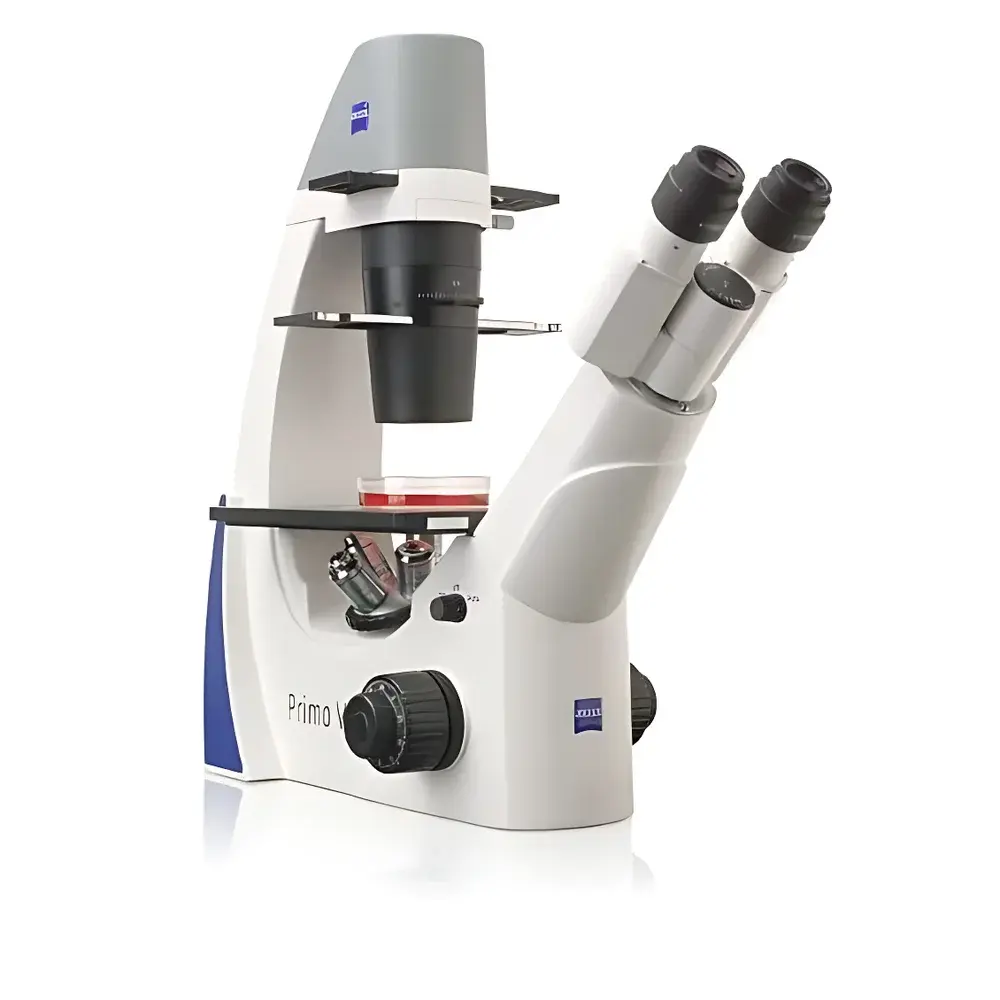
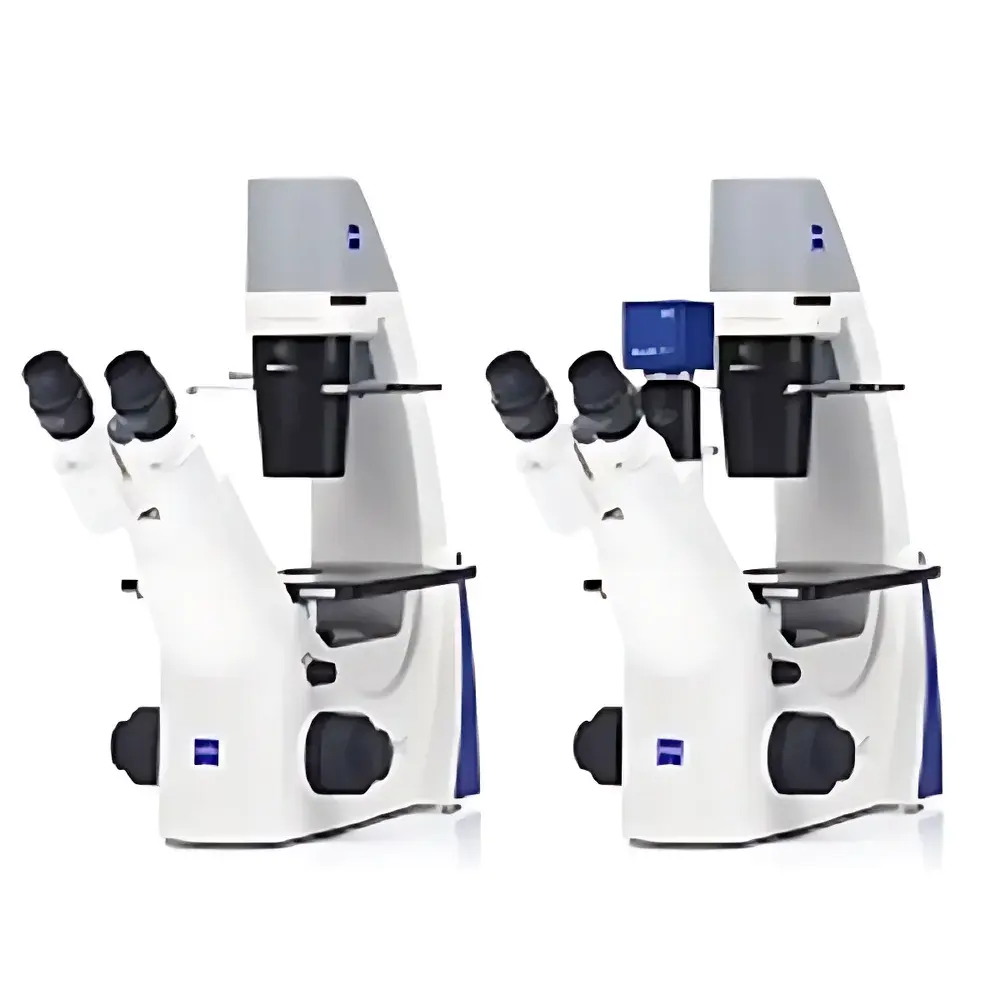
ZEISS Primovert Inverted Microscope
| Brand | ZEISS |
|---|---|
| Origin | Germany |
| Model | Primovert |
| Optical Path | V-shaped high-efficiency infinity-corrected achromatic optics |
| Illumination Options | 12 V/100 W halogen lamp or LED light source |
| Contrast Methods | Phase contrast (standard), fluorescence (optional) |
| Ergonomic Design | Yes |
| Power Management | Intelligent standby mode with auto-shutdown |
| Footprint | Compact inverted configuration optimized for laminar flow hood integration |
| Imaging Compatibility | Supports ZEISS Labscope software and Primovert HDcam digital camera system |
| Regulatory Compliance | Designed to support GLP-compliant cell culture monitoring workflows |
Overview
The ZEISS Primovert is a purpose-engineered inverted microscope optimized for routine and advanced live-cell observation in sterile environments. Built upon ZEISS’s legacy of precision optical engineering, the Primovert employs a V-shaped high-efficiency infinity-corrected achromatic optical path—delivering consistent image fidelity across magnifications while minimizing chromatic aberration and field curvature. Its inverted architecture positions the objective lenses beneath the specimen stage, enabling direct access to cell culture vessels (e.g., Petri dishes, flasks, multi-well plates) without disturbing sample integrity or sterility. This design is fundamental for long-term time-lapse imaging, passaging protocols, and real-time morphological assessment of adherent and suspension cultures. The system supports both transmitted-light phase contrast as standard—ideal for label-free visualization of unstained mammalian cells, primary isolates, and stem cell colonies—and optional fluorescence modules for detection of GFP, RFP, and other common fluorophores used in gene expression and cytoskeletal studies. As a non-invasive, benchtop-grade platform, the Primovert bridges the gap between teaching-grade instrumentation and research-grade reliability—without compromising on optical consistency or ergonomic operability.
Key Features
- V-shaped infinity-corrected achromatic optical path engineered for high transmission efficiency and minimal optical distortion across the visible spectrum.
- Dual illumination options: switchable 12 V/100 W halogen lamp for broad-spectrum white-light imaging or energy-efficient LED illumination with stable color temperature and extended service life (>25,000 h).
- Compact footprint (W × D × H ≈ 300 × 400 × 380 mm) enabling seamless integration into ISO Class 5 laminar flow hoods and biosafety cabinets—no external optical benches or vibration isolation required.
- One-touch contrast mode switching between phase contrast and fluorescence configurations via mechanical turret alignment, reducing setup time and operator-induced variability.
- Ergonomically optimized stage controls and coaxial focus knobs with dual-speed fine adjustment (1 µm graduation) for precise Z-axis navigation during delicate manipulation or serial focal plane acquisition.
- Intelligent power management system: automatically enters low-power standby after 15 minutes of inactivity and fully shuts down after 60 minutes—reducing energy consumption and thermal drift during unattended operation.
Sample Compatibility & Compliance
The Primovert accommodates standard tissue culture formats including 35–150 mm Petri dishes, T-25 to T-225 flasks, 6–96-well plates, and chambered coverglasses—without requiring custom adapters. Its low-profile stage permits unobstructed access to vessel lids and ports, facilitating micropipette-based interventions under observation. All optical components comply with ZEISS’s internal quality control standards aligned with DIN EN ISO 9001. While not certified as medical device hardware, the system is routinely deployed in laboratories operating under GLP and GMP-aligned quality systems for cell line authentication, viability assays, and pre-transfection morphology screening. When paired with ZEISS Labscope software, audit-trail functionality—including user login timestamps, image metadata embedding (objective ID, magnification, exposure settings), and export logs—supports traceability requirements per FDA 21 CFR Part 11 when configured with appropriate IT governance controls.
Software & Data Management
The Primovert integrates natively with ZEISS Labscope—a lightweight, Windows-based imaging platform designed for collaborative microscopy in regulated environments. Labscope enables real-time multi-user viewing over local networks, allowing remote observers to annotate, measure, and discuss live images without breaking sterile workflow continuity. Captured images and time-series stacks are stored in TIFF or ZEN-compatible .czi format, preserving bit-depth and metadata integrity. Batch export functions support automated naming conventions tied to user ID, date/time stamp, and experimental condition tags—facilitating downstream analysis in ImageJ/Fiji, MATLAB, or commercial quantification suites. Optional HDcam integration provides 5 MP resolution at 30 fps, with on-camera white balance calibration and dynamic range optimization for low-light phase and fluorescence conditions.
Applications
- Cell biology: Monitoring confluency, mitotic index, and morphological changes in HeLa, U2OS, and iPSC-derived cultures; validating CRISPR-edited clones via GFP-actin cytoskeletal patterning.
- Microbiology: Observing bacterial colony formation kinetics, biofilm development on coated surfaces, and yeast budding dynamics under controlled humidity and CO2 conditions.
- Plant science: Imaging root hair elongation, protoplast regeneration, and callus tissue differentiation in sterile culture vessels using differential interference contrast (DIC) add-on modules.
- Quality control in biomanufacturing: Routine inspection of master cell banks, working cell banks, and production bioreactor harvests prior to cryopreservation or downstream processing.
FAQ
Can the Primovert be used inside a CO2 incubator?
No—the Primovert is designed for use in laminar flow hoods and ambient lab environments. It is not rated for continuous operation under elevated CO2, humidity, or temperature cycling.
Is fluorescence capability built-in or modular?
Fluorescence observation is an optional module requiring dedicated filter cubes, excitation/emission optics, and a compatible light source (LED or mercury arc lamp). Base configurations include only phase contrast optics.
Does the system support motorized Z-focus or stage automation?
The standard Primovert is manually operated. Motorized Z-drive and XY stage options are available through ZEISS Custom Solutions but require separate quotation and integration validation.
What camera interfaces are supported?
Native support includes USB 3.0–connected ZEISS HDcam models. Third-party cameras with DirectShow or GenICam compliance may operate via Labscope SDK, subject to driver certification.
How often does the halogen lamp require replacement?
Rated lifetime is approximately 100 hours at full intensity; LED illumination eliminates lamp replacement entirely and maintains stable output over >25,000 operational hours.





