
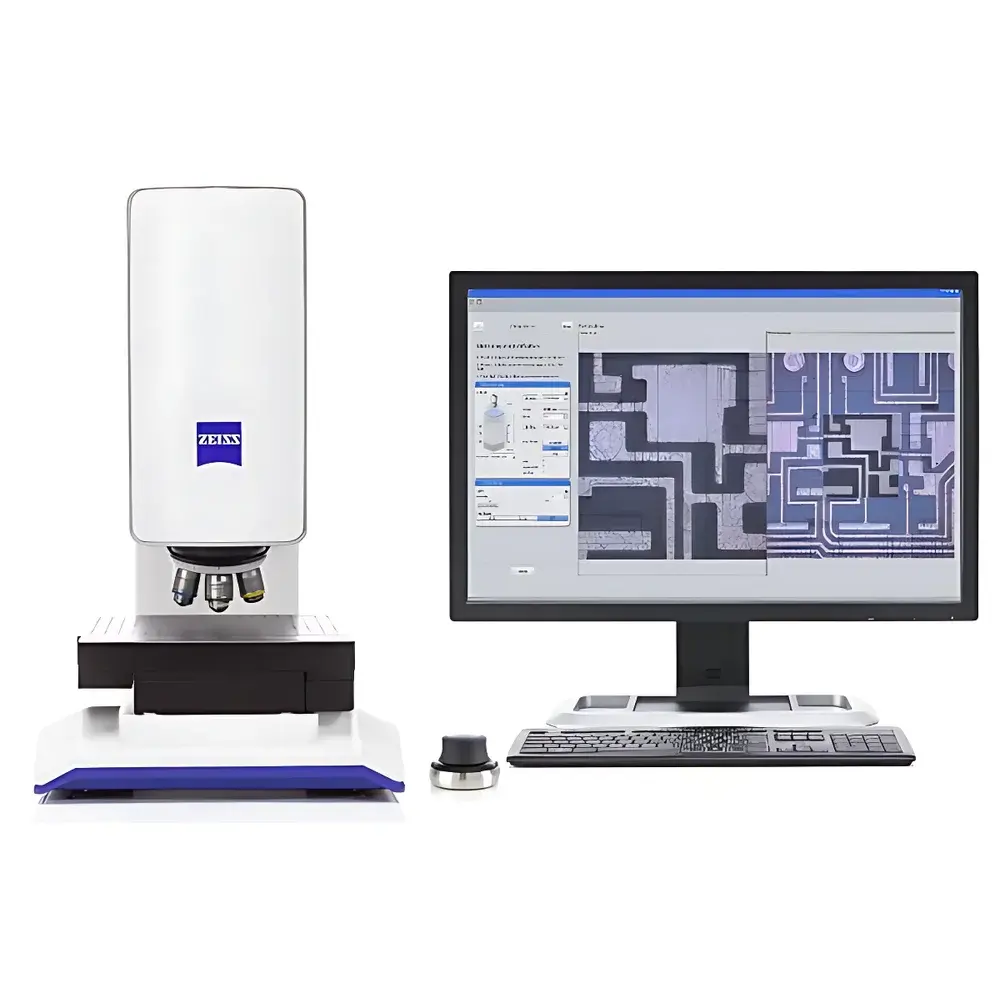
ZEISS Smartproof 5 High-Speed Spinning-Disk Confocal Microscope
| Brand | ZEISS |
|---|---|
| Origin | Germany |
| Model | Smartproof 5 |
| Wavelength | 405 nm |
| Lateral Resolution (XY) | 120 nm |
| Z-Axis Minimum Step Size | 1 nm |
| Imaging Speed | >50 fps (2048 × 2048 resolution) |
| Objective Range | 2.5×–100× |
| Maximum Height Scan Range | 5 mm |
| Stage Travel | 150 mm × 150 mm |
| Software | Smartproof 5 Application Software |
| Surface Metrology Compliance | ISO 4287 (profile roughness), ISO 25178 (areal roughness) |
Overview
The ZEISS Smartproof 5 is a high-speed spinning-disk confocal microscope engineered for industrial surface metrology and non-contact 3D topographic analysis. Unlike conventional point-scanning confocal systems, the Smartproof 5 employs a patented rotating Nipkow disk architecture to achieve parallel optical sectioning—enabling simultaneous acquisition of multiple focal planes across the field of view. This design leverages the fundamental principle of confocal microscopy: spatial filtering via a pinhole array to reject out-of-focus light, thereby enhancing axial resolution and contrast in thick or reflective samples. The system operates at 405 nm excitation wavelength, optimizing signal-to-noise ratio for metallic, ceramic, and polymer surfaces common in precision manufacturing. Its robust mechanical architecture eliminates the need for external vibration isolation, allowing stable operation in factory-floor environments—including QC labs adjacent to CNC machining or assembly lines.
Key Features
- Enhanced lateral resolution: Achieves 120 nm XY resolution—1.4× improvement over standard widefield optics—enabled by diffraction-limited confocal detection and high-NA objective lenses (2.5×–100×).
- Nanometric Z-axis control: Integrated piezo-driven focus mechanism with 1 nm minimum step size ensures sub-micrometer vertical repeatability, critical for quantifying step heights, coating thicknesses, and micro-geometries per ISO 5436-1 and ISO 25178-601.
- High-throughput imaging: Spinning-disk scanning delivers >50 frames per second at full 2048 × 2048 pixel resolution—2–3× faster than conventional laser-scanning confocals—without compromising depth discrimination or signal fidelity.
- True-color surface visualization: Tri-wavelength LED illumination (RGB) preserves native surface chromaticity, supporting defect identification, coating uniformity assessment, and multi-material interface analysis beyond monochrome intensity mapping.
- Integrated metrology platform: Combines optical sectioning with calibrated stage motion and thermal-stable mechanics to deliver traceable height measurements up to 5 mm vertical range, validated against NIST-traceable step-height standards.
Sample Compatibility & Compliance
The Smartproof 5 accommodates a broad spectrum of industrial specimens—from polished silicon wafers and medical-grade titanium implants to cast aluminum engine blocks and embossed paper substrates. Its large 150 mm × 150 mm motorized stage supports oversized components without tiling artifacts. All quantitative surface analyses comply with international metrology standards: 2D profile parameters (Ra, Rz, Rsk, etc.) are calculated per ISO 4287; 3D areal parameters (Sa, Sq, Sdr, etc.) follow ISO 25178-2 and ISO 25178-602. System validation includes documented measurement uncertainty budgets aligned with ISO/IEC 17025 requirements. For regulated industries, audit trails, user access controls, and electronic signature support are available via optional software modules compliant with FDA 21 CFR Part 11 and EU Annex 11.
Software & Data Management
The Smartproof 5 Application Software provides a unified interface for acquisition, real-time rendering, and standardized reporting. It features automated stitching of up to 100×100 tile sets with sub-pixel registration accuracy, adaptive noise suppression filters (Gaussian, median, anisotropic diffusion), and ISO-conformant filtration (Gaussian, spline, robust Gaussian). Measurement workflows support customizable templates for recurring tasks—e.g., weld seam angle evaluation per ISO 13920 or implant surface texture verification per ISO 14289-1. Export formats include industry-standard STP, OBJ, and CSV, with metadata embedding per ASTM E2917 for long-term data integrity. All raw image stacks and parameter logs are stored in vendor-neutral HDF5 containers, ensuring future-readability independent of software version.
Applications
- Automotive: Quantitative wear analysis of piston rings, roughness characterization of cylinder bore honing patterns, and angular deviation measurement of laser-welded joints.
- Aerospace: Seal groove geometry verification on turbine housings, erosion mapping of thermal barrier coatings, and porosity analysis in additive-manufactured Inconel components.
- Medical devices: Surface finish assessment of orthopedic implants per ISO 14644-1 cleanliness thresholds, edge radius measurement of stent struts, and scratch depth profiling on intraocular lenses.
- Micro-optics & MEMS: Wavefront error mapping of diffractive optical elements, sidewall angle determination of etched silicon photonics waveguides, and aspheric lens sagitta verification.
- Electronics: Solder joint coplanarity inspection (IPC-A-610 Class 3), copper trace width/thickness metrology, and underfill void fraction quantification in flip-chip packages.
- Paper & packaging: Basis weight variation correlation with surface roughness (ISO 8791-4), ink penetration depth estimation, and embossing depth uniformity across roll-to-roll production.
FAQ
Is the Smartproof 5 suitable for in-line production monitoring?
Yes—the system’s vibration-insensitive design, rapid acquisition speed (>50 fps), and operator-mode workflow allow integration into semi-automated inspection stations without cleanroom infrastructure.
Does it support automated pass/fail decision-making based on ISO tolerances?
Yes—customizable acceptance criteria can be embedded in measurement templates, with real-time color-coded overlays and exportable compliance reports aligned to ISO 1101 geometric tolerancing frameworks.
Can it measure transparent or highly reflective surfaces without coating?
Yes—its 405 nm confocal configuration minimizes specular reflection artifacts, and polarization-sensitive acquisition modes mitigate glare from polished metals and glass substrates.
What calibration protocols are recommended for GLP/GMP environments?
ZEISS provides certified calibration kits traceable to PTB/NIST, including step-height standards (±0.011 µm uncertainty) and roughness reference samples (Ra ±0.02 µm), with full documentation per ISO/IEC 17025.
Is remote diagnostics and software update capability available?
Yes—secure TLS-encrypted remote access enables firmware updates, log analysis, and preventive maintenance scheduling via ZEISS Remote Service Portal, compliant with IEC 62443-3-3 cybersecurity guidelines.






