
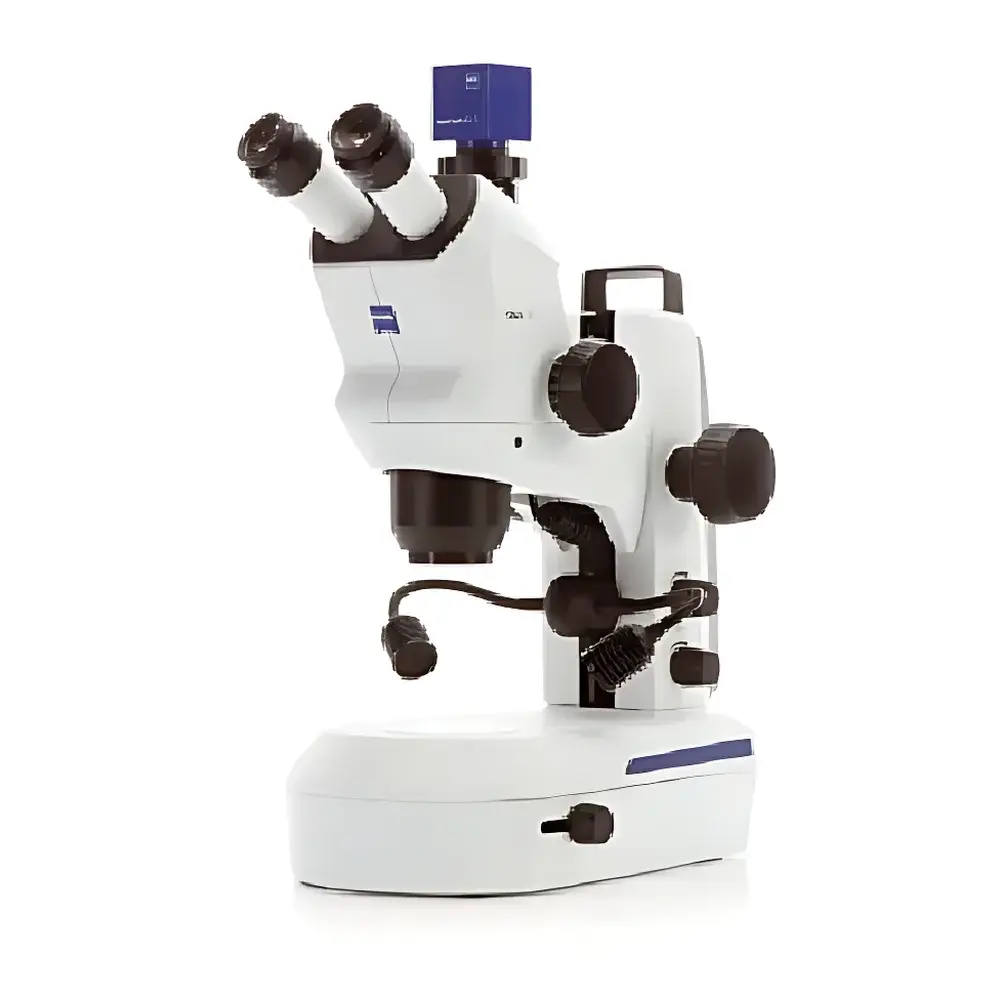
ZEISS Stemi 508 Research-Grade Stereo Microscope
| Brand | ZEISS |
|---|---|
| Origin | Germany |
| Model | Stemi 508 |
| Total Magnification Range | 6.3×–250× |
| Zoom Ratio | 8:1 |
| Working Distance | 286 mm |
| Objective Type | Apochromatic Zoom Optical System |
| Illumination | Integrated LED |
Overview
The ZEISS Stemi 508 is a research-grade stereo microscope engineered for high-fidelity three-dimensional visualization across demanding scientific, industrial, and clinical applications. Built upon ZEISS’s legacy of optical excellence since 1846, the Stemi 508 employs an advanced apochromatic zoom optical path—distinct from conventional Greenough or common-main-objective architectures—to deliver diffraction-limited resolution, chromatic aberration correction across the full visible spectrum, and exceptional depth of field. Its optical design ensures minimal geometric distortion, zero lateral color fringing, and consistent contrast throughout the entire 8:1 zoom range (6.3× to 50× base magnification, extendable to 250× with auxiliary optics). With a maximum field of view diameter of 121 mm and a long working distance of 286 mm at lowest magnification, the system accommodates large, complex, or topographically heterogeneous specimens—including PCB assemblies, biomedical devices, geological sections, and cultural heritage artifacts—without mechanical interference or repositioning.
Key Features
- Apochromatic zoom optics with stray-light suppression coating for high-fidelity color fidelity and spatial accuracy
- Ergonomic 35° inclined viewing angle, optimized for prolonged seated operation and reduced operator fatigue
- Modular mechanical architecture supporting interchangeable front objectives (0.5×, 1×, 1.5×, 2×), wide-field eyepieces (10× standard), and optional trinocular port
- Integrated, flicker-free, temperature-stabilized LED illumination with adjustable intensity and uniform Köhler-like illumination profile
- Robust aluminum-magnesium alloy frame with precision-ground kinematic mounts, rated for continuous laboratory use under ISO 14644 Class 5 cleanroom-compatible conditions
- Repeatable zoom calibration via dual-scale vernier ring and motorized zoom drive option (Stemi 508 C) for GLP-compliant documentation workflows
Sample Compatibility & Compliance
The Stemi 508 supports specimens up to 121 mm in lateral dimension and accommodates heights exceeding 200 mm when paired with extended-focus stands or tilt/rotation stages. It is compatible with transmitted light bases (including polarized and oblique illumination modules), sliding XY stages (±50 mm travel), tilting stages (±90°), and rotating polarizing stages for birefringence analysis. The system complies with IEC 61000-6-3 (EMC emissions), IEC 61000-6-2 (immunity), and meets CE marking requirements for laboratory equipment. Optional configurations support FDA 21 CFR Part 11–compliant audit trails when integrated with ZEISS ZEN Core software and calibrated digital cameras (e.g., Axiocam 305 mono/color).
Software & Data Management
The microscope integrates natively with ZEISS ZEN Core imaging platform—a modular, Windows-based application supporting real-time image acquisition, multi-channel fluorescence overlay (with optional filter cubes), measurement (length, angle, area, particle count), annotation, and report generation. ZEN Core logs all acquisition parameters—including magnification, exposure time, white balance, and stage coordinates—with timestamped metadata. When deployed in regulated environments, ZEN Core can be configured with electronic signatures, role-based access control, and secure database archiving aligned with ISO/IEC 17025 and GLP/GMP documentation standards. Third-party compatibility includes TWAIN and GenICam protocols for integration with custom LIMS or MES systems.
Applications
- Materials science: Fracture surface analysis, grain boundary mapping, composite delamination assessment, and corrosion morphology evaluation
- Semiconductor QA: Post-etch inspection of wafer-level interconnects, bond pad alignment verification, and probe card wear analysis
- Medical device manufacturing: Dimensional validation of catheter hubs, stent crimping integrity, and O-ring seal geometry inspection
- Pharmaceutical development: Polymorph identification via birefringence, tablet coating uniformity assessment, and lyophilized cake structure analysis
- Forensic science: Fiber cross-section morphology, gunshot residue particle classification, and document alteration detection
- Cultural heritage conservation: Pigment layer stratigraphy, varnish degradation mapping, and micro-inpainting guidance with sub-10 µm feature resolution
- Electronics assembly: Solder joint voiding quantification, BGA ball coplanarity checks, and flex-circuit trace continuity verification
FAQ
What is the maximum usable field of view diameter at 6.3× magnification?
The Stemi 508 provides a 121 mm field of view diameter at its lowest magnification setting (6.3×), enabling macro-to-micro transition without sample relocation.
Can the Stemi 508 be used with third-party digital cameras?
Yes—via standardized C-mount or F-mount adapters; however, ZEISS-certified Axiocam models ensure optimal sensor alignment, color calibration, and metadata synchronization with ZEN Core.
Is motorized zoom available as a factory option?
Yes—the Stemi 508 C variant includes a stepper-motor-driven zoom mechanism with programmable step resolution (0.1× increments) and RS-232/USB control for automated inspection routines.
Does the system support polarization contrast for stress analysis?
Yes—when equipped with the optional transmitted polarizer/analyzer set and strain-sensitive objectives, it enables quantitative photoelastic stress mapping per ASTM E837 guidelines.
What maintenance intervals are recommended for long-term optical performance?
ZEISS recommends biannual cleaning of external optical surfaces using certified lens tissue and solvent, and annual factory recalibration of zoom linearity and parfocality—traceable to PTB (Physikalisch-Technische Bundesanstalt) reference standards.




