
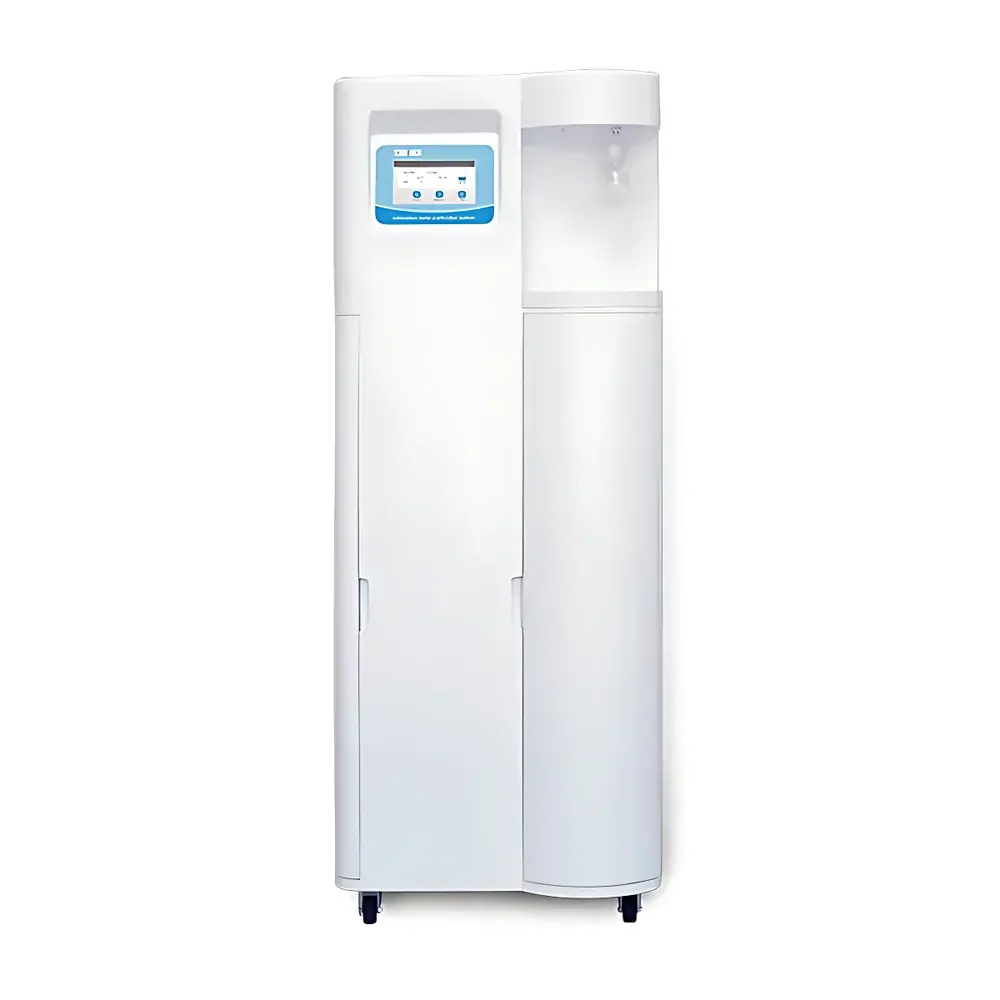
Zelab Center-EDI Ultra Pure Water System
| Brand | Zelab |
|---|---|
| Origin | USA |
| Manufacturer Type | Authorized Distributor |
| Product Category | Imported Laboratory Equipment |
| Model | Center-EDI |
| Output Capacity | 45–90 L/h (RO), up to 2.0 L/min (UP) |
| Resistivity | 18.2 MΩ·cm at 25 °C |
| Heavy Metals & Soluble Silica | <0.01 ppb |
| Total Organic Carbon (TOC) | <3 ppb |
| Microbial Count | <0.01 CFU/mL |
| Endotoxin | <0.001 EU/mL |
| Particles (>0.1 µm) | <1 particle/mL |
| UV Wavelength | 254 nm & 185 nm dual-lamp system |
| UF Membrane MWCO | 5000 Da |
| Final Filtration | 0.2 µm PES membrane |
| Compliance | ASTM D1193, USP <1231>, CLSI EP22-A, ISO 3696, GB/T 6682–2008, CAP guidelines |
Overview
The Zelab Center-EDI Ultra Pure Water System is a fully integrated, modular laboratory water purification platform engineered for consistent production of Type I ultrapure water (ASTM D1193) and Type II pure water from municipal tap feed. It employs a validated, multi-stage purification architecture comprising dual-stage reverse osmosis (RO), continuous electrodeionization (EDI), ultraviolet photooxidation (254/185 nm), ultrafiltration (5000 Da MWCO), and final 0.2 µm polyethersulfone (PES) filtration. The system delivers ultrapure water meeting stringent requirements for molecular biology, HPLC, LC-MS, trace elemental analysis, and cell culture applications—where low endotoxin, RNase/DNase, TOC, and particulate contamination are non-negotiable. Its design prioritizes operational reliability, regulatory traceability, and long-term cost efficiency through optimized EDI regeneration, intelligent RO membrane protection, and NSF-certified fluid path components—including Dow FilmTec™ RO membranes and nuclear-grade ion exchange resins.
Key Features
- 7-inch full-color capacitive touchscreen interface with animated menu navigation, real-time system diagnostics, and intuitive fingertip control
- Dual-pump, dual-membrane RO architecture with intermediate storage tank—reducing energy consumption by up to 25% and wastewater generation by 30% versus conventional single-stage systems
- Continuous EDI module with automatic polarity reversal and current modulation, ensuring stable ≥10 MΩ·cm resistivity and <30 ppb TOC for Type II water without chemical regeneration
- Triple-point water quality monitoring: real-time display of feed water conductivity, RO permeate resistivity, and UP water resistivity/TOC—no manual sampling required
- Two independent precision dispensing modes: volumetric (10–999,999 mL) and quality-triggered (0–18.25 MΩ·cm), with programmable endpoint logic
- Integrated data logging via USB port and SD card—storing ≥12 months of timestamped operational parameters, alarms, and maintenance events in CSV format
- Three-section modular cabinet with tool-free access to prefiltration, RO/EDI, and UP polishing modules—enabling rapid, contamination-controlled service intervals
- Removable spill tray with sloped drainage channels; NSF-certified quick-connect fittings throughout the fluid path; corrosion-resistant engineering-grade polymer chassis compliant with GLP structural integrity requirements
Sample Compatibility & Compliance
The Center-EDI system is validated for use with potable municipal water supplies (5–45 °C, 1.0–4.0 kgf/cm² inlet pressure). Its purification train meets or exceeds specifications defined in ASTM D1193 (Type I), USP (Purified Water and Water for Injection), ISO 3696 (Grade 1), CLSI EP22-A (Water Quality for Clinical Laboratories), and GB/T 6682–2008 (China National Standard for Analytical Laboratory Water). The final UP water output satisfies critical application thresholds: endotoxin <0.001 EU/mL (validated for sterile filtration compatibility), RNase <1 pg/mL and DNase 0.1 µm <1 mL⁻¹ (verified per ISO 21501-4). All wetted materials—including Dow ultra-low TOC resins, PES final filters, and UV quartz sleeves—are extractables-tested and certified per USP .
Software & Data Management
The embedded control firmware supports full GLP/GMP data integrity compliance. Audit trails record all user actions—including parameter changes, alarm acknowledgments, and consumable replacements—with immutable timestamps and operator ID tagging. Data export is configurable by date range and event type (e.g., “all TOC excursions >5 ppb in Q3”). USB exports include raw sensor readings (resistivity, UV intensity, flow rate), system status logs, and calibration history—all formatted for direct import into LIMS or electronic lab notebooks (ELN). Password-protected dual-tier access (factory technician + authorized user) prevents unauthorized configuration changes. Time-stamped consumable lifetime tracking—based on actual runtime hours and flow volume—triggers visual alerts and optional email notifications when replacement thresholds are reached.
Applications
The Center-EDI serves as a primary water source for high-sensitivity analytical workflows requiring reproducible baseline performance. Its ultrapure output is routinely employed in: HPLC and UHPLC mobile phase preparation; LC-MS and ICP-MS solvent blanks; electrophysiology and patch-clamp buffer formulation; mammalian and stem cell culture media preparation; qPCR and next-generation sequencing reagent dilution; and atomic absorption spectroscopy (AAS) and inductively coupled plasma optical emission spectrometry (ICP-OES) standards preparation. The FC and FV variants—with integrated ultrafiltration and dual-wavelength UV—extend utility to endotoxin-sensitive applications including monoclonal antibody purification, vaccine development, and pyrogen testing per USP .
FAQ
What is the maximum allowable feed water hardness for optimal RO membrane life?
Feed water total hardness should not exceed 200 ppm CaCO₃ equivalent. Pre-treatment with KDF-55 and activated carbon mitigates scaling; automatic RO flush cycles (configurable interval/duration) further extend membrane service life beyond 3 years under typical lab conditions.
Does the system support 21 CFR Part 11-compliant electronic signatures?
While the base firmware provides audit-trail functionality and user authentication, full 21 CFR Part 11 compliance requires integration with a validated third-party ELN or LIMS platform that manages digital signature enforcement and biometric verification.
Can the UP water loop be isolated during maintenance without interrupting RO/EDI production?
Yes—the modular architecture allows physical and hydraulic isolation of the UP polishing circuit (including UV, UF, and final filter) while maintaining continuous RO permeate and EDI product water generation for non-critical applications.
Is the TOC specification of <3 ppb measured online or offline?
TOC is monitored continuously using a built-in, low-volume (<50 µL) UV-persulfate oxidation sensor calibrated against NIST-traceable standards; validation reports include correlation data versus offline HACH DR3900 measurements.
How often must the EDI stack be replaced?
Under standard municipal feed water conditions (TDS <300 ppm, silica 5 years of service life with no performance degradation—confirmed by quarterly resistivity/TOC trending per internal SOP-UPW-007.



