
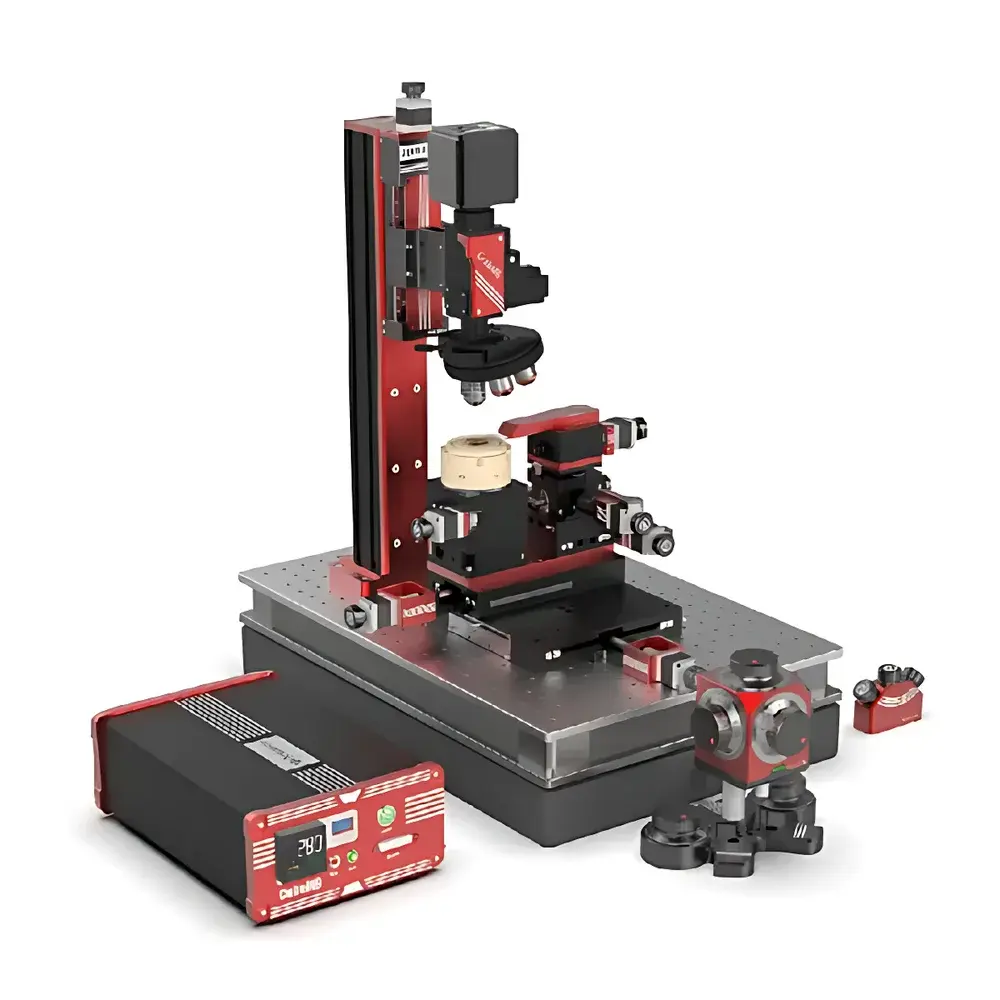
ZEPTOOLS 2DTrans-ams-03 Automated 2D Material Transfer Stage
| Brand | ZEPTOOLS |
|---|---|
| Origin | Guangdong, China |
| Manufacturer Type | Direct Manufacturer |
| Product Category | Domestic |
| Model | 2DTrans-ams-03 |
| Product Type | Motorized Translation Stage |
| Sample Stage | 5-Axis Motorized Platform (X/Y/Z/α/β) |
| Carrier Slide Stage | 5-Axis Motorized Platform (X/Y/Z/α/β) |
| Rotation Precision (R) | ≤ ±0.01° |
| Linear Repeatability (XY) | ≤ ±2 µm |
| Vertical Repeatability (Z) | ≤ 1 µm |
| Tilt Precision (α/β) | ≤ ±0.005° |
| Heating Range | Up to 240 °C |
| Temperature Stability | ±0.1 °C |
| Microscope | Integrated Motorized Optical Microscope with HDMI Camera (8 MP, 30 fps) |
| Vacuum & Magnetic Sample Holding | Dual-mode Adsorption Module |
| Vibration Isolation | Desktop Pneumatic Air-Floating Platform |
| Motion Control Axes | 7-axis (ZT02) or 9-axis (ZT03) Controller |
Overview
The ZEPTOOLS 2DTrans-ams-03 is a fully integrated, motorized 2D material transfer stage engineered for deterministic assembly of van der Waals heterostructures via mechanical exfoliation and dry/wet transfer methodologies. Unlike conventional CVD growth or stochastic scotch-tape exfoliation, this system implements a precision metrology-driven approach—leveraging coordinated multi-axis motion control, real-time optical feedback, and environmental stabilization—to enable layer-by-layer stacking of atomically thin crystals including graphene, MoS₂, h-BN, WSe₂, and related transition metal dichalcogenides (TMDs). Its operational principle mirrors microscale lamination: the system precisely aligns and contacts monolayer flakes on target substrates under controlled vacuum, temperature, and mechanical force, preserving interfacial cleanliness and crystallographic registry. Designed explicitly for academic nanoscience laboratories and advanced materials R&D centers, the 2DTrans-ams-03 bridges the gap between manual transfer protocols and industrial-scale fabrication by delivering sub-micron positional fidelity, angular alignment down to 0.005°, and thermal stability essential for reproducible heterostructure synthesis.
Key Features
- Modular five-axis motorized carrier slide platform (X/Y/Z/α/β) with ≤ ±2 µm linear repeatability and ≤ ±0.005° angular resolution—enabling precise control over flake orientation, vertical contact pressure, and in-plane tilt compensation.
- Dedicated five-axis motorized sample stage (X/Y/Z/R/θ) featuring ±50 mm XY travel, full 360° continuous rotation, and ≤ ±0.01° rotational repeatability—critical for twist-angle engineering of moiré superlattices.
- Integrated optical microscopy subsystem: motorized nosepiece with four standardized objective mounts (5×, 10×, 20×, 50×), high-resolution 8 MP HDMI camera (30 fps), and real-time display output—eliminating external frame grabbers or software dependencies.
- Thermally regulated sample environment: built-in PID-controlled heater with 240 °C maximum setpoint, ±0.1 °C stability, and forced-air cooling—supporting annealing-assisted transfer and contamination-free interface formation.
- Dual-mode sample fixation: vacuum suction combined with localized magnetic clamping ensures uniform adhesion across diverse substrates (SiO₂/Si, TEM grids, PET films, h-BN flakes) without mechanical deformation or residue.
- Pneumatic air-floating isolation table (desktop form factor) suppresses floor-borne vibrations below 1 Hz, maintaining optical focus and positional integrity during prolonged transfer sequences.
- Scalable motion control architecture: 7-axis controller (ZT02 configuration) or 9-axis controller (ZT03) with programmable trajectory sequencing, coordinate referencing, and hardware-triggered synchronization with imaging or vacuum cycles.
Sample Compatibility & Compliance
The 2DTrans-ams-03 accommodates standard 25 × 75 mm microscope slides, 3 mm TEM grids, silicon wafers up to 4″ diameter, and flexible polymer substrates. All motion stages comply with ISO 9283 repeatability standards for linear and angular positioning. The integrated vacuum manifold meets ISO 8573-1 Class 4 purity requirements for oil-free operation. Thermal control firmware supports logging of time-stamped temperature profiles compliant with GLP documentation workflows. While not certified for GMP manufacturing environments, the system’s audit-trail-capable controller (ZT03 variant) records all axis positions, vacuum status, heater setpoints, and user-initiated events—facilitating traceability in federally funded research (e.g., NSF, DOE) and institutional compliance reviews.
Software & Data Management
The system operates via a Windows-based native application with no third-party runtime dependencies. Core functionalities include coordinate mapping (stage-to-image registration), multi-point homing with encoder-based absolute referencing, scriptable transfer routines (Python API available upon request), and synchronized image capture tagging. All position logs, thermal profiles, and vacuum cycle timestamps are exported in CSV format with ISO 8601 timestamps. Firmware updates are delivered via signed binary packages; controller memory retains calibration parameters across power cycles. No cloud connectivity or telemetry is enabled by default—data sovereignty is maintained entirely on local host systems.
Applications
- Construction of twisted bilayer graphene (tBLG) devices with controlled interlayer rotation angles (0.1°–3.0° range) for correlated electron physics studies.
- Fabrication of vertical heterostructures (e.g., graphene/h-BN/MoS₂) for gate-tunable tunneling transistors and photodetectors.
- Transfer of exfoliated flakes onto pre-patterned electrodes or photonic waveguides for optoelectronic integration.
- In situ thermal annealing during transfer to remove polymer residues and improve interfacial adhesion.
- Multi-step stacking of >5-layer heterostructures with intermediate optical verification at each layer.
- Correlative analysis workflows combining transfer alignment with subsequent Raman or PL mapping on the same substrate.
FAQ
What is the minimum controllable rotation angle for twist-angle engineering?
The motorized rotation stage achieves ≤ ±0.01° repeatability, enabling reliable targeting of discrete moiré angles such as 1.1°, 1.6°, or 2.2° with statistical confidence across repeated transfers.
Can the system handle wet-transfer processes using PMMA or PDMS stamps?
Yes—the stage design includes removable, chemically resistant surface coatings and configurable vacuum port routing to accommodate solvent-compatible stamp handling and controlled release protocols.
Is remote operation supported for shared-facility environments?
Local network access is supported via TCP/IP interface; however, remote desktop or VNC access must be provisioned externally per institutional IT policy—no built-in web server or cloud interface is included.
Does the system support custom substrate holders or non-standard slide formats?
Standard M4 and SM1 threaded mounting interfaces are provided on both sample and carrier stages, allowing mechanical integration of user-designed fixtures, cryo-holders, or electrical probe cards.
How is calibration verified and maintained over time?
Each axis includes incremental optical encoders; factory calibration certificates document linearity error (< ±0.05% FS) and bidirectional repeatability. Users may perform routine verification using NIST-traceable step gauges or interferometric reference targets.





